Event submissions
EventsThe 1st International Electronic Conference on Medicinal Chemistry and Pharmaceutics
Published
This submission belongs to the session S6. Novel and Sustainable approaches in Medicinal Chemistry of the event The 1st International Electronic Conference on Medicinal Chemistry and Pharmaceutics
Published date
29 Oct, 2025
Academic Editor
'%3e%3cpath%20d='M12.6657%2010.9104C12.4185%2010.325%2012.0599%209.79327%2011.6097%209.34482C11.1609%208.89508%2010.6293%208.5365%2010.0442%208.28888C10.0389%208.28626%2010.0337%208.28495%2010.0285%208.28233C10.8446%207.69279%2011.3752%206.73249%2011.3752%205.64904C11.3752%203.8542%209.92103%202.39999%208.1262%202.39999C6.33136%202.39999%204.87715%203.8542%204.87715%205.64904C4.87715%206.73249%205.40774%207.69279%206.22393%208.28364C6.21869%208.28626%206.21345%208.28757%206.20821%208.29019C5.62129%208.5378%205.09463%208.89284%204.64265%209.34613C4.1929%209.79493%203.83432%2010.3266%203.58671%2010.9117C3.34345%2011.4845%203.21226%2012.0987%203.20023%2012.7209C3.19988%2012.7349%203.20233%2012.7488%203.20744%2012.7619C3.21255%2012.7749%203.22022%2012.7867%203.22998%2012.7968C3.23975%2012.8068%203.25142%2012.8147%203.26431%2012.8202C3.2772%2012.8256%203.29105%2012.8284%203.30504%2012.8284H4.09109C4.14874%2012.8284%204.19459%2012.7825%204.1959%2012.7262C4.2221%2011.7148%204.62823%2010.7676%205.34617%2010.0497C6.08899%209.30683%207.0755%208.89808%208.1262%208.89808C9.17689%208.89808%2010.1634%209.30683%2010.9062%2010.0497C11.6242%2010.7676%2012.0303%2011.7148%2012.0565%2012.7262C12.0578%2012.7838%2012.1037%2012.8284%2012.1613%2012.8284H12.9474C12.9613%2012.8284%2012.9752%2012.8256%2012.9881%2012.8202C13.001%2012.8147%2013.0126%2012.8068%2013.0224%2012.7968C13.0322%2012.7867%2013.0398%2012.7749%2013.0449%2012.7619C13.0501%2012.7488%2013.0525%2012.7349%2013.0522%2012.7209C13.0391%2012.0947%2012.9094%2011.4855%2012.6657%2010.9104ZM8.1262%207.9024C7.52486%207.9024%206.9589%207.6679%206.53312%207.24211C6.10733%206.81633%205.87283%206.25037%205.87283%205.64904C5.87283%205.0477%206.10733%204.48174%206.53312%204.05596C6.9589%203.63018%207.52486%203.39567%208.1262%203.39567C8.72753%203.39567%209.29349%203.63018%209.71927%204.05596C10.1451%204.48174%2010.3796%205.0477%2010.3796%205.64904C10.3796%206.25037%2010.1451%206.81633%209.71927%207.24211C9.29349%207.6679%208.72753%207.9024%208.1262%207.9024Z'%20fill='%235D1EE1'/%3e%3c/g%3e%3c/svg%3e) Mary Jane Meegan
Mary Jane MeeganCitation
Elizaveta Michailovna Pnachina, Lubov Vladimirovna Krylova, Natalia Sergeevna Kuzmina, Vasilii Fedorovich Otvagin, Ekaterina Andreevna Fedotova, Alexey Yurievich Fedorov, Irina Vladimirovna Balalaeva, Meso-methyl-BODIPY conjugate with cabozantinib as a red-light-activated prodrug for anticancer therapy, in Proceedings of The 1st International Electronic Conference on Medicinal Chemistry and Pharmaceutics, 1 November–30 November 2025, MDPI: Basel, Switzerland
Share
Email
Facebook
Twitter
LinkedIn
Meso-methyl-BODIPY conjugate with cabozantinib as a red-light-activated prodrug for anticancer therapy
'%3e%3cpath%20d='M12.6647%2010.9104C12.4176%2010.325%2012.0589%209.7933%2011.6088%209.34485C11.16%208.89511%2010.6283%208.53653%2010.0432%208.28891C10.038%208.28629%2010.0327%208.28498%2010.0275%208.28236C10.8437%207.69282%2011.3743%206.73252%2011.3743%205.64907C11.3743%203.85423%209.92005%202.40002%208.12522%202.40002C6.33038%202.40002%204.87618%203.85423%204.87618%205.64907C4.87618%206.73252%205.40677%207.69282%206.22296%208.28367C6.21772%208.28629%206.21248%208.2876%206.20724%208.29022C5.62031%208.53783%205.09365%208.89287%204.64167%209.34616C4.19192%209.79496%203.83334%2010.3266%203.58573%2010.9117C3.34247%2011.4846%203.21128%2012.0987%203.19925%2012.721C3.1989%2012.735%203.20135%2012.7489%203.20646%2012.7619C3.21157%2012.7749%203.21924%2012.7868%203.22901%2012.7968C3.23877%2012.8068%203.25045%2012.8148%203.26334%2012.8202C3.27623%2012.8256%203.29007%2012.8284%203.30406%2012.8284H4.09012C4.14776%2012.8284%204.19362%2012.7825%204.19493%2012.7262C4.22113%2011.7148%204.62726%2010.7676%205.34519%2010.0497C6.08802%209.30686%207.07452%208.89811%208.12522%208.89811C9.17592%208.89811%2010.1624%209.30686%2010.9052%2010.0497C11.6232%2010.7676%2012.0293%2011.7148%2012.0555%2012.7262C12.0568%2012.7839%2012.1027%2012.8284%2012.1603%2012.8284H12.9464C12.9604%2012.8284%2012.9742%2012.8256%2012.9871%2012.8202C13%2012.8148%2013.0117%2012.8068%2013.0214%2012.7968C13.0312%2012.7868%2013.0389%2012.7749%2013.044%2012.7619C13.0491%2012.7489%2013.0515%2012.735%2013.0512%2012.721C13.0381%2012.0947%2012.9084%2011.4856%2012.6647%2010.9104ZM8.12522%207.90243C7.52388%207.90243%206.95792%207.66793%206.53214%207.24215C6.10636%206.81636%205.87185%206.2504%205.87185%205.64907C5.87185%205.04773%206.10636%204.48177%206.53214%204.05599C6.95792%203.63021%207.52388%203.3957%208.12522%203.3957C8.72655%203.3957%209.29252%203.63021%209.7183%204.05599C10.1441%204.48177%2010.3786%205.04773%2010.3786%205.64907C10.3786%206.2504%2010.1441%206.81636%209.7183%207.24215C9.29252%207.66793%208.72655%207.90243%208.12522%207.90243Z'%20fill='%235D1EE1'/%3e%3c/g%3e%3c/svg%3e)
Elizaveta Michailovna Pnachina 1
Lubov Vladimirovna Krylova 2
Natalia Sergeevna Kuzmina 2

Vasilii Fedorovich Otvagin 2
Ekaterina Andreevna Fedotova 2

Alexey Yurievich Fedorov 2

Irina Vladimirovna Balalaeva 1
1. Department of Biophysics, Institute of Biology and Biomedicine, Lobachevsky University, Nizhny Novgorod 603022, Russia
2. Department of Organic Chemistry, Faculty of Chemistry, Lobachevsky University, Nizhny Novgorod 603022, Russia
Abstract
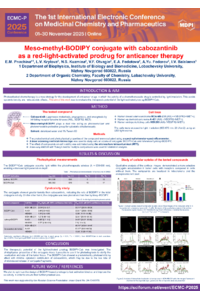
Photoactivated chemotherapy is a new strategy for the development of anticancer drugs in which the activity of a chemotherapeutic drug is controlled by light irradiation. This avoids systemic toxicity and reduces side effects. The aim of this work was to evaluate the therapeutic potential of the light-activated prodrug BODIPY-Cab. The tested conjugate consists of cabozantinib, which was used as a cytostatic, and meso-methyl-BODIPY as a photoremovable protecting group (PPG), which is also used as a photosensitizer, allowing for combined therapy.
The photochemical and photophysical properties of the compound were evaluated using a spectrophotometer-spectrofluorometer. To study the biological properties, cell cultures with different expression of target receptors were selected: A-431 (human epidermoid carcinoma), MDA-MB-231 (human breast adenocarcinoma), HEK293 (human embryonic kidney). A laser scanning confocal microscope was used to study the intracellular localization of the BODIPY-Cab. The effect of compounds on cell viability was estimated using the microculture tetrazolium test.
The conjugate has absorption maxima at 368 and 662 nm and a fluorescence maximum at 678 nm. Irradiation of the BODIPY-Cab solution using a red light demonstrated photodegradation of the conjugate and moderate yield of the cabozantinib derivative. Fluorescence quantum yield of BODIPY-Cab was 16%, and the quantum yield of singlet oxygen was 17%. The compound is localized in mitochondria and the endoplasmic reticulum. Activation of the conjugate by light (655−675 nm), increased cytotoxicity, with the generation of ROS, especially superoxide O2•−. Cabozantinib derivative exhibited lower toxicity in cells compared to conjugate, suggesting that the photosensitizer should play a predominant role in initiating cellular damage.
The possibility of controlled release of a cytostatic under the action of red light is shown. The results can be used for further optimization of PPG based on meso-methyl-BODIPY.
This work was supported by the Russian Science Foundation under Grant No. 24-13-00179
Keywords
anticancer therapy
photoactivated chemotherapy
prodrug
BODIPY
cabozantinib
Poster
BODIPY-Cab poster.pdf
Thermodynamic Framework for Quantifying Drug Precipitation and Solubility in Cyclodextrin-Based Systems
DEVELOPMENT OF NEW QUALITY CONTROL METHODS FOR PROSPIDIUM CHLORIDE USING THE ESI-HPLC-MS SYSTEM