Event submissions
EventsThe 1st International Electronic Conference on Medicinal Chemistry and Pharmaceutics
Published
This submission belongs to the session S6. Novel and Sustainable approaches in Medicinal Chemistry of the event The 1st International Electronic Conference on Medicinal Chemistry and Pharmaceutics
Published date
29 Oct, 2025
Academic Editor
'%3e%3cpath%20d='M12.6657%2010.9104C12.4185%2010.325%2012.0599%209.79327%2011.6097%209.34482C11.1609%208.89508%2010.6293%208.5365%2010.0442%208.28888C10.0389%208.28626%2010.0337%208.28495%2010.0285%208.28233C10.8446%207.69279%2011.3752%206.73249%2011.3752%205.64904C11.3752%203.8542%209.92103%202.39999%208.1262%202.39999C6.33136%202.39999%204.87715%203.8542%204.87715%205.64904C4.87715%206.73249%205.40774%207.69279%206.22393%208.28364C6.21869%208.28626%206.21345%208.28757%206.20821%208.29019C5.62129%208.5378%205.09463%208.89284%204.64265%209.34613C4.1929%209.79493%203.83432%2010.3266%203.58671%2010.9117C3.34345%2011.4845%203.21226%2012.0987%203.20023%2012.7209C3.19988%2012.7349%203.20233%2012.7488%203.20744%2012.7619C3.21255%2012.7749%203.22022%2012.7867%203.22998%2012.7968C3.23975%2012.8068%203.25142%2012.8147%203.26431%2012.8202C3.2772%2012.8256%203.29105%2012.8284%203.30504%2012.8284H4.09109C4.14874%2012.8284%204.19459%2012.7825%204.1959%2012.7262C4.2221%2011.7148%204.62823%2010.7676%205.34617%2010.0497C6.08899%209.30683%207.0755%208.89808%208.1262%208.89808C9.17689%208.89808%2010.1634%209.30683%2010.9062%2010.0497C11.6242%2010.7676%2012.0303%2011.7148%2012.0565%2012.7262C12.0578%2012.7838%2012.1037%2012.8284%2012.1613%2012.8284H12.9474C12.9613%2012.8284%2012.9752%2012.8256%2012.9881%2012.8202C13.001%2012.8147%2013.0126%2012.8068%2013.0224%2012.7968C13.0322%2012.7867%2013.0398%2012.7749%2013.0449%2012.7619C13.0501%2012.7488%2013.0525%2012.7349%2013.0522%2012.7209C13.0391%2012.0947%2012.9094%2011.4855%2012.6657%2010.9104ZM8.1262%207.9024C7.52486%207.9024%206.9589%207.6679%206.53312%207.24211C6.10733%206.81633%205.87283%206.25037%205.87283%205.64904C5.87283%205.0477%206.10733%204.48174%206.53312%204.05596C6.9589%203.63018%207.52486%203.39567%208.1262%203.39567C8.72753%203.39567%209.29349%203.63018%209.71927%204.05596C10.1451%204.48174%2010.3796%205.0477%2010.3796%205.64904C10.3796%206.25037%2010.1451%206.81633%209.71927%207.24211C9.29349%207.6679%208.72753%207.9024%208.1262%207.9024Z'%20fill='%235D1EE1'/%3e%3c/g%3e%3c/svg%3e) Diego Muñoz-Torrero
Diego Muñoz-TorreroCitation
Sofia Dafnomili, Georgia Kythreoti, Marina Sagnou, Evaluation of Curcumin and Its Derivatives as Photosensitizers for Antibacterial Photodynamic Therapy through an In-House Irradiation Assay, in Proceedings of The 1st International Electronic Conference on Medicinal Chemistry and Pharmaceutics, 1 November–30 November 2025, MDPI: Basel, Switzerland
Share
Email
Facebook
Twitter
LinkedIn
Evaluation of Curcumin and Its Derivatives as Photosensitizers for Antibacterial Photodynamic Therapy through an In-House Irradiation Assay
'%3e%3cpath%20d='M12.6647%2010.9104C12.4176%2010.325%2012.0589%209.7933%2011.6088%209.34485C11.16%208.89511%2010.6283%208.53653%2010.0432%208.28891C10.038%208.28629%2010.0327%208.28498%2010.0275%208.28236C10.8437%207.69282%2011.3743%206.73252%2011.3743%205.64907C11.3743%203.85423%209.92005%202.40002%208.12522%202.40002C6.33038%202.40002%204.87618%203.85423%204.87618%205.64907C4.87618%206.73252%205.40677%207.69282%206.22296%208.28367C6.21772%208.28629%206.21248%208.2876%206.20724%208.29022C5.62031%208.53783%205.09365%208.89287%204.64167%209.34616C4.19192%209.79496%203.83334%2010.3266%203.58573%2010.9117C3.34247%2011.4846%203.21128%2012.0987%203.19925%2012.721C3.1989%2012.735%203.20135%2012.7489%203.20646%2012.7619C3.21157%2012.7749%203.21924%2012.7868%203.22901%2012.7968C3.23877%2012.8068%203.25045%2012.8148%203.26334%2012.8202C3.27623%2012.8256%203.29007%2012.8284%203.30406%2012.8284H4.09012C4.14776%2012.8284%204.19362%2012.7825%204.19493%2012.7262C4.22113%2011.7148%204.62726%2010.7676%205.34519%2010.0497C6.08802%209.30686%207.07452%208.89811%208.12522%208.89811C9.17592%208.89811%2010.1624%209.30686%2010.9052%2010.0497C11.6232%2010.7676%2012.0293%2011.7148%2012.0555%2012.7262C12.0568%2012.7839%2012.1027%2012.8284%2012.1603%2012.8284H12.9464C12.9604%2012.8284%2012.9742%2012.8256%2012.9871%2012.8202C13%2012.8148%2013.0117%2012.8068%2013.0214%2012.7968C13.0312%2012.7868%2013.0389%2012.7749%2013.044%2012.7619C13.0491%2012.7489%2013.0515%2012.735%2013.0512%2012.721C13.0381%2012.0947%2012.9084%2011.4856%2012.6647%2010.9104ZM8.12522%207.90243C7.52388%207.90243%206.95792%207.66793%206.53214%207.24215C6.10636%206.81636%205.87185%206.2504%205.87185%205.64907C5.87185%205.04773%206.10636%204.48177%206.53214%204.05599C6.95792%203.63021%207.52388%203.3957%208.12522%203.3957C8.72655%203.3957%209.29252%203.63021%209.7183%204.05599C10.1441%204.48177%2010.3786%205.04773%2010.3786%205.64907C10.3786%206.2504%2010.1441%206.81636%209.7183%207.24215C9.29252%207.66793%208.72655%207.90243%208.12522%207.90243Z'%20fill='%235D1EE1'/%3e%3c/g%3e%3c/svg%3e)
Sofia Dafnomili 1
Georgia Kythreoti 1
Marina Sagnou 1,2
1. Department of Science and Mathematics, Deree – The American College of Greece (ACG), Athens, Greece
2. Institute of Biosciences and Applications, NCSR “Demokritos,” Athens, Greece
Abstract
Antimicrobial resistance (AMR) poses a critical global health challenge, necessitating the development of alternative, non-antibiotic strategies. Antimicrobial photodynamic therapy (aPDT) represents a promising approach, employing the combined action of a photosensitizer (PS), visible light, and molecular oxygen to generate reactive oxygen species (ROS) that eradicate microbial cells. In this study, we established a standardized irradiation assay and investigated the suitability of curcumin and five structurally related derivatives as candidate PSs for aPDT applications. The compounds were characterized for their optical absorption properties using UV–Vis spectroscopy and subsequently tested for photodynamic antibacterial efficacy against representative Gram-positive and Gram-negative species: Staphylococcus aureus, Escherichia coli, and Pseudomonas aeruginosa. High-throughput growth inhibition assays were conducted under blue light irradiation (470 nm), enabling determination of half-maximal inhibitory concentrations (IC₅₀).
Curcumin displayed broad-spectrum phototoxicity, achieving bacterial growth inhibition with moderate IC₅₀ values. Several derivatives, including monodemethoxycurcumin and analogues with extended conjugation, exhibited distinct absorption shifts and, in selected cases, enhanced antibacterial potency. However, activity patterns varied across bacterial types, reflecting trade-offs between favorable photophysical properties and effective microbial uptake. These findings underscore the importance of structure–activity relationship (SAR) insights in optimizing PS design.
Overall, curcumin remains a safe and accessible scaffold for aPDT, but targeted chemical modifications—particularly those improving aqueous solubility and penetration of Gram-negative outer membranes—are essential to enhance therapeutic potential. This work provides a framework for rational design of next-generation curcumin-based photosensitizers toward clinically viable antimicrobial photodynamic therapies.
Keywords
Antimicrobial resistance (AMR)
Antimicrobial photodynamic therapy (aPDT)
Curcumin
Photosensitizers
Reactive oxygen species (ROS)
Structure–activity relationship (SAR)
Blue light irradiation
Poster
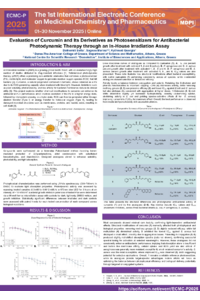
ECMC-P 2025 Poster Dafnomili.pdf
Catalyst-Free Green Synthetic Approaches for Bioactive Metabolites of Simarouba glauca: Toward Sustainable Drug Discovery
Rational Design and Synthesis of Melanostatin Derivatives to Probe Structural and Functional Diversity