Event submissions
EventsThe 1st International Electronic Conference on Medicinal Chemistry and Pharmaceutics
Published
This submission belongs to the session S10. Nanomedicine and Nanotechnology of the event The 1st International Electronic Conference on Medicinal Chemistry and Pharmaceutics
Published date
29 Oct, 2025
Academic Editor
'%3e%3cpath%20d='M12.6657%2010.9104C12.4185%2010.325%2012.0599%209.79327%2011.6097%209.34482C11.1609%208.89508%2010.6293%208.5365%2010.0442%208.28888C10.0389%208.28626%2010.0337%208.28495%2010.0285%208.28233C10.8446%207.69279%2011.3752%206.73249%2011.3752%205.64904C11.3752%203.8542%209.92103%202.39999%208.1262%202.39999C6.33136%202.39999%204.87715%203.8542%204.87715%205.64904C4.87715%206.73249%205.40774%207.69279%206.22393%208.28364C6.21869%208.28626%206.21345%208.28757%206.20821%208.29019C5.62129%208.5378%205.09463%208.89284%204.64265%209.34613C4.1929%209.79493%203.83432%2010.3266%203.58671%2010.9117C3.34345%2011.4845%203.21226%2012.0987%203.20023%2012.7209C3.19988%2012.7349%203.20233%2012.7488%203.20744%2012.7619C3.21255%2012.7749%203.22022%2012.7867%203.22998%2012.7968C3.23975%2012.8068%203.25142%2012.8147%203.26431%2012.8202C3.2772%2012.8256%203.29105%2012.8284%203.30504%2012.8284H4.09109C4.14874%2012.8284%204.19459%2012.7825%204.1959%2012.7262C4.2221%2011.7148%204.62823%2010.7676%205.34617%2010.0497C6.08899%209.30683%207.0755%208.89808%208.1262%208.89808C9.17689%208.89808%2010.1634%209.30683%2010.9062%2010.0497C11.6242%2010.7676%2012.0303%2011.7148%2012.0565%2012.7262C12.0578%2012.7838%2012.1037%2012.8284%2012.1613%2012.8284H12.9474C12.9613%2012.8284%2012.9752%2012.8256%2012.9881%2012.8202C13.001%2012.8147%2013.0126%2012.8068%2013.0224%2012.7968C13.0322%2012.7867%2013.0398%2012.7749%2013.0449%2012.7619C13.0501%2012.7488%2013.0525%2012.7349%2013.0522%2012.7209C13.0391%2012.0947%2012.9094%2011.4855%2012.6657%2010.9104ZM8.1262%207.9024C7.52486%207.9024%206.9589%207.6679%206.53312%207.24211C6.10733%206.81633%205.87283%206.25037%205.87283%205.64904C5.87283%205.0477%206.10733%204.48174%206.53312%204.05596C6.9589%203.63018%207.52486%203.39567%208.1262%203.39567C8.72753%203.39567%209.29349%203.63018%209.71927%204.05596C10.1451%204.48174%2010.3796%205.0477%2010.3796%205.64904C10.3796%206.25037%2010.1451%206.81633%209.71927%207.24211C9.29349%207.6679%208.72753%207.9024%208.1262%207.9024Z'%20fill='%235D1EE1'/%3e%3c/g%3e%3c/svg%3e) Gareth R. Williams
Gareth R. WilliamsCitation
Marwa H.S. Dawoud, Heba T. Elbalkiny, Yasmeen E.M. Gharib, Sara A.A. Fakkar, Rowaa Saber, Mary E. Yanni, Mai A. Zaafan, Hybrid Lipid-Polymeric Nanoparticles for Enhanced Bioavailability of Vardenafil in Hepatic Encephalopathy Prevention: A Drug Repurposing Approach, in Proceedings of The 1st International Electronic Conference on Medicinal Chemistry and Pharmaceutics, 1 November–30 November 2025, MDPI: Basel, Switzerland
Share
Email
Facebook
Twitter
LinkedIn
Hybrid Lipid-Polymeric Nanoparticles for Enhanced Bioavailability of Vardenafil in Hepatic Encephalopathy Prevention: A Drug Repurposing Approach
'%3e%3cpath%20d='M12.6647%2010.9104C12.4176%2010.325%2012.0589%209.7933%2011.6088%209.34485C11.16%208.89511%2010.6283%208.53653%2010.0432%208.28891C10.038%208.28629%2010.0327%208.28498%2010.0275%208.28236C10.8437%207.69282%2011.3743%206.73252%2011.3743%205.64907C11.3743%203.85423%209.92005%202.40002%208.12522%202.40002C6.33038%202.40002%204.87618%203.85423%204.87618%205.64907C4.87618%206.73252%205.40677%207.69282%206.22296%208.28367C6.21772%208.28629%206.21248%208.2876%206.20724%208.29022C5.62031%208.53783%205.09365%208.89287%204.64167%209.34616C4.19192%209.79496%203.83334%2010.3266%203.58573%2010.9117C3.34247%2011.4846%203.21128%2012.0987%203.19925%2012.721C3.1989%2012.735%203.20135%2012.7489%203.20646%2012.7619C3.21157%2012.7749%203.21924%2012.7868%203.22901%2012.7968C3.23877%2012.8068%203.25045%2012.8148%203.26334%2012.8202C3.27623%2012.8256%203.29007%2012.8284%203.30406%2012.8284H4.09012C4.14776%2012.8284%204.19362%2012.7825%204.19493%2012.7262C4.22113%2011.7148%204.62726%2010.7676%205.34519%2010.0497C6.08802%209.30686%207.07452%208.89811%208.12522%208.89811C9.17592%208.89811%2010.1624%209.30686%2010.9052%2010.0497C11.6232%2010.7676%2012.0293%2011.7148%2012.0555%2012.7262C12.0568%2012.7839%2012.1027%2012.8284%2012.1603%2012.8284H12.9464C12.9604%2012.8284%2012.9742%2012.8256%2012.9871%2012.8202C13%2012.8148%2013.0117%2012.8068%2013.0214%2012.7968C13.0312%2012.7868%2013.0389%2012.7749%2013.044%2012.7619C13.0491%2012.7489%2013.0515%2012.735%2013.0512%2012.721C13.0381%2012.0947%2012.9084%2011.4856%2012.6647%2010.9104ZM8.12522%207.90243C7.52388%207.90243%206.95792%207.66793%206.53214%207.24215C6.10636%206.81636%205.87185%206.2504%205.87185%205.64907C5.87185%205.04773%206.10636%204.48177%206.53214%204.05599C6.95792%203.63021%207.52388%203.3957%208.12522%203.3957C8.72655%203.3957%209.29252%203.63021%209.7183%204.05599C10.1441%204.48177%2010.3786%205.04773%2010.3786%205.64907C10.3786%206.2504%2010.1441%206.81636%209.7183%207.24215C9.29252%207.66793%208.72655%207.90243%208.12522%207.90243Z'%20fill='%235D1EE1'/%3e%3c/g%3e%3c/svg%3e)
Marwa H.S. Dawoud 1
Heba T. Elbalkiny 2
Yasmeen E.M. Gharib 3
Sara A.A. Fakkar 3
Rowaa Saber 3
Mary E. Yanni 3
Mai A. Zaafan 4
1. Pharmaceutics department, faculty of pharmacy, October University for modern Sciences and Arts, Giza, Egypt
2. Analytical Chemistry department, faculty of pharmacy, October University for modern Sciences and Arts, Giza, Egypt
3. Faculty of pharmacy, October University for modern Sciences and Arts, Giza, Egypt
4. Pharmacology department, faculty of pharmacy, October University for modern Sciences and Arts University, Giza, Egypt
Abstract
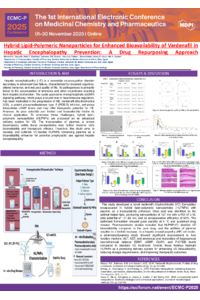
Hepatic encephalopathy (HE) is a severe neurological complication of liver failure with limited therapeutic options. Vardenafil dihydrochloride (VD), a PDE5 inhibitor, used for erectile dysfunction, shows potential for HE prophylaxis through cGMP elevation and neuroprotection, but it suffers poor oral bioavailability due to low solubility and first-pass metabolism. This study aimed to develop hybrid lipid-polymeric nanoparticles (HLPNPs) with piperine as a bioavailability enhancer for VD repurposing in HE prevention.
HLPNPs were prepared using homogenization/ultrasonication technique with glyceryl tripalmitate and Eudragit RS100. The helper polymer type (oleic acid, chitosan, sodium alginate) was evaluated using a one-factor experimental design on each of the particle size, polydispersity index, zeta potential, and entrapment efficiency. In vitro release studies, pharmacokinetics and therapeutic efficacy tests in a thioacetamide-induced HE mouse model were conducted.
Oleic acid emerged as the optimal helper polymer, yielding HLPNPs with 128±2.8 nm particle size, 0.173±0.07 PDI, -32±1.67 mV zeta potential, and 93±1.8% entrapment efficiency. In vitro release showed sustained VD release (~70% over 72h) following Korsmeyer-Peppas kinetics. Pharmacokinetic studies revealed a remarkable 9-fold improvement for the optimized formulation compared to standard VD, with Cmax increasing from 9 ng/mL to 22 ng/mL. In the HE mouse model, the optimized formulation significantly improved liver enzymes (ALT, AST), reduced ammonia levels, and enhanced hippocampal BDNF, cGMP, GluR1, and P-CREB levels compared to standard VD treatment.
The piperine-enhanced HLPNPs successfully overcame VD's bioavailability limitations and demonstrated superior therapeutic efficacy in HE prevention. This innovative drug repurposing approach combining nanotechnology with bioavailability enhancement offers a promising strategy for expanding VD's therapeutic applications beyond erectile dysfunction to neurological conditions.
Keywords
vardenafil
hybrid nanoparticles
hepatic encephalopathy
drug repurposing
bioavailability enhancement
Poster
Electronic Conference Poster y 2.pdf
FORMULATION, OPTIMIZATION AND EVALUATION OF MEBENDAZOLE NANOSUSPENSION: AN APPROACH TO ENHANCE DISSOLUTION
Optimizing Graphene Oxide Dispersion in DMSO via Ultrasonic Processing: A UV-Vis-NIR Spectroscopic Study for Biomedical Applications