Event submissions
EventsThe 1st International Electronic Conference on Medicinal Chemistry and Pharmaceutics
Published
This submission belongs to the session S10. Nanomedicine and Nanotechnology of the event The 1st International Electronic Conference on Medicinal Chemistry and Pharmaceutics
Published date
29 Oct, 2025
Academic Editor
'%3e%3cpath%20d='M12.6657%2010.9104C12.4185%2010.325%2012.0599%209.79327%2011.6097%209.34482C11.1609%208.89508%2010.6293%208.5365%2010.0442%208.28888C10.0389%208.28626%2010.0337%208.28495%2010.0285%208.28233C10.8446%207.69279%2011.3752%206.73249%2011.3752%205.64904C11.3752%203.8542%209.92103%202.39999%208.1262%202.39999C6.33136%202.39999%204.87715%203.8542%204.87715%205.64904C4.87715%206.73249%205.40774%207.69279%206.22393%208.28364C6.21869%208.28626%206.21345%208.28757%206.20821%208.29019C5.62129%208.5378%205.09463%208.89284%204.64265%209.34613C4.1929%209.79493%203.83432%2010.3266%203.58671%2010.9117C3.34345%2011.4845%203.21226%2012.0987%203.20023%2012.7209C3.19988%2012.7349%203.20233%2012.7488%203.20744%2012.7619C3.21255%2012.7749%203.22022%2012.7867%203.22998%2012.7968C3.23975%2012.8068%203.25142%2012.8147%203.26431%2012.8202C3.2772%2012.8256%203.29105%2012.8284%203.30504%2012.8284H4.09109C4.14874%2012.8284%204.19459%2012.7825%204.1959%2012.7262C4.2221%2011.7148%204.62823%2010.7676%205.34617%2010.0497C6.08899%209.30683%207.0755%208.89808%208.1262%208.89808C9.17689%208.89808%2010.1634%209.30683%2010.9062%2010.0497C11.6242%2010.7676%2012.0303%2011.7148%2012.0565%2012.7262C12.0578%2012.7838%2012.1037%2012.8284%2012.1613%2012.8284H12.9474C12.9613%2012.8284%2012.9752%2012.8256%2012.9881%2012.8202C13.001%2012.8147%2013.0126%2012.8068%2013.0224%2012.7968C13.0322%2012.7867%2013.0398%2012.7749%2013.0449%2012.7619C13.0501%2012.7488%2013.0525%2012.7349%2013.0522%2012.7209C13.0391%2012.0947%2012.9094%2011.4855%2012.6657%2010.9104ZM8.1262%207.9024C7.52486%207.9024%206.9589%207.6679%206.53312%207.24211C6.10733%206.81633%205.87283%206.25037%205.87283%205.64904C5.87283%205.0477%206.10733%204.48174%206.53312%204.05596C6.9589%203.63018%207.52486%203.39567%208.1262%203.39567C8.72753%203.39567%209.29349%203.63018%209.71927%204.05596C10.1451%204.48174%2010.3796%205.0477%2010.3796%205.64904C10.3796%206.25037%2010.1451%206.81633%209.71927%207.24211C9.29349%207.6679%208.72753%207.9024%208.1262%207.9024Z'%20fill='%235D1EE1'/%3e%3c/g%3e%3c/svg%3e) Gareth R. Williams
Gareth R. WilliamsCitation
Josenildo Pessoa Sena, Claudio Henrique Rodrigues, Beate Saegesser Santos, Fluorescent Carbon Dots: Emerging Multifunctional Platforms for Drug Delivery and Bioimaging, in Proceedings of The 1st International Electronic Conference on Medicinal Chemistry and Pharmaceutics, 1 November–30 November 2025, MDPI: Basel, Switzerland
Share
Email
Facebook
Twitter
LinkedIn
Fluorescent Carbon Dots: Emerging Multifunctional Platforms for Drug Delivery and Bioimaging
'%3e%3cpath%20d='M12.6647%2010.9104C12.4176%2010.325%2012.0589%209.7933%2011.6088%209.34485C11.16%208.89511%2010.6283%208.53653%2010.0432%208.28891C10.038%208.28629%2010.0327%208.28498%2010.0275%208.28236C10.8437%207.69282%2011.3743%206.73252%2011.3743%205.64907C11.3743%203.85423%209.92005%202.40002%208.12522%202.40002C6.33038%202.40002%204.87618%203.85423%204.87618%205.64907C4.87618%206.73252%205.40677%207.69282%206.22296%208.28367C6.21772%208.28629%206.21248%208.2876%206.20724%208.29022C5.62031%208.53783%205.09365%208.89287%204.64167%209.34616C4.19192%209.79496%203.83334%2010.3266%203.58573%2010.9117C3.34247%2011.4846%203.21128%2012.0987%203.19925%2012.721C3.1989%2012.735%203.20135%2012.7489%203.20646%2012.7619C3.21157%2012.7749%203.21924%2012.7868%203.22901%2012.7968C3.23877%2012.8068%203.25045%2012.8148%203.26334%2012.8202C3.27623%2012.8256%203.29007%2012.8284%203.30406%2012.8284H4.09012C4.14776%2012.8284%204.19362%2012.7825%204.19493%2012.7262C4.22113%2011.7148%204.62726%2010.7676%205.34519%2010.0497C6.08802%209.30686%207.07452%208.89811%208.12522%208.89811C9.17592%208.89811%2010.1624%209.30686%2010.9052%2010.0497C11.6232%2010.7676%2012.0293%2011.7148%2012.0555%2012.7262C12.0568%2012.7839%2012.1027%2012.8284%2012.1603%2012.8284H12.9464C12.9604%2012.8284%2012.9742%2012.8256%2012.9871%2012.8202C13%2012.8148%2013.0117%2012.8068%2013.0214%2012.7968C13.0312%2012.7868%2013.0389%2012.7749%2013.044%2012.7619C13.0491%2012.7489%2013.0515%2012.735%2013.0512%2012.721C13.0381%2012.0947%2012.9084%2011.4856%2012.6647%2010.9104ZM8.12522%207.90243C7.52388%207.90243%206.95792%207.66793%206.53214%207.24215C6.10636%206.81636%205.87185%206.2504%205.87185%205.64907C5.87185%205.04773%206.10636%204.48177%206.53214%204.05599C6.95792%203.63021%207.52388%203.3957%208.12522%203.3957C8.72655%203.3957%209.29252%203.63021%209.7183%204.05599C10.1441%204.48177%2010.3786%205.04773%2010.3786%205.64907C10.3786%206.2504%2010.1441%206.81636%209.7183%207.24215C9.29252%207.66793%208.72655%207.90243%208.12522%207.90243Z'%20fill='%235D1EE1'/%3e%3c/g%3e%3c/svg%3e)
Josenildo Pessoa Sena 1
Claudio Henrique Rodrigues 1
Beate Saegesser Santos 1
1. Department of Pharmaceutical Sciences, Federal University of Pernambuco, Recife, 50740-520, Brazil
Abstract
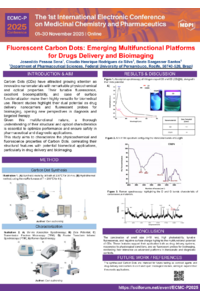
Introduction: Carbon Dots (CDs) have emerged as promising nanomaterials for pharmaceutical and diagnostic applications due to their tunable fluorescence, biocompatibility, and potential for surface functionalization. Their dual applicability as drug delivery nanocarriers and fluorescent probes for bioimaging makes their physicochemical characterization crucial for advancing biomedical research. Methods: CDs were synthesized using citric acid as the carbon precursor through two distinct approaches: thermal pyrolysis in an oil bath at 200 °C for 30 min and a hydrothermal method at 200 °C for 4 h in the presence of urea as a nitrogen source. The nanostructures were characterized by transmission electron microscopy (TEM), UV-Vis absorption spectroscopy, photoluminescence spectroscopy, Fourier-transform infrared spectroscopy (FTIR), Raman spectroscopy, and zeta potential analysis. Results: TEM analysis revealed spherical and homogeneous particles with an average diameter of 3.0–3.5 nm, consistent with the size range of quantum dots. Optical characterization showed stable photoluminescence, with absorption maxima at 333–350 nm and excitation-independent emission attributed to ordered sp² domains. Nitrogen doping significantly enhanced fluorescence intensity, increasing quantum yield and improving stability within a physiological pH range (4.5–9.5). FTIR spectra confirmed the presence of surface functional groups such as C=O, C–N, and C–OH, while Raman analysis revealed the characteristic D and G bands of graphitic carbon. Zeta potential values of approximately –30 mV indicated high colloidal stability and abundant anionic groups favorable for further functionalization. Conclusions: The combination of small size (<10 nm), high photostability, tunable fluorescence, and negative surface charge highlights the multifunctional potential of CDs. These features support their application both as drug delivery systems, responsive to physiological conditions, and as fluorescent probes for bioimaging, reinforcing their relevance as advanced platforms in therapeutic and diagnostic contexts.
Keywords
Carbon Dots
Drug Delivery
Fluorescent Bioimaging
Physicochemical Characterization
Nanomedicine
Poster
Josenildo_Sena.pdf
Optimizing Graphene Oxide Dispersion in DMSO via Ultrasonic Processing: A UV-Vis-NIR Spectroscopic Study for Biomedical Applications
Can polymers influence antifungal activity of silver nanospheres? A study on Candida albicans