Event submissions
EventsThe 1st International Electronic Conference on Medicinal Chemistry and Pharmaceutics
Published
This submission belongs to the session S11. Formulation, Drug Delivery and Controlled Release of the event The 1st International Electronic Conference on Medicinal Chemistry and Pharmaceutics
Published date
29 Oct, 2025
Academic Editor
'%3e%3cpath%20d='M12.6657%2010.9104C12.4185%2010.325%2012.0599%209.79327%2011.6097%209.34482C11.1609%208.89508%2010.6293%208.5365%2010.0442%208.28888C10.0389%208.28626%2010.0337%208.28495%2010.0285%208.28233C10.8446%207.69279%2011.3752%206.73249%2011.3752%205.64904C11.3752%203.8542%209.92103%202.39999%208.1262%202.39999C6.33136%202.39999%204.87715%203.8542%204.87715%205.64904C4.87715%206.73249%205.40774%207.69279%206.22393%208.28364C6.21869%208.28626%206.21345%208.28757%206.20821%208.29019C5.62129%208.5378%205.09463%208.89284%204.64265%209.34613C4.1929%209.79493%203.83432%2010.3266%203.58671%2010.9117C3.34345%2011.4845%203.21226%2012.0987%203.20023%2012.7209C3.19988%2012.7349%203.20233%2012.7488%203.20744%2012.7619C3.21255%2012.7749%203.22022%2012.7867%203.22998%2012.7968C3.23975%2012.8068%203.25142%2012.8147%203.26431%2012.8202C3.2772%2012.8256%203.29105%2012.8284%203.30504%2012.8284H4.09109C4.14874%2012.8284%204.19459%2012.7825%204.1959%2012.7262C4.2221%2011.7148%204.62823%2010.7676%205.34617%2010.0497C6.08899%209.30683%207.0755%208.89808%208.1262%208.89808C9.17689%208.89808%2010.1634%209.30683%2010.9062%2010.0497C11.6242%2010.7676%2012.0303%2011.7148%2012.0565%2012.7262C12.0578%2012.7838%2012.1037%2012.8284%2012.1613%2012.8284H12.9474C12.9613%2012.8284%2012.9752%2012.8256%2012.9881%2012.8202C13.001%2012.8147%2013.0126%2012.8068%2013.0224%2012.7968C13.0322%2012.7867%2013.0398%2012.7749%2013.0449%2012.7619C13.0501%2012.7488%2013.0525%2012.7349%2013.0522%2012.7209C13.0391%2012.0947%2012.9094%2011.4855%2012.6657%2010.9104ZM8.1262%207.9024C7.52486%207.9024%206.9589%207.6679%206.53312%207.24211C6.10733%206.81633%205.87283%206.25037%205.87283%205.64904C5.87283%205.0477%206.10733%204.48174%206.53312%204.05596C6.9589%203.63018%207.52486%203.39567%208.1262%203.39567C8.72753%203.39567%209.29349%203.63018%209.71927%204.05596C10.1451%204.48174%2010.3796%205.0477%2010.3796%205.64904C10.3796%206.25037%2010.1451%206.81633%209.71927%207.24211C9.29349%207.6679%208.72753%207.9024%208.1262%207.9024Z'%20fill='%235D1EE1'/%3e%3c/g%3e%3c/svg%3e) Giovanna Rassu
Giovanna RassuCitation
Agnieszka Markowska-Radomska, Patryk Skowronski, Konrad Kosicki, Ewa Dluska, Multiple Emulsions for Anti-Inflammatory Treatment of Chemoradiotherapy-Induced Skin Damage, in Proceedings of The 1st International Electronic Conference on Medicinal Chemistry and Pharmaceutics, 1 November–30 November 2025, MDPI: Basel, Switzerland
Share
Email
Facebook
Twitter
LinkedIn
Multiple Emulsions for Anti-Inflammatory Treatment of Chemoradiotherapy-Induced Skin Damage
'%3e%3cpath%20d='M12.6647%2010.9104C12.4176%2010.325%2012.0589%209.7933%2011.6088%209.34485C11.16%208.89511%2010.6283%208.53653%2010.0432%208.28891C10.038%208.28629%2010.0327%208.28498%2010.0275%208.28236C10.8437%207.69282%2011.3743%206.73252%2011.3743%205.64907C11.3743%203.85423%209.92005%202.40002%208.12522%202.40002C6.33038%202.40002%204.87618%203.85423%204.87618%205.64907C4.87618%206.73252%205.40677%207.69282%206.22296%208.28367C6.21772%208.28629%206.21248%208.2876%206.20724%208.29022C5.62031%208.53783%205.09365%208.89287%204.64167%209.34616C4.19192%209.79496%203.83334%2010.3266%203.58573%2010.9117C3.34247%2011.4846%203.21128%2012.0987%203.19925%2012.721C3.1989%2012.735%203.20135%2012.7489%203.20646%2012.7619C3.21157%2012.7749%203.21924%2012.7868%203.22901%2012.7968C3.23877%2012.8068%203.25045%2012.8148%203.26334%2012.8202C3.27623%2012.8256%203.29007%2012.8284%203.30406%2012.8284H4.09012C4.14776%2012.8284%204.19362%2012.7825%204.19493%2012.7262C4.22113%2011.7148%204.62726%2010.7676%205.34519%2010.0497C6.08802%209.30686%207.07452%208.89811%208.12522%208.89811C9.17592%208.89811%2010.1624%209.30686%2010.9052%2010.0497C11.6232%2010.7676%2012.0293%2011.7148%2012.0555%2012.7262C12.0568%2012.7839%2012.1027%2012.8284%2012.1603%2012.8284H12.9464C12.9604%2012.8284%2012.9742%2012.8256%2012.9871%2012.8202C13%2012.8148%2013.0117%2012.8068%2013.0214%2012.7968C13.0312%2012.7868%2013.0389%2012.7749%2013.044%2012.7619C13.0491%2012.7489%2013.0515%2012.735%2013.0512%2012.721C13.0381%2012.0947%2012.9084%2011.4856%2012.6647%2010.9104ZM8.12522%207.90243C7.52388%207.90243%206.95792%207.66793%206.53214%207.24215C6.10636%206.81636%205.87185%206.2504%205.87185%205.64907C5.87185%205.04773%206.10636%204.48177%206.53214%204.05599C6.95792%203.63021%207.52388%203.3957%208.12522%203.3957C8.72655%203.3957%209.29252%203.63021%209.7183%204.05599C10.1441%204.48177%2010.3786%205.04773%2010.3786%205.64907C10.3786%206.2504%2010.1441%206.81636%209.7183%207.24215C9.29252%207.66793%208.72655%207.90243%208.12522%207.90243Z'%20fill='%235D1EE1'/%3e%3c/g%3e%3c/svg%3e)
Agnieszka Markowska-Radomska 1
Patryk Skowronski 1
Konrad Kosicki 2
Ewa Dluska 1
1. Faculty of Chemical and Process Engineering, Warsaw University of Technology, ul. Warynskiego 1, 00-645 Warsaw, Poland
2. Institute of Genetics and Biotechnology, Faculty of Biology, University of Warsaw, ul. Miecznikowa 1, 02-096 Warsaw, Poland
Abstract
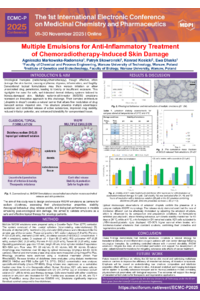
Introduction: Oncological therapies (radiotherapy/chemotherapy) often impair the skin barrier, leading to erythema, dryness, and inflammation. These changes make conventional topical formulations unsafe, as they may provoke irritation or cause uncontrolled drug penetration, resulting in either toxic or sub-therapeutic exposure. Multiple water-in-oil-in-water (W/O/W) emulsions offer a promising solution, providing controlled release, drug stabilisation, and better tolerability for fragile, inflamed tissue. Emulsion complex structure (aqueous droplets within larger oil drops) enables modulation of drug transport across damaged skin. Methods: Sodium diclofenac was encapsulated in W/O/W emulsions. Emulsion characterisation included diclofenac encapsulation efficiency, droplet size, three-month stability, and rheological behaviour. Transdermal delivery was evaluated in Franz diffusion cells using synthetic membranes and skin models subjected to UV-irradiation or cytostatic-induced inflammation to simulate post-therapy conditions. Drug concentration was quantified spectroscopically. Fibroblast viability was assessed with PrestoBlue assay. Results: Emulsions exhibited high encapsulation efficiencies (70.3±0.7% - 95.8±0.7%), droplet diameters of 15.1±0.5 – 22.5±0.9 µm, less than 15% size variation during storage, and showed shear-thinning behaviour consistent with the Power law model (consistency indices: 0.363–0.480 Pa·sⁿ; flow indices: 0.640–0.682; R² > 0.99). Damaged skin models displayed markedly increased and irregular permeability; conventional diclofenac formulations penetrated excessively and intensified irritation. In contrast, W/O/W emulsions provided modulated release, maintained therapeutic concentrations of drug. Fibroblasts exposed to UV/cytostatic damage showed >25% higher survival with diclofenac-loaded emulsions compared to standard solutions, indicating protective and regenerative potential. Conclusions: W/O/W emulsions represent a rational approach to transdermal delivery of anti-inflammatory drugs in oncology patients with impaired skin barrier. By ensuring controlled release and enhanced tolerability, they improve the safety of topical therapy.
The research was financially supported by the Warsaw University of Technology under the IChem-2025 grant from the Scientific Council of Chemical Engineering.
Keywords
multiple emulsions
transdermal delivery
diclofenac
chemoradiotherapy-induced skin damage
controlled release
Poster
AMR_sciforum-152314.pdf
Quality by design (QbD) driven development of sinensetin embedded hydrogel for diabetic wound healing applications.
Design and Characterization of Novel Nanoemulsion Formulation of Cannabinoid using Nanotechnology Platform for Targeted Ophthalmic Drug Delivery