Event submissions
EventsThe 1st International Electronic Conference on Medicinal Chemistry and Pharmaceutics
Published
This submission belongs to the session S12. Biopharmaceutics, Pharmacokinetics and Pharmacodynamics of the event The 1st International Electronic Conference on Medicinal Chemistry and Pharmaceutics
Published date
29 Oct, 2025
Academic Editor
'%3e%3cpath%20d='M12.6657%2010.9104C12.4185%2010.325%2012.0599%209.79327%2011.6097%209.34482C11.1609%208.89508%2010.6293%208.5365%2010.0442%208.28888C10.0389%208.28626%2010.0337%208.28495%2010.0285%208.28233C10.8446%207.69279%2011.3752%206.73249%2011.3752%205.64904C11.3752%203.8542%209.92103%202.39999%208.1262%202.39999C6.33136%202.39999%204.87715%203.8542%204.87715%205.64904C4.87715%206.73249%205.40774%207.69279%206.22393%208.28364C6.21869%208.28626%206.21345%208.28757%206.20821%208.29019C5.62129%208.5378%205.09463%208.89284%204.64265%209.34613C4.1929%209.79493%203.83432%2010.3266%203.58671%2010.9117C3.34345%2011.4845%203.21226%2012.0987%203.20023%2012.7209C3.19988%2012.7349%203.20233%2012.7488%203.20744%2012.7619C3.21255%2012.7749%203.22022%2012.7867%203.22998%2012.7968C3.23975%2012.8068%203.25142%2012.8147%203.26431%2012.8202C3.2772%2012.8256%203.29105%2012.8284%203.30504%2012.8284H4.09109C4.14874%2012.8284%204.19459%2012.7825%204.1959%2012.7262C4.2221%2011.7148%204.62823%2010.7676%205.34617%2010.0497C6.08899%209.30683%207.0755%208.89808%208.1262%208.89808C9.17689%208.89808%2010.1634%209.30683%2010.9062%2010.0497C11.6242%2010.7676%2012.0303%2011.7148%2012.0565%2012.7262C12.0578%2012.7838%2012.1037%2012.8284%2012.1613%2012.8284H12.9474C12.9613%2012.8284%2012.9752%2012.8256%2012.9881%2012.8202C13.001%2012.8147%2013.0126%2012.8068%2013.0224%2012.7968C13.0322%2012.7867%2013.0398%2012.7749%2013.0449%2012.7619C13.0501%2012.7488%2013.0525%2012.7349%2013.0522%2012.7209C13.0391%2012.0947%2012.9094%2011.4855%2012.6657%2010.9104ZM8.1262%207.9024C7.52486%207.9024%206.9589%207.6679%206.53312%207.24211C6.10733%206.81633%205.87283%206.25037%205.87283%205.64904C5.87283%205.0477%206.10733%204.48174%206.53312%204.05596C6.9589%203.63018%207.52486%203.39567%208.1262%203.39567C8.72753%203.39567%209.29349%203.63018%209.71927%204.05596C10.1451%204.48174%2010.3796%205.0477%2010.3796%205.64904C10.3796%206.25037%2010.1451%206.81633%209.71927%207.24211C9.29349%207.6679%208.72753%207.9024%208.1262%207.9024Z'%20fill='%235D1EE1'/%3e%3c/g%3e%3c/svg%3e) Patrick Sinko
Patrick SinkoCitation
Rita Onyekachukwu Asomadu, Dominion Ebubechi Ngele, Pharmacokinetics and inhibitory activities of UPLC-detected compounds of Voacanga africana roots on acetylcholinesterase and monoamine oxidase B: Potential drug candidates for neurological disorders, in Proceedings of The 1st International Electronic Conference on Medicinal Chemistry and Pharmaceutics, 1 November–30 November 2025, MDPI: Basel, Switzerland
Share
Email
Facebook
Twitter
LinkedIn
Pharmacokinetics and inhibitory activities of UPLC-detected compounds of Voacanga africana roots on acetylcholinesterase and monoamine oxidase B: Potential drug candidates for neurological disorders
'%3e%3cpath%20d='M12.6647%2010.9104C12.4176%2010.325%2012.0589%209.7933%2011.6088%209.34485C11.16%208.89511%2010.6283%208.53653%2010.0432%208.28891C10.038%208.28629%2010.0327%208.28498%2010.0275%208.28236C10.8437%207.69282%2011.3743%206.73252%2011.3743%205.64907C11.3743%203.85423%209.92005%202.40002%208.12522%202.40002C6.33038%202.40002%204.87618%203.85423%204.87618%205.64907C4.87618%206.73252%205.40677%207.69282%206.22296%208.28367C6.21772%208.28629%206.21248%208.2876%206.20724%208.29022C5.62031%208.53783%205.09365%208.89287%204.64167%209.34616C4.19192%209.79496%203.83334%2010.3266%203.58573%2010.9117C3.34247%2011.4846%203.21128%2012.0987%203.19925%2012.721C3.1989%2012.735%203.20135%2012.7489%203.20646%2012.7619C3.21157%2012.7749%203.21924%2012.7868%203.22901%2012.7968C3.23877%2012.8068%203.25045%2012.8148%203.26334%2012.8202C3.27623%2012.8256%203.29007%2012.8284%203.30406%2012.8284H4.09012C4.14776%2012.8284%204.19362%2012.7825%204.19493%2012.7262C4.22113%2011.7148%204.62726%2010.7676%205.34519%2010.0497C6.08802%209.30686%207.07452%208.89811%208.12522%208.89811C9.17592%208.89811%2010.1624%209.30686%2010.9052%2010.0497C11.6232%2010.7676%2012.0293%2011.7148%2012.0555%2012.7262C12.0568%2012.7839%2012.1027%2012.8284%2012.1603%2012.8284H12.9464C12.9604%2012.8284%2012.9742%2012.8256%2012.9871%2012.8202C13%2012.8148%2013.0117%2012.8068%2013.0214%2012.7968C13.0312%2012.7868%2013.0389%2012.7749%2013.044%2012.7619C13.0491%2012.7489%2013.0515%2012.735%2013.0512%2012.721C13.0381%2012.0947%2012.9084%2011.4856%2012.6647%2010.9104ZM8.12522%207.90243C7.52388%207.90243%206.95792%207.66793%206.53214%207.24215C6.10636%206.81636%205.87185%206.2504%205.87185%205.64907C5.87185%205.04773%206.10636%204.48177%206.53214%204.05599C6.95792%203.63021%207.52388%203.3957%208.12522%203.3957C8.72655%203.3957%209.29252%203.63021%209.7183%204.05599C10.1441%204.48177%2010.3786%205.04773%2010.3786%205.64907C10.3786%206.2504%2010.1441%206.81636%209.7183%207.24215C9.29252%207.66793%208.72655%207.90243%208.12522%207.90243Z'%20fill='%235D1EE1'/%3e%3c/g%3e%3c/svg%3e)
Rita Onyekachukwu Asomadu 1
Dominion Ebubechi Ngele 1
1. Department of Biochemistry, Faculty of Biological Sciences, University of Nigeria, Nsukka, 410001, Enugu State, Nigeria
Abstract
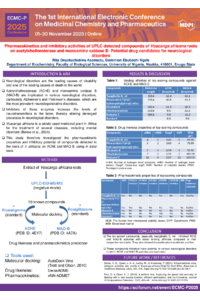
Introduction: Voacanga africana is a widely used medicinal plant in Africa for the treatment of several diseases, including mental disorders. This study investigated the ADME properties and inhibitory potential of compounds detected in the roots of the plant on acetylcholinesterase (AChE) and monoamine oxidase B (MAO-B), targets implicated in neurological disorders.
Methods: The roots of V. africana were extracted with 80% methanol, after which the extract was subjected to UPLC-ESI-MS/MS in negative mode. Known compounds were docked against AChE and MAO-B obtained from the Protein Data Bank (PDB ID: 4EY7 and 4A7A, respectively), using AutoDock. Drug likeness and ADME prediction were achieved using SwissADME and vNN-ADMET online servers, respectively. Rivastigmine and Rosiglitazone were used as the standard inhibitors of AChE and MAO-B, respectively.
Results: Some of the compounds had higher binding affinities against AChE and MAO-B compared to the standards, which had binding affinities of -8.0 and -9.8 kcal/mol, respectively. The top five compounds inhibited both targets with binding affinities of -12.4 to -9.6 kcal/mol for AChE and -12.1 to -10.2 kcal/mol for MAO-B. They include tsangibeilin B, rel-, Elisabatin B, Pinocembrin 7-[4-(1-hydroxyethyl)phenyl] ether, Hedyotol C and obochalcolactone. Tsangibeilin B, rel- had the highest binding affinity for both targets. It exhibits desirable drug-likeness properties, acts as a P-glycoprotein inhibitor and substrate, permeates the blood-brain barrier, is stable with respect to the human liver microsomal stability assay, and does not inhibit cytochrome P450 enzymes.
Conclusion: The top-scored compounds, especially tsangibeilin B, rel- therefore, pose as potent inhibitors of AChE and MAO-B, demonstrating their potential in neurological disorders..
Keywords
Voacanga africana
acetylcholinesterase
monoamine oxidase B
tsangibeilin B
rel-
Poster
Asomadu, Rita (ECMC-P).pdf
Patient digital twin for peptide muscle relaxant ativity control
Development of Kojic Acid–3-Hydroxyindolin-2-one Conjugates: Structural Characterization and Pharmacological Evaluation