Event submissions
Published
This submission belongs to the session S3. Soft Matter, Biomaterials, Composites and Interfaces of the event The 4th International Online Conference on Materials
Published date
29 Oct, 2025
Academic Editor
'%3e%3cpath%20d='M12.6657%2010.9104C12.4185%2010.325%2012.0599%209.79327%2011.6097%209.34482C11.1609%208.89508%2010.6293%208.5365%2010.0442%208.28888C10.0389%208.28626%2010.0337%208.28495%2010.0285%208.28233C10.8446%207.69279%2011.3752%206.73249%2011.3752%205.64904C11.3752%203.8542%209.92103%202.39999%208.1262%202.39999C6.33136%202.39999%204.87715%203.8542%204.87715%205.64904C4.87715%206.73249%205.40774%207.69279%206.22393%208.28364C6.21869%208.28626%206.21345%208.28757%206.20821%208.29019C5.62129%208.5378%205.09463%208.89284%204.64265%209.34613C4.1929%209.79493%203.83432%2010.3266%203.58671%2010.9117C3.34345%2011.4845%203.21226%2012.0987%203.20023%2012.7209C3.19988%2012.7349%203.20233%2012.7488%203.20744%2012.7619C3.21255%2012.7749%203.22022%2012.7867%203.22998%2012.7968C3.23975%2012.8068%203.25142%2012.8147%203.26431%2012.8202C3.2772%2012.8256%203.29105%2012.8284%203.30504%2012.8284H4.09109C4.14874%2012.8284%204.19459%2012.7825%204.1959%2012.7262C4.2221%2011.7148%204.62823%2010.7676%205.34617%2010.0497C6.08899%209.30683%207.0755%208.89808%208.1262%208.89808C9.17689%208.89808%2010.1634%209.30683%2010.9062%2010.0497C11.6242%2010.7676%2012.0303%2011.7148%2012.0565%2012.7262C12.0578%2012.7838%2012.1037%2012.8284%2012.1613%2012.8284H12.9474C12.9613%2012.8284%2012.9752%2012.8256%2012.9881%2012.8202C13.001%2012.8147%2013.0126%2012.8068%2013.0224%2012.7968C13.0322%2012.7867%2013.0398%2012.7749%2013.0449%2012.7619C13.0501%2012.7488%2013.0525%2012.7349%2013.0522%2012.7209C13.0391%2012.0947%2012.9094%2011.4855%2012.6657%2010.9104ZM8.1262%207.9024C7.52486%207.9024%206.9589%207.6679%206.53312%207.24211C6.10733%206.81633%205.87283%206.25037%205.87283%205.64904C5.87283%205.0477%206.10733%204.48174%206.53312%204.05596C6.9589%203.63018%207.52486%203.39567%208.1262%203.39567C8.72753%203.39567%209.29349%203.63018%209.71927%204.05596C10.1451%204.48174%2010.3796%205.0477%2010.3796%205.64904C10.3796%206.25037%2010.1451%206.81633%209.71927%207.24211C9.29349%207.6679%208.72753%207.9024%208.1262%207.9024Z'%20fill='%235D1EE1'/%3e%3c/g%3e%3c/svg%3e) Ingo Dierking
Ingo DierkingCitation
Yuriy Garbovskiy, Control of ions in molecular liquid crystals using multiple nanoparticles, in Proceedings of The 4th International Online Conference on Materials, 3 November–6 November 2025, MDPI: Basel, Switzerland
Share
Email
Facebook
Twitter
LinkedIn
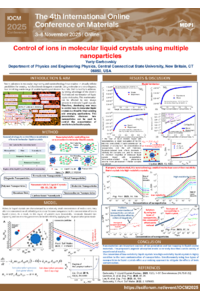
Control of ions in molecular liquid crystals using multiple nanoparticles

Yuriy Garbovskiy 1
1. Department of Physics and Engineering Physics, Central Connecticut State University, New Britain, CT 06050, USA
Abstract
Advanced applications of molecular liquid crystals, such as high-resolution displays for augmented and virtual reality, tunable electro-optical components for high-resolution imaging and space exploration, spatial light modulators for flat optics and structured light generation, lasers, sensors, and smart windows, rely heavily on the development of new mesogenic materials with improved functionalities. Recent advances in molecular engineering and nanotechnology have resulted in virtually infinite possibilities for creating multifunctional mesogenic materials using molecular and nano-dopants, thus benefiting a wide range of tunable liquid crystal devices. As a rule, their tunability is achieved by taking advantage of the electric field-induced reorientation of liquid crystal molecules. This reorientation can be affected by ions always present in molecular liquid crystals. Therefore, developing new ways to control ions in molecular liquid crystals is critical for their existing and emerging applications.
This presentation discusses how nanoparticles can be used to control the concentration of mobile ions in molecular liquid crystals. For a single type of nanoparticle, an elementary model considering interactions between ions and nanoparticles, the possibility of ionic contamination of nanoparticles, and experimental results supporting the model are discussed. The change in the concentration of mobile ions in nematic liquid crystals containing ferroelectric and magnetic nanoparticles leads to the modification of the DC electrical conductivity, which is evaluated using the impedance spectroscopy method. For better control over the DC electrical conductivity of molecular liquid crystals, the simultaneous use of several types of nanoparticles is proposed. This way, it is possible to achieve a nearly three order of magnitude decrease or increase in the DC electrical conductivity of molecular liquid crystals.
Keywords
liquid crystals
ions
electrical conductivity
nanomaterials
advanced applications
Poster
YG IOCM 2025.pdf
Machine Learning-Driven Insight into Crystallization Kinetics in Liquid Crystals
Three-Dimensional-Printed Polymer Composites for Temporary Crowns