Event submissions
Published
This submission belongs to the session S3. Soft Matter, Biomaterials, Composites and Interfaces of the event The 4th International Online Conference on Materials
Published date
29 Oct, 2025
Academic Editor
'%3e%3cpath%20d='M12.6657%2010.9104C12.4185%2010.325%2012.0599%209.79327%2011.6097%209.34482C11.1609%208.89508%2010.6293%208.5365%2010.0442%208.28888C10.0389%208.28626%2010.0337%208.28495%2010.0285%208.28233C10.8446%207.69279%2011.3752%206.73249%2011.3752%205.64904C11.3752%203.8542%209.92103%202.39999%208.1262%202.39999C6.33136%202.39999%204.87715%203.8542%204.87715%205.64904C4.87715%206.73249%205.40774%207.69279%206.22393%208.28364C6.21869%208.28626%206.21345%208.28757%206.20821%208.29019C5.62129%208.5378%205.09463%208.89284%204.64265%209.34613C4.1929%209.79493%203.83432%2010.3266%203.58671%2010.9117C3.34345%2011.4845%203.21226%2012.0987%203.20023%2012.7209C3.19988%2012.7349%203.20233%2012.7488%203.20744%2012.7619C3.21255%2012.7749%203.22022%2012.7867%203.22998%2012.7968C3.23975%2012.8068%203.25142%2012.8147%203.26431%2012.8202C3.2772%2012.8256%203.29105%2012.8284%203.30504%2012.8284H4.09109C4.14874%2012.8284%204.19459%2012.7825%204.1959%2012.7262C4.2221%2011.7148%204.62823%2010.7676%205.34617%2010.0497C6.08899%209.30683%207.0755%208.89808%208.1262%208.89808C9.17689%208.89808%2010.1634%209.30683%2010.9062%2010.0497C11.6242%2010.7676%2012.0303%2011.7148%2012.0565%2012.7262C12.0578%2012.7838%2012.1037%2012.8284%2012.1613%2012.8284H12.9474C12.9613%2012.8284%2012.9752%2012.8256%2012.9881%2012.8202C13.001%2012.8147%2013.0126%2012.8068%2013.0224%2012.7968C13.0322%2012.7867%2013.0398%2012.7749%2013.0449%2012.7619C13.0501%2012.7488%2013.0525%2012.7349%2013.0522%2012.7209C13.0391%2012.0947%2012.9094%2011.4855%2012.6657%2010.9104ZM8.1262%207.9024C7.52486%207.9024%206.9589%207.6679%206.53312%207.24211C6.10733%206.81633%205.87283%206.25037%205.87283%205.64904C5.87283%205.0477%206.10733%204.48174%206.53312%204.05596C6.9589%203.63018%207.52486%203.39567%208.1262%203.39567C8.72753%203.39567%209.29349%203.63018%209.71927%204.05596C10.1451%204.48174%2010.3796%205.0477%2010.3796%205.64904C10.3796%206.25037%2010.1451%206.81633%209.71927%207.24211C9.29349%207.6679%208.72753%207.9024%208.1262%207.9024Z'%20fill='%235D1EE1'/%3e%3c/g%3e%3c/svg%3e) Qingchun Yuan
Qingchun YuanCitation
Jose Luis Aparicio Collado, José Molina Mateo, Alba Cano Vicent, Miguel Martí, Ángel Serrano Aroca, Roser Sabater i Serra, Development of Poly(3-hydroxybutyrate-co-3-hydroxyvalerate)/Poly(methyl acrylate) Hybrid Composites with Enhanced Electrical Conductivity through Graphene Nanoplatelet Incorporation and Optimization of Their Blend Ratio, in Proceedings of The 4th International Online Conference on Materials, 3 November–6 November 2025, MDPI: Basel, Switzerland
Share
Email
Facebook
Twitter
LinkedIn
Development of Poly(3-hydroxybutyrate-co-3-hydroxyvalerate)/Poly(methyl acrylate) Hybrid Composites with Enhanced Electrical Conductivity through Graphene Nanoplatelet Incorporation and Optimization of Their Blend Ratio
'%3e%3cpath%20d='M12.6647%2010.9104C12.4176%2010.325%2012.0589%209.7933%2011.6088%209.34485C11.16%208.89511%2010.6283%208.53653%2010.0432%208.28891C10.038%208.28629%2010.0327%208.28498%2010.0275%208.28236C10.8437%207.69282%2011.3743%206.73252%2011.3743%205.64907C11.3743%203.85423%209.92005%202.40002%208.12522%202.40002C6.33038%202.40002%204.87618%203.85423%204.87618%205.64907C4.87618%206.73252%205.40677%207.69282%206.22296%208.28367C6.21772%208.28629%206.21248%208.2876%206.20724%208.29022C5.62031%208.53783%205.09365%208.89287%204.64167%209.34616C4.19192%209.79496%203.83334%2010.3266%203.58573%2010.9117C3.34247%2011.4846%203.21128%2012.0987%203.19925%2012.721C3.1989%2012.735%203.20135%2012.7489%203.20646%2012.7619C3.21157%2012.7749%203.21924%2012.7868%203.22901%2012.7968C3.23877%2012.8068%203.25045%2012.8148%203.26334%2012.8202C3.27623%2012.8256%203.29007%2012.8284%203.30406%2012.8284H4.09012C4.14776%2012.8284%204.19362%2012.7825%204.19493%2012.7262C4.22113%2011.7148%204.62726%2010.7676%205.34519%2010.0497C6.08802%209.30686%207.07452%208.89811%208.12522%208.89811C9.17592%208.89811%2010.1624%209.30686%2010.9052%2010.0497C11.6232%2010.7676%2012.0293%2011.7148%2012.0555%2012.7262C12.0568%2012.7839%2012.1027%2012.8284%2012.1603%2012.8284H12.9464C12.9604%2012.8284%2012.9742%2012.8256%2012.9871%2012.8202C13%2012.8148%2013.0117%2012.8068%2013.0214%2012.7968C13.0312%2012.7868%2013.0389%2012.7749%2013.044%2012.7619C13.0491%2012.7489%2013.0515%2012.735%2013.0512%2012.721C13.0381%2012.0947%2012.9084%2011.4856%2012.6647%2010.9104ZM8.12522%207.90243C7.52388%207.90243%206.95792%207.66793%206.53214%207.24215C6.10636%206.81636%205.87185%206.2504%205.87185%205.64907C5.87185%205.04773%206.10636%204.48177%206.53214%204.05599C6.95792%203.63021%207.52388%203.3957%208.12522%203.3957C8.72655%203.3957%209.29252%203.63021%209.7183%204.05599C10.1441%204.48177%2010.3786%205.04773%2010.3786%205.64907C10.3786%206.2504%2010.1441%206.81636%209.7183%207.24215C9.29252%207.66793%208.72655%207.90243%208.12522%207.90243Z'%20fill='%235D1EE1'/%3e%3c/g%3e%3c/svg%3e)
Jose Luis Aparicio Collado 1
José Molina Mateo 1
Alba Cano Vicent 2

Miguel Martí 2

Ángel Serrano Aroca 2
Roser Sabater i Serra 1,3
1. Centre for Biomaterials and Tissue Engineering, Universitat Politècnica de València, Valencia, Spain.
2. Biomaterials and Bioengineering Lab, Centro de Investigación Traslacional San Alberto Magno, Universidad Católica de Valencia San Vicente Mártir, Valencia, Spain
3. Biomedical Research Networking Centre in Bioengineering, Biomaterials and Nanomedicine (CIBER-BBN), Spain.
Abstract
Introduction:
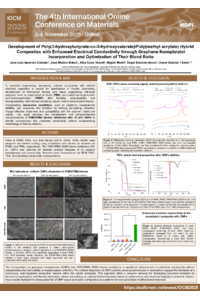
To develop hybrid composites with enhanced electrical properties, graphene nanoplatelets (GNPs, 10 wt%) were incorporated into films based on blends of poly(methyl acrylate) (PMA) and poly(3-hydroxybutyrate-co-3-hydroxyvalerate) (PHBV). While PMA offers flexibility and processability, PHBV contributes biodegradability and biocompatibility. However, both polymers are inherently insulating. Various blend ratios were tested, but only the PHBV/PMA 20/80 wt% ratio showed a significant enhancement in electrical conductivity upon GNP addition. This specific ratio enabled the formation of a more efficient conductive network.
Methods:
Films of PHBV, PMA, and their blends (30/70, 20/80, 70/30, 80/20) were prepared via solvent casting, using chloroform and toluene as solvents for PHBV and PMA, respectively. The PHBV/PMA 20/80–10% GNP composition was selected for detailed analysis due to its superior homogeneity and conductivity. Samples were characterized by SEM, FTIR, DSC, TGA, and conductivity measurements.
Results:
SEM revealed uniform GNP dispersion only in the PHBV/PMA 20/80 blend, while significant aggregation occurred in neat PHBV and PMA. FTIR confirmed the presence of both polymers. Thermal analysis showed that the blend suppressed PHBV crystallization, but GNPs acted as nucleating agents, restoring semicrystalline behaviour. TGA indicated that thermal stability remained comparable to neat PMA after GNP addition. Electrical conductivity increased from 0.4 mS/m (PHBV/PMA) to 5 mS/m with GNPs—an over 12-fold enhancement—indicating formation of a percolation network.
Conclusions:
Incorporating GNPs into PHBV/PMA 20/80 blends significantly enhanced conductivity without compromising thermal stability or morphology. The uniform GNP dispersion and conductivity increase confirm a continuous conductive network. This strategy enables the development of functional materials for biomedical devices and flexible electronics, where electrical performance and structural integrity are crucial. These conductive composites offer a promising platform for next-generation multifunctional materials.
Keywords
hybrid composites
graphene
electrical conductivity
Poster
Poster IOCM 2025.pdf
Physical, chemical and morphological characterization of mammon (Melicoccus bijugatus) shell as a potential biomaterial for wastewater treatment
Electrospun Nanofibers for Biomedical Applications: Biocompatible Dressings and Bioactive Implant Coatings