Event submissions
Published
This submission belongs to the session S3. Soft Matter, Biomaterials, Composites and Interfaces of the event The 4th International Online Conference on Materials
Published date
29 Oct, 2025
Academic Editor
'%3e%3cpath%20d='M12.6657%2010.9104C12.4185%2010.325%2012.0599%209.79327%2011.6097%209.34482C11.1609%208.89508%2010.6293%208.5365%2010.0442%208.28888C10.0389%208.28626%2010.0337%208.28495%2010.0285%208.28233C10.8446%207.69279%2011.3752%206.73249%2011.3752%205.64904C11.3752%203.8542%209.92103%202.39999%208.1262%202.39999C6.33136%202.39999%204.87715%203.8542%204.87715%205.64904C4.87715%206.73249%205.40774%207.69279%206.22393%208.28364C6.21869%208.28626%206.21345%208.28757%206.20821%208.29019C5.62129%208.5378%205.09463%208.89284%204.64265%209.34613C4.1929%209.79493%203.83432%2010.3266%203.58671%2010.9117C3.34345%2011.4845%203.21226%2012.0987%203.20023%2012.7209C3.19988%2012.7349%203.20233%2012.7488%203.20744%2012.7619C3.21255%2012.7749%203.22022%2012.7867%203.22998%2012.7968C3.23975%2012.8068%203.25142%2012.8147%203.26431%2012.8202C3.2772%2012.8256%203.29105%2012.8284%203.30504%2012.8284H4.09109C4.14874%2012.8284%204.19459%2012.7825%204.1959%2012.7262C4.2221%2011.7148%204.62823%2010.7676%205.34617%2010.0497C6.08899%209.30683%207.0755%208.89808%208.1262%208.89808C9.17689%208.89808%2010.1634%209.30683%2010.9062%2010.0497C11.6242%2010.7676%2012.0303%2011.7148%2012.0565%2012.7262C12.0578%2012.7838%2012.1037%2012.8284%2012.1613%2012.8284H12.9474C12.9613%2012.8284%2012.9752%2012.8256%2012.9881%2012.8202C13.001%2012.8147%2013.0126%2012.8068%2013.0224%2012.7968C13.0322%2012.7867%2013.0398%2012.7749%2013.0449%2012.7619C13.0501%2012.7488%2013.0525%2012.7349%2013.0522%2012.7209C13.0391%2012.0947%2012.9094%2011.4855%2012.6657%2010.9104ZM8.1262%207.9024C7.52486%207.9024%206.9589%207.6679%206.53312%207.24211C6.10733%206.81633%205.87283%206.25037%205.87283%205.64904C5.87283%205.0477%206.10733%204.48174%206.53312%204.05596C6.9589%203.63018%207.52486%203.39567%208.1262%203.39567C8.72753%203.39567%209.29349%203.63018%209.71927%204.05596C10.1451%204.48174%2010.3796%205.0477%2010.3796%205.64904C10.3796%206.25037%2010.1451%206.81633%209.71927%207.24211C9.29349%207.6679%208.72753%207.9024%208.1262%207.9024Z'%20fill='%235D1EE1'/%3e%3c/g%3e%3c/svg%3e) Ingo Dierking
Ingo DierkingCitation
Stefania Caragnano, Raffaele De Palo, Felice Alberto Sfregola, Caterina Gaudiuso, Francesco Mezzapesa, Pietro Patimisco, Antonio Ancona, Annalisa Volpe, Femtosecond Laser Micro- and Nanostructuring of Aluminium Moulds for Durable Superhydrophobic PDMS Surfaces, in Proceedings of The 4th International Online Conference on Materials, 3 November–6 November 2025, MDPI: Basel, Switzerland
Share
Email
Facebook
Twitter
LinkedIn
Femtosecond Laser Micro- and Nanostructuring of Aluminium Moulds for Durable Superhydrophobic PDMS Surfaces

Stefania Caragnano 1,2
'%3e%3cpath%20d='M12.6647%2010.9104C12.4176%2010.325%2012.0589%209.7933%2011.6088%209.34485C11.16%208.89511%2010.6283%208.53653%2010.0432%208.28891C10.038%208.28629%2010.0327%208.28498%2010.0275%208.28236C10.8437%207.69282%2011.3743%206.73252%2011.3743%205.64907C11.3743%203.85423%209.92005%202.40002%208.12522%202.40002C6.33038%202.40002%204.87618%203.85423%204.87618%205.64907C4.87618%206.73252%205.40677%207.69282%206.22296%208.28367C6.21772%208.28629%206.21248%208.2876%206.20724%208.29022C5.62031%208.53783%205.09365%208.89287%204.64167%209.34616C4.19192%209.79496%203.83334%2010.3266%203.58573%2010.9117C3.34247%2011.4846%203.21128%2012.0987%203.19925%2012.721C3.1989%2012.735%203.20135%2012.7489%203.20646%2012.7619C3.21157%2012.7749%203.21924%2012.7868%203.22901%2012.7968C3.23877%2012.8068%203.25045%2012.8148%203.26334%2012.8202C3.27623%2012.8256%203.29007%2012.8284%203.30406%2012.8284H4.09012C4.14776%2012.8284%204.19362%2012.7825%204.19493%2012.7262C4.22113%2011.7148%204.62726%2010.7676%205.34519%2010.0497C6.08802%209.30686%207.07452%208.89811%208.12522%208.89811C9.17592%208.89811%2010.1624%209.30686%2010.9052%2010.0497C11.6232%2010.7676%2012.0293%2011.7148%2012.0555%2012.7262C12.0568%2012.7839%2012.1027%2012.8284%2012.1603%2012.8284H12.9464C12.9604%2012.8284%2012.9742%2012.8256%2012.9871%2012.8202C13%2012.8148%2013.0117%2012.8068%2013.0214%2012.7968C13.0312%2012.7868%2013.0389%2012.7749%2013.044%2012.7619C13.0491%2012.7489%2013.0515%2012.735%2013.0512%2012.721C13.0381%2012.0947%2012.9084%2011.4856%2012.6647%2010.9104ZM8.12522%207.90243C7.52388%207.90243%206.95792%207.66793%206.53214%207.24215C6.10636%206.81636%205.87185%206.2504%205.87185%205.64907C5.87185%205.04773%206.10636%204.48177%206.53214%204.05599C6.95792%203.63021%207.52388%203.3957%208.12522%203.3957C8.72655%203.3957%209.29252%203.63021%209.7183%204.05599C10.1441%204.48177%2010.3786%205.04773%2010.3786%205.64907C10.3786%206.2504%2010.1441%206.81636%209.7183%207.24215C9.29252%207.66793%208.72655%207.90243%208.12522%207.90243Z'%20fill='%235D1EE1'/%3e%3c/g%3e%3c/svg%3e)
Raffaele De Palo 1
Felice Alberto Sfregola 1,2

Caterina Gaudiuso 2
Francesco Mezzapesa 2

Pietro Patimisco 1,3

Antonio Ancona 1,2

Annalisa Volpe 1,2
1. Dipartimento Interateneo di Fisica, University and Politecnico of Bari, Via Amendola 173, 70126 Bari, Italy
2. Institute for Photonics and Nanotechnologies, CNR-IFN, via Amendola 122/D, 70126, Bari, Italy
3. PolySense Innovations srl, Via Amendola 173, Bari 70126, Italy
Abstract
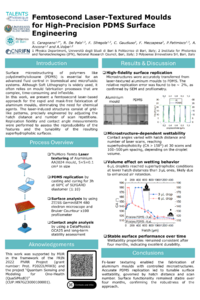
Surface functionalization of polymers plays a crucial role in enhancing key properties such as wettability, frictional behaviour and resistance to mechanical wear. Polydimethylsiloxane (PDMS) is a widely used polymer in microfluidics and biomedical applications due to its excellent biocompatibility, optical transparency and ease of processing. A common approach to tailoring its surface morphology and consequently its wettability is soft lithography. However, the fabrication of the moulds required for this technique is often time-consuming and resource-intensive.
In this study, we present a scalable strategy based on femtosecond laser micromachining to fabricate textured aluminium (AA2024) moulds for replicating PDMS surfaces with tunable hydrophobic behaviour. The moulds were laser-textured using a TruMicro Femto Laser system (Trumpf GmbH, Ditzingen, Germany) to create grid structures with controlled hatch distances and depths. Additionally, Laser-Induced Periodic Surface Structures (LIPSS) were generated to assess nanoscale replication capabilities. PDMS was then cast onto the moulds and cured under standard conditions.
Surface characterization by scanning electron microscopy (ZEISS GeminiSEM 480) and profilometry (Bruker Countour x100) confirmed the high-fidelity transfer of both micro- and nanostructures from the laser-textured moulds to the PDMS. Wettability analysis via static contact angle measurements (DataPhysics OCA25) on water droplets of varying volume revealed a marked increase in hydrophobicity, reaching superhydrophobic levels for optimized geometries.
Moreover, a four-month stability test demonstrated that both hydrophobic and superhydrophobic properties remained stable over time, without the need for additional treatments or signs of surface degradation. This method, entirely free of chemical coatings, offers precise control over surface morphology and functional performance.
In conclusion, femtosecond laser-textured aluminium moulds offer a high-throughput, cost-effective approach for engineering hydrophobic and superhydrophobic PDMS surfaces, with promising applicability in lab-on-chip platforms, implantable biomedical devices and surface-functionalized microfluidic systems.
Keywords
femtosecond laser micromachining
surface functionalization
PDMS
hydrophobicity
superhydrophobic surfaces
LIPSS
soft lithography
microfluidics
Poster
Poster_bordeaux_final_Caragnano.pdf
The activation modification of hollow glass microspheres and their application in lightweight rubber-based shoe materials
Wearable Textile Organic Electrochemical Transistors and Biosensors (OECTs) for Non-Invasive Real-Time Monitoring of Neurodegenerative Disorders