Event submissions
Published
This submission belongs to the session S3. Soft Matter, Biomaterials, Composites and Interfaces of the event The 4th International Online Conference on Materials
Published date
29 Oct, 2025
Academic Editor
'%3e%3cpath%20d='M12.6657%2010.9104C12.4185%2010.325%2012.0599%209.79327%2011.6097%209.34482C11.1609%208.89508%2010.6293%208.5365%2010.0442%208.28888C10.0389%208.28626%2010.0337%208.28495%2010.0285%208.28233C10.8446%207.69279%2011.3752%206.73249%2011.3752%205.64904C11.3752%203.8542%209.92103%202.39999%208.1262%202.39999C6.33136%202.39999%204.87715%203.8542%204.87715%205.64904C4.87715%206.73249%205.40774%207.69279%206.22393%208.28364C6.21869%208.28626%206.21345%208.28757%206.20821%208.29019C5.62129%208.5378%205.09463%208.89284%204.64265%209.34613C4.1929%209.79493%203.83432%2010.3266%203.58671%2010.9117C3.34345%2011.4845%203.21226%2012.0987%203.20023%2012.7209C3.19988%2012.7349%203.20233%2012.7488%203.20744%2012.7619C3.21255%2012.7749%203.22022%2012.7867%203.22998%2012.7968C3.23975%2012.8068%203.25142%2012.8147%203.26431%2012.8202C3.2772%2012.8256%203.29105%2012.8284%203.30504%2012.8284H4.09109C4.14874%2012.8284%204.19459%2012.7825%204.1959%2012.7262C4.2221%2011.7148%204.62823%2010.7676%205.34617%2010.0497C6.08899%209.30683%207.0755%208.89808%208.1262%208.89808C9.17689%208.89808%2010.1634%209.30683%2010.9062%2010.0497C11.6242%2010.7676%2012.0303%2011.7148%2012.0565%2012.7262C12.0578%2012.7838%2012.1037%2012.8284%2012.1613%2012.8284H12.9474C12.9613%2012.8284%2012.9752%2012.8256%2012.9881%2012.8202C13.001%2012.8147%2013.0126%2012.8068%2013.0224%2012.7968C13.0322%2012.7867%2013.0398%2012.7749%2013.0449%2012.7619C13.0501%2012.7488%2013.0525%2012.7349%2013.0522%2012.7209C13.0391%2012.0947%2012.9094%2011.4855%2012.6657%2010.9104ZM8.1262%207.9024C7.52486%207.9024%206.9589%207.6679%206.53312%207.24211C6.10733%206.81633%205.87283%206.25037%205.87283%205.64904C5.87283%205.0477%206.10733%204.48174%206.53312%204.05596C6.9589%203.63018%207.52486%203.39567%208.1262%203.39567C8.72753%203.39567%209.29349%203.63018%209.71927%204.05596C10.1451%204.48174%2010.3796%205.0477%2010.3796%205.64904C10.3796%206.25037%2010.1451%206.81633%209.71927%207.24211C9.29349%207.6679%208.72753%207.9024%208.1262%207.9024Z'%20fill='%235D1EE1'/%3e%3c/g%3e%3c/svg%3e) Qingchun Yuan
Qingchun YuanCitation
Eleonora Sofia Cama, Mariacecilia Pasini, Francesco Galeotti, Umberto Giovanella, Influence of Processing Parameters on Cracking Behavior: Insights from a Comparative Study Based on a Full Factorial Design, in Proceedings of The 4th International Online Conference on Materials, 3 November–6 November 2025, MDPI: Basel, Switzerland
Share
Email
Facebook
Twitter
LinkedIn
Influence of Processing Parameters on Cracking Behavior: Insights from a Comparative Study Based on a Full Factorial Design
'%3e%3cpath%20d='M12.6647%2010.9104C12.4176%2010.325%2012.0589%209.7933%2011.6088%209.34485C11.16%208.89511%2010.6283%208.53653%2010.0432%208.28891C10.038%208.28629%2010.0327%208.28498%2010.0275%208.28236C10.8437%207.69282%2011.3743%206.73252%2011.3743%205.64907C11.3743%203.85423%209.92005%202.40002%208.12522%202.40002C6.33038%202.40002%204.87618%203.85423%204.87618%205.64907C4.87618%206.73252%205.40677%207.69282%206.22296%208.28367C6.21772%208.28629%206.21248%208.2876%206.20724%208.29022C5.62031%208.53783%205.09365%208.89287%204.64167%209.34616C4.19192%209.79496%203.83334%2010.3266%203.58573%2010.9117C3.34247%2011.4846%203.21128%2012.0987%203.19925%2012.721C3.1989%2012.735%203.20135%2012.7489%203.20646%2012.7619C3.21157%2012.7749%203.21924%2012.7868%203.22901%2012.7968C3.23877%2012.8068%203.25045%2012.8148%203.26334%2012.8202C3.27623%2012.8256%203.29007%2012.8284%203.30406%2012.8284H4.09012C4.14776%2012.8284%204.19362%2012.7825%204.19493%2012.7262C4.22113%2011.7148%204.62726%2010.7676%205.34519%2010.0497C6.08802%209.30686%207.07452%208.89811%208.12522%208.89811C9.17592%208.89811%2010.1624%209.30686%2010.9052%2010.0497C11.6232%2010.7676%2012.0293%2011.7148%2012.0555%2012.7262C12.0568%2012.7839%2012.1027%2012.8284%2012.1603%2012.8284H12.9464C12.9604%2012.8284%2012.9742%2012.8256%2012.9871%2012.8202C13%2012.8148%2013.0117%2012.8068%2013.0214%2012.7968C13.0312%2012.7868%2013.0389%2012.7749%2013.044%2012.7619C13.0491%2012.7489%2013.0515%2012.735%2013.0512%2012.721C13.0381%2012.0947%2012.9084%2011.4856%2012.6647%2010.9104ZM8.12522%207.90243C7.52388%207.90243%206.95792%207.66793%206.53214%207.24215C6.10636%206.81636%205.87185%206.2504%205.87185%205.64907C5.87185%205.04773%206.10636%204.48177%206.53214%204.05599C6.95792%203.63021%207.52388%203.3957%208.12522%203.3957C8.72655%203.3957%209.29252%203.63021%209.7183%204.05599C10.1441%204.48177%2010.3786%205.04773%2010.3786%205.64907C10.3786%206.2504%2010.1441%206.81636%209.7183%207.24215C9.29252%207.66793%208.72655%207.90243%208.12522%207.90243Z'%20fill='%235D1EE1'/%3e%3c/g%3e%3c/svg%3e)
Eleonora Sofia Cama 1

Mariacecilia Pasini 1

Francesco Galeotti 1

Umberto Giovanella 1
1. National Research Council (CNR), Institute of Chemical Sciences and Technologies (SCITEC), Via Alfonso Corti 12, 20133 Milan, Italy
Abstract
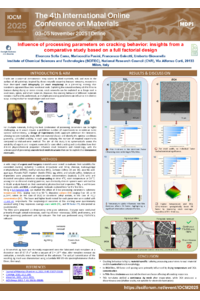
Cracks in materials and thin films are traditionally regarded as defects to be avoided; however, emerging research highlights how controlled cracking can be exploited as a design tool in electronics, optics, and smart materials. In this study, we explored a broad set of materials to assess their suitability for controlled cracking, including D-sorbitol, deoxycholic acid (DCA), chitosan, hydroxypropyl methylcellulose (HPMC), methyl cellulose, Carbopol, ascorbic acid, agar-agar, titanium dioxide (TiO₂), Pluronic F127, egg white, and soluble coffee, tested under various processing conditions. Among those showing reproducible cracking, two chemically distinct representatives were selected for detailed investigation based on contrasting physicochemical properties: TiO₂, a well-established inorganic oxide, and DCA, a small organic molecule explored here for the first time. This contrast enables a comprehensive assessment of material-dependent cracking mechanisms across a broader chemical spectrum.
Using a 2³ full factorial Design of Experiments (DoE), we explored the effects of substrate temperature (X1) ranging from 4 to 50 °C, deposited volume (X2) ranging from 15 to 40 μL/cm2, and solute (in the case of DCA) or co-solvent (in the case of TiO2) concentration (X3) on cracking behavior, having each tested at two levels (−1: low, +1: high). The films were prepared via drop-casting onto glass substrates and evaluated based on two quantitative metrics: average crack width and fill factor (cracked area fraction). Analyses were performed mainly through optical microscopy, scanning electron microscopy (SEM), image processing, and profilometry.
Results reveal strong material-dependent responses. In DCA films, fill factor and spacing were primarily influenced by drying temperature and DCA concentration. In TiO₂ films, thickness was instead the dominant factor affecting all cracking responses. These findings establish a foundation for predictive modeling of crack behavior, enabling the deliberate tuning of crack morphology through processing parameters to meet the specific requirements of targeted applications.
Keywords
crack template
thin films
drop casting
design of experiment
Poster
Cama_poster IOCM 2025.pdf
Voltammetric Platform for Real-Time Creatinine Monitoring in Clinical Applications
Mechanical spectroscopy of polyurethane-based polymers for orthodontic aligners