Event submissions
Published
This submission belongs to the session S1. Optical, Electric and Magnetic Materials and Their Characterization of the event The 4th International Online Conference on Materials
Published date
29 Oct, 2025
Academic Editor
'%3e%3cpath%20d='M12.6657%2010.9104C12.4185%2010.325%2012.0599%209.79327%2011.6097%209.34482C11.1609%208.89508%2010.6293%208.5365%2010.0442%208.28888C10.0389%208.28626%2010.0337%208.28495%2010.0285%208.28233C10.8446%207.69279%2011.3752%206.73249%2011.3752%205.64904C11.3752%203.8542%209.92103%202.39999%208.1262%202.39999C6.33136%202.39999%204.87715%203.8542%204.87715%205.64904C4.87715%206.73249%205.40774%207.69279%206.22393%208.28364C6.21869%208.28626%206.21345%208.28757%206.20821%208.29019C5.62129%208.5378%205.09463%208.89284%204.64265%209.34613C4.1929%209.79493%203.83432%2010.3266%203.58671%2010.9117C3.34345%2011.4845%203.21226%2012.0987%203.20023%2012.7209C3.19988%2012.7349%203.20233%2012.7488%203.20744%2012.7619C3.21255%2012.7749%203.22022%2012.7867%203.22998%2012.7968C3.23975%2012.8068%203.25142%2012.8147%203.26431%2012.8202C3.2772%2012.8256%203.29105%2012.8284%203.30504%2012.8284H4.09109C4.14874%2012.8284%204.19459%2012.7825%204.1959%2012.7262C4.2221%2011.7148%204.62823%2010.7676%205.34617%2010.0497C6.08899%209.30683%207.0755%208.89808%208.1262%208.89808C9.17689%208.89808%2010.1634%209.30683%2010.9062%2010.0497C11.6242%2010.7676%2012.0303%2011.7148%2012.0565%2012.7262C12.0578%2012.7838%2012.1037%2012.8284%2012.1613%2012.8284H12.9474C12.9613%2012.8284%2012.9752%2012.8256%2012.9881%2012.8202C13.001%2012.8147%2013.0126%2012.8068%2013.0224%2012.7968C13.0322%2012.7867%2013.0398%2012.7749%2013.0449%2012.7619C13.0501%2012.7488%2013.0525%2012.7349%2013.0522%2012.7209C13.0391%2012.0947%2012.9094%2011.4855%2012.6657%2010.9104ZM8.1262%207.9024C7.52486%207.9024%206.9589%207.6679%206.53312%207.24211C6.10733%206.81633%205.87283%206.25037%205.87283%205.64904C5.87283%205.0477%206.10733%204.48174%206.53312%204.05596C6.9589%203.63018%207.52486%203.39567%208.1262%203.39567C8.72753%203.39567%209.29349%203.63018%209.71927%204.05596C10.1451%204.48174%2010.3796%205.0477%2010.3796%205.64904C10.3796%206.25037%2010.1451%206.81633%209.71927%207.24211C9.29349%207.6679%208.72753%207.9024%208.1262%207.9024Z'%20fill='%235D1EE1'/%3e%3c/g%3e%3c/svg%3e) Weili Zhang
Weili ZhangCitation
Umer Draz, Tailoring Structural and Optical Properties of Metal-Doped ZnO Nanoparticles for Next-Generation Optoelectronic and Consumer Applications, in Proceedings of The 4th International Online Conference on Materials, 3 November–6 November 2025, MDPI: Basel, Switzerland
Share
Email
Facebook
Twitter
LinkedIn
Tailoring Structural and Optical Properties of Metal-Doped ZnO Nanoparticles for Next-Generation Optoelectronic and Consumer Applications

Umer Draz 1
1. Department of Civil, Chemical and Environmental Engineering - DICCA, University of Genoa, 16145, ITALY
Abstract
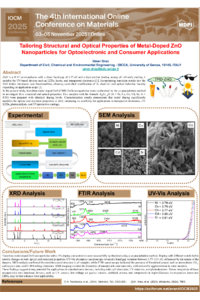
Metal-doped ZnO nanoparticles were prepared using the co-precipitation synthesis method to analyze their optical and structural properties. Five different samples with the formula AXZn1-XO (where A = Ni, Cu, Co, Cd, Sr, and X = 0.01) were prepared by using the same doping concentration. X-ray diffraction (XRD) measurement confirmed that all prepared samples maintained a single-phase structure without having any secondary oxide peaks. Fourier-transform infrared (FTIR) spectroscopy showed the presence of functional groups such as carboxylate, zinc carboxylate, and hydroxide. The surface morphology of the samples was examined using scanning electron microscopy (SEM), which revealed the formation of both nanoparticles and nanorods. The particle sizes were approximately in the range of 50 nm and varied depending on the dopant used. The optical properties, particularly the electronic and optical band gaps, were analyzed using UV-Visible absorption spectroscopy and Tauc plots. It was calculated that the band gap increased from 3.37 eV in pure ZnO to about ~3.8 eV in the doped samples, depending on the dopant. These results suggest that the type of metal dopant has a significant impact on the optical behavior of ZnO. The doped ZnO nanoparticles demonstrate promising potential for use in various applications, including transparent electronics, UV LEDs and lasers, UV-blocking coatings, photocatalysis, and consumer products such as sunblock and sunglasses.
Keywords
Metal-doping
Nanostructures
Bandgap
Photocatalysis
Optoelectronics
Poster
Poster Umer MDPI Material.pdf
Antibacterial and Functional Enhancement of Layer-by-Layer Assembled Organic Multilayer Thin Films
Raman spectroscopy to evaluate thermomechanical local stress: three case study examples for electronic integrated circuits