Event submissions
Published
This submission belongs to the session S3. Soft Matter, Biomaterials, Composites and Interfaces of the event The 4th International Online Conference on Materials
Published date
29 Oct, 2025
Academic Editor
'%3e%3cpath%20d='M12.6657%2010.9104C12.4185%2010.325%2012.0599%209.79327%2011.6097%209.34482C11.1609%208.89508%2010.6293%208.5365%2010.0442%208.28888C10.0389%208.28626%2010.0337%208.28495%2010.0285%208.28233C10.8446%207.69279%2011.3752%206.73249%2011.3752%205.64904C11.3752%203.8542%209.92103%202.39999%208.1262%202.39999C6.33136%202.39999%204.87715%203.8542%204.87715%205.64904C4.87715%206.73249%205.40774%207.69279%206.22393%208.28364C6.21869%208.28626%206.21345%208.28757%206.20821%208.29019C5.62129%208.5378%205.09463%208.89284%204.64265%209.34613C4.1929%209.79493%203.83432%2010.3266%203.58671%2010.9117C3.34345%2011.4845%203.21226%2012.0987%203.20023%2012.7209C3.19988%2012.7349%203.20233%2012.7488%203.20744%2012.7619C3.21255%2012.7749%203.22022%2012.7867%203.22998%2012.7968C3.23975%2012.8068%203.25142%2012.8147%203.26431%2012.8202C3.2772%2012.8256%203.29105%2012.8284%203.30504%2012.8284H4.09109C4.14874%2012.8284%204.19459%2012.7825%204.1959%2012.7262C4.2221%2011.7148%204.62823%2010.7676%205.34617%2010.0497C6.08899%209.30683%207.0755%208.89808%208.1262%208.89808C9.17689%208.89808%2010.1634%209.30683%2010.9062%2010.0497C11.6242%2010.7676%2012.0303%2011.7148%2012.0565%2012.7262C12.0578%2012.7838%2012.1037%2012.8284%2012.1613%2012.8284H12.9474C12.9613%2012.8284%2012.9752%2012.8256%2012.9881%2012.8202C13.001%2012.8147%2013.0126%2012.8068%2013.0224%2012.7968C13.0322%2012.7867%2013.0398%2012.7749%2013.0449%2012.7619C13.0501%2012.7488%2013.0525%2012.7349%2013.0522%2012.7209C13.0391%2012.0947%2012.9094%2011.4855%2012.6657%2010.9104ZM8.1262%207.9024C7.52486%207.9024%206.9589%207.6679%206.53312%207.24211C6.10733%206.81633%205.87283%206.25037%205.87283%205.64904C5.87283%205.0477%206.10733%204.48174%206.53312%204.05596C6.9589%203.63018%207.52486%203.39567%208.1262%203.39567C8.72753%203.39567%209.29349%203.63018%209.71927%204.05596C10.1451%204.48174%2010.3796%205.0477%2010.3796%205.64904C10.3796%206.25037%2010.1451%206.81633%209.71927%207.24211C9.29349%207.6679%208.72753%207.9024%208.1262%207.9024Z'%20fill='%235D1EE1'/%3e%3c/g%3e%3c/svg%3e) Ingo Dierking
Ingo DierkingCitation
Selene Libertad Rodríguez López, Flor Cecilia Sánchez Vargas, Cecilio Santos Hernandez, Salvador Ivan Garduño Vertiz, Félix Sánchez De Jesús, Ana María Bolarín Miró, María Del Pilar Gutiérrez Amador, María Isabel Reyes Valderrama, Synthesis and characterization of Cu-Ni bimetallic system for its potential application in glucose biosensors, in Proceedings of The 4th International Online Conference on Materials, 3 November–6 November 2025, MDPI: Basel, Switzerland
Share
Email
Facebook
Twitter
LinkedIn
Synthesis and characterization of Cu-Ni bimetallic system for its potential application in glucose biosensors
'%3e%3cpath%20d='M12.6647%2010.9104C12.4176%2010.325%2012.0589%209.7933%2011.6088%209.34485C11.16%208.89511%2010.6283%208.53653%2010.0432%208.28891C10.038%208.28629%2010.0327%208.28498%2010.0275%208.28236C10.8437%207.69282%2011.3743%206.73252%2011.3743%205.64907C11.3743%203.85423%209.92005%202.40002%208.12522%202.40002C6.33038%202.40002%204.87618%203.85423%204.87618%205.64907C4.87618%206.73252%205.40677%207.69282%206.22296%208.28367C6.21772%208.28629%206.21248%208.2876%206.20724%208.29022C5.62031%208.53783%205.09365%208.89287%204.64167%209.34616C4.19192%209.79496%203.83334%2010.3266%203.58573%2010.9117C3.34247%2011.4846%203.21128%2012.0987%203.19925%2012.721C3.1989%2012.735%203.20135%2012.7489%203.20646%2012.7619C3.21157%2012.7749%203.21924%2012.7868%203.22901%2012.7968C3.23877%2012.8068%203.25045%2012.8148%203.26334%2012.8202C3.27623%2012.8256%203.29007%2012.8284%203.30406%2012.8284H4.09012C4.14776%2012.8284%204.19362%2012.7825%204.19493%2012.7262C4.22113%2011.7148%204.62726%2010.7676%205.34519%2010.0497C6.08802%209.30686%207.07452%208.89811%208.12522%208.89811C9.17592%208.89811%2010.1624%209.30686%2010.9052%2010.0497C11.6232%2010.7676%2012.0293%2011.7148%2012.0555%2012.7262C12.0568%2012.7839%2012.1027%2012.8284%2012.1603%2012.8284H12.9464C12.9604%2012.8284%2012.9742%2012.8256%2012.9871%2012.8202C13%2012.8148%2013.0117%2012.8068%2013.0214%2012.7968C13.0312%2012.7868%2013.0389%2012.7749%2013.044%2012.7619C13.0491%2012.7489%2013.0515%2012.735%2013.0512%2012.721C13.0381%2012.0947%2012.9084%2011.4856%2012.6647%2010.9104ZM8.12522%207.90243C7.52388%207.90243%206.95792%207.66793%206.53214%207.24215C6.10636%206.81636%205.87185%206.2504%205.87185%205.64907C5.87185%205.04773%206.10636%204.48177%206.53214%204.05599C6.95792%203.63021%207.52388%203.3957%208.12522%203.3957C8.72655%203.3957%209.29252%203.63021%209.7183%204.05599C10.1441%204.48177%2010.3786%205.04773%2010.3786%205.64907C10.3786%206.2504%2010.1441%206.81636%209.7183%207.24215C9.29252%207.66793%208.72655%207.90243%208.12522%207.90243Z'%20fill='%235D1EE1'/%3e%3c/g%3e%3c/svg%3e)
Selene Libertad Rodríguez López 1
Flor Cecilia Sánchez Vargas 1
Cecilio Santos Hernandez 1
Salvador Ivan Garduño Vertiz 2
Félix Sánchez De Jesús 1
Ana María Bolarín Miró 1
María Del Pilar Gutiérrez Amador 3
María Isabel Reyes Valderrama 1
1. Academic Area of Earth Sciences and Materials, Autonomous University of Hidalgo State, Carretera Pachuca-Tulancingo Km. 4.5, Ciudad del Conocimiento, Mineral de la Reforma 42184, Hidalgo, México.
2. Researcher for Mexico, SECIHTI–UAEH, Academic Area of Earth Sciences and Materials, Autonomous University of Hidalgo State, Carretera Pachuca-Tulancingo Km. 4.5, Ciudad del Conocimiento, Mineral de la Reforma 42184, Hidalgo, México.
3. Apan High School, Autonomous University of Hidalgo State, Chimalpa Tlalayote, Municipio de Apan, Hidalgo, México.
Abstract
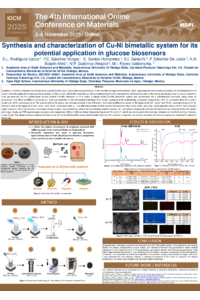
Diabetes is a chronic disease that has become a global health issue. Due to the annual increase in the number of diagnosed patients, there is growing interest in research works and the development of novel materials applicable to glucose biodetection. In this context, bimetallic materials are being implemented in the improvement of biosensors due to the enhanced physical and chemical properties that are provided by the combination of two related metallic elements. In this study, a copper–nickel (Cu-Ni) bimetallic system was synthesized via a hydrothermal approach, using them as precursors. The effect on different physical and chemical properties of the pH variation between 5 to 10 was evaluated while maintaining a constant temperature (140 °C), a reaction time (6 h), and a molar rate of the precursors (1:1). The synthesized Cu-Ni system was characterized by X-ray diffraction, determining diffraction peaks at 2θ angles of 44.33°, 51.62° and 76.31°, corresponding to the Ni element, and at 2θ angles of 43.34°, 50.47° and 74.23°, associated with Cu. The diffraction peaks of both metals correspond to the (111), (200), and (220) crystallographic planes of the face-centered cubic structure. Scanning electron microscopy characterzation was carried out, where the morphology analysis showed bar- and sphere-shaped particles for the bimetallic synthesized within the varied pH range. Finally, an FTIR spectroscopy analysis in the range from 400 to 4,000 exhibited absorption bands at 470 and 517, which are attributed to the bending vibrations of the Ni-O and Cu-O bonds, respectively. The obtained results support the formation of the Cu-Ni bimetallic system and provide evidence of its suitable properties for use as a receptor element in a capacitive biosensor for glucose detection.
Keywords
Bimetallic
hydrothermal
Biosensor
Copper
Nickel
Poster
selene.pdf
Influence of printing and post-treatment parameters on the mechanical properties of a dental resin
Switching effect initiated by changing the boundary conditions of the metal/polymer interface