Event submissions
Published
This submission belongs to the session S3. Soft Matter, Biomaterials, Composites and Interfaces of the event The 4th International Online Conference on Materials
Published date
29 Oct, 2025
Academic Editor
'%3e%3cpath%20d='M12.6657%2010.9104C12.4185%2010.325%2012.0599%209.79327%2011.6097%209.34482C11.1609%208.89508%2010.6293%208.5365%2010.0442%208.28888C10.0389%208.28626%2010.0337%208.28495%2010.0285%208.28233C10.8446%207.69279%2011.3752%206.73249%2011.3752%205.64904C11.3752%203.8542%209.92103%202.39999%208.1262%202.39999C6.33136%202.39999%204.87715%203.8542%204.87715%205.64904C4.87715%206.73249%205.40774%207.69279%206.22393%208.28364C6.21869%208.28626%206.21345%208.28757%206.20821%208.29019C5.62129%208.5378%205.09463%208.89284%204.64265%209.34613C4.1929%209.79493%203.83432%2010.3266%203.58671%2010.9117C3.34345%2011.4845%203.21226%2012.0987%203.20023%2012.7209C3.19988%2012.7349%203.20233%2012.7488%203.20744%2012.7619C3.21255%2012.7749%203.22022%2012.7867%203.22998%2012.7968C3.23975%2012.8068%203.25142%2012.8147%203.26431%2012.8202C3.2772%2012.8256%203.29105%2012.8284%203.30504%2012.8284H4.09109C4.14874%2012.8284%204.19459%2012.7825%204.1959%2012.7262C4.2221%2011.7148%204.62823%2010.7676%205.34617%2010.0497C6.08899%209.30683%207.0755%208.89808%208.1262%208.89808C9.17689%208.89808%2010.1634%209.30683%2010.9062%2010.0497C11.6242%2010.7676%2012.0303%2011.7148%2012.0565%2012.7262C12.0578%2012.7838%2012.1037%2012.8284%2012.1613%2012.8284H12.9474C12.9613%2012.8284%2012.9752%2012.8256%2012.9881%2012.8202C13.001%2012.8147%2013.0126%2012.8068%2013.0224%2012.7968C13.0322%2012.7867%2013.0398%2012.7749%2013.0449%2012.7619C13.0501%2012.7488%2013.0525%2012.7349%2013.0522%2012.7209C13.0391%2012.0947%2012.9094%2011.4855%2012.6657%2010.9104ZM8.1262%207.9024C7.52486%207.9024%206.9589%207.6679%206.53312%207.24211C6.10733%206.81633%205.87283%206.25037%205.87283%205.64904C5.87283%205.0477%206.10733%204.48174%206.53312%204.05596C6.9589%203.63018%207.52486%203.39567%208.1262%203.39567C8.72753%203.39567%209.29349%203.63018%209.71927%204.05596C10.1451%204.48174%2010.3796%205.0477%2010.3796%205.64904C10.3796%206.25037%2010.1451%206.81633%209.71927%207.24211C9.29349%207.6679%208.72753%207.9024%208.1262%207.9024Z'%20fill='%235D1EE1'/%3e%3c/g%3e%3c/svg%3e) Ingo Dierking
Ingo DierkingCitation
Ha-Yeon Song, Seobeen Jo, Hayeong Seo, JiHun Kim, Jae-In Lee, Se-Jin Choi, Jung-Mi Kim, Genomic and Functional Characterization of a High-Performance MICP Strain for Sustainable Concrete Applications, in Proceedings of The 4th International Online Conference on Materials, 3 November–6 November 2025, MDPI: Basel, Switzerland
Share
Email
Facebook
Twitter
LinkedIn
Genomic and Functional Characterization of a High-Performance MICP Strain for Sustainable Concrete Applications
'%3e%3cpath%20d='M12.6647%2010.9104C12.4176%2010.325%2012.0589%209.7933%2011.6088%209.34485C11.16%208.89511%2010.6283%208.53653%2010.0432%208.28891C10.038%208.28629%2010.0327%208.28498%2010.0275%208.28236C10.8437%207.69282%2011.3743%206.73252%2011.3743%205.64907C11.3743%203.85423%209.92005%202.40002%208.12522%202.40002C6.33038%202.40002%204.87618%203.85423%204.87618%205.64907C4.87618%206.73252%205.40677%207.69282%206.22296%208.28367C6.21772%208.28629%206.21248%208.2876%206.20724%208.29022C5.62031%208.53783%205.09365%208.89287%204.64167%209.34616C4.19192%209.79496%203.83334%2010.3266%203.58573%2010.9117C3.34247%2011.4846%203.21128%2012.0987%203.19925%2012.721C3.1989%2012.735%203.20135%2012.7489%203.20646%2012.7619C3.21157%2012.7749%203.21924%2012.7868%203.22901%2012.7968C3.23877%2012.8068%203.25045%2012.8148%203.26334%2012.8202C3.27623%2012.8256%203.29007%2012.8284%203.30406%2012.8284H4.09012C4.14776%2012.8284%204.19362%2012.7825%204.19493%2012.7262C4.22113%2011.7148%204.62726%2010.7676%205.34519%2010.0497C6.08802%209.30686%207.07452%208.89811%208.12522%208.89811C9.17592%208.89811%2010.1624%209.30686%2010.9052%2010.0497C11.6232%2010.7676%2012.0293%2011.7148%2012.0555%2012.7262C12.0568%2012.7839%2012.1027%2012.8284%2012.1603%2012.8284H12.9464C12.9604%2012.8284%2012.9742%2012.8256%2012.9871%2012.8202C13%2012.8148%2013.0117%2012.8068%2013.0214%2012.7968C13.0312%2012.7868%2013.0389%2012.7749%2013.044%2012.7619C13.0491%2012.7489%2013.0515%2012.735%2013.0512%2012.721C13.0381%2012.0947%2012.9084%2011.4856%2012.6647%2010.9104ZM8.12522%207.90243C7.52388%207.90243%206.95792%207.66793%206.53214%207.24215C6.10636%206.81636%205.87185%206.2504%205.87185%205.64907C5.87185%205.04773%206.10636%204.48177%206.53214%204.05599C6.95792%203.63021%207.52388%203.3957%208.12522%203.3957C8.72655%203.3957%209.29252%203.63021%209.7183%204.05599C10.1441%204.48177%2010.3786%205.04773%2010.3786%205.64907C10.3786%206.2504%2010.1441%206.81636%209.7183%207.24215C9.29252%207.66793%208.72655%207.90243%208.12522%207.90243Z'%20fill='%235D1EE1'/%3e%3c/g%3e%3c/svg%3e)
Ha-Yeon Song 1
Seobeen Jo 2
Hayeong Seo 3
JiHun Kim 2
Jae-In Lee 4

Se-Jin Choi 4
Jung-Mi Kim 3
1. Institute of Life Science and Natural Resources, Wonkwang University, Iksan, Jeonbuk, 54538 Republic of Korea
2. Department of Life and Environmental Science, Wonkwang University, Iksan, Jeonbuk, 54538 Republic of Korea
3. Department of Biomedical Materials Science, Wonkwang University, Iksan, Jeonbuk, 54538 Republic of Korea
4. Department of Architectural Engineering, Wonkwang University, Iksan, Jeonbuk, 54538 Republic of Korea
Abstract
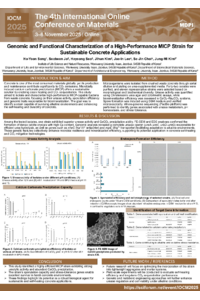
The growing demand for eco-friendly and carbon-neutral concrete technologies has driven interest in microbial solutions for CO₂ sequestration and self-healing properties. Microbially induced calcium carbonate precipitation (MICP) is a promising biomineralization process in which specific microorganisms hydrolyze urea via urease enzymes, increasing pH and promoting calcium carbonate formation. This precipitate fills pores and cracks in concrete, enhancing durability and enabling self-repair. In this study, microorganisms were isolated from waste concrete, yielding a total of 42 isolates. Biological analyses identified 11 distinct strains, from which those with high urease activity or spore-forming ability for alkaline survival were selected. The selected strains were tested in CaCl₂–Na₂CO₃ media, revealing that one strain exhibited the highest biomineralization efficiency. Genomic analysis identified a complete urease gene cluster (ureA–ureC structural genes and ureD, ureE, ureF, ureG maturation genes), with genetic variations influencing ureolytic activity. Additionally, genes such as nhaC, involved in pH homeostasis, and mgtE, regulating Mg²⁺ for membrane stability, were found to contribute to performance in alkaline concrete environments. These functional and genomic insights position the strain as a strong candidate for microbial concrete enhancement. Future work will focus on improving strain viability within concrete and validating its performance in real structures. This research advances sustainable construction materials by enabling enhanced durability, reduced carbon emissions, and the potential for large-scale CO₂ mitigation in the concrete industry.
Keywords
Microbially induced calcium carbonate precipitation
MICP
biomineralization
concrete durability
carbon-neutral construction
urease gene cluster
sustainable building materials
Poster
IOCM 2025 - Ha-Yeon Song.pdf
Titanium dioxide nanotubes as a matrix for tailoring photoactivity and magnetic properties
X-ray luminescence efficiency of a Barium Fluoride (BaF2) single-crystal scintillator: Temperature dependence