Event submissions
Published
This submission belongs to the session S1. Optical, Electric and Magnetic Materials and Their Characterization of the event The 4th International Online Conference on Materials
Published date
29 Oct, 2025
Academic Editor
'%3e%3cpath%20d='M12.6657%2010.9104C12.4185%2010.325%2012.0599%209.79327%2011.6097%209.34482C11.1609%208.89508%2010.6293%208.5365%2010.0442%208.28888C10.0389%208.28626%2010.0337%208.28495%2010.0285%208.28233C10.8446%207.69279%2011.3752%206.73249%2011.3752%205.64904C11.3752%203.8542%209.92103%202.39999%208.1262%202.39999C6.33136%202.39999%204.87715%203.8542%204.87715%205.64904C4.87715%206.73249%205.40774%207.69279%206.22393%208.28364C6.21869%208.28626%206.21345%208.28757%206.20821%208.29019C5.62129%208.5378%205.09463%208.89284%204.64265%209.34613C4.1929%209.79493%203.83432%2010.3266%203.58671%2010.9117C3.34345%2011.4845%203.21226%2012.0987%203.20023%2012.7209C3.19988%2012.7349%203.20233%2012.7488%203.20744%2012.7619C3.21255%2012.7749%203.22022%2012.7867%203.22998%2012.7968C3.23975%2012.8068%203.25142%2012.8147%203.26431%2012.8202C3.2772%2012.8256%203.29105%2012.8284%203.30504%2012.8284H4.09109C4.14874%2012.8284%204.19459%2012.7825%204.1959%2012.7262C4.2221%2011.7148%204.62823%2010.7676%205.34617%2010.0497C6.08899%209.30683%207.0755%208.89808%208.1262%208.89808C9.17689%208.89808%2010.1634%209.30683%2010.9062%2010.0497C11.6242%2010.7676%2012.0303%2011.7148%2012.0565%2012.7262C12.0578%2012.7838%2012.1037%2012.8284%2012.1613%2012.8284H12.9474C12.9613%2012.8284%2012.9752%2012.8256%2012.9881%2012.8202C13.001%2012.8147%2013.0126%2012.8068%2013.0224%2012.7968C13.0322%2012.7867%2013.0398%2012.7749%2013.0449%2012.7619C13.0501%2012.7488%2013.0525%2012.7349%2013.0522%2012.7209C13.0391%2012.0947%2012.9094%2011.4855%2012.6657%2010.9104ZM8.1262%207.9024C7.52486%207.9024%206.9589%207.6679%206.53312%207.24211C6.10733%206.81633%205.87283%206.25037%205.87283%205.64904C5.87283%205.0477%206.10733%204.48174%206.53312%204.05596C6.9589%203.63018%207.52486%203.39567%208.1262%203.39567C8.72753%203.39567%209.29349%203.63018%209.71927%204.05596C10.1451%204.48174%2010.3796%205.0477%2010.3796%205.64904C10.3796%206.25037%2010.1451%206.81633%209.71927%207.24211C9.29349%207.6679%208.72753%207.9024%208.1262%207.9024Z'%20fill='%235D1EE1'/%3e%3c/g%3e%3c/svg%3e) Weili Zhang
Weili ZhangCitation
Roman Mukhachev, Alexey Lukoyanov, Magnetic ordering and electronic structure of GdRhIn, in Proceedings of The 4th International Online Conference on Materials, 3 November–6 November 2025, MDPI: Basel, Switzerland
Share
Email
Facebook
Twitter
LinkedIn
Magnetic ordering and electronic structure of GdRhIn

Roman Mukhachev 1

Alexey Lukoyanov 1,2
1. M.N. Mikheev Institute of Metal Physics of Ural Branch of Russian Academy of Sciences, 620108 Yekaterinburg, Russia
2. Ural Federal University named after the first President of Russia B.N. Yeltsin, 620002 Yekaterinburg, Russia
Abstract
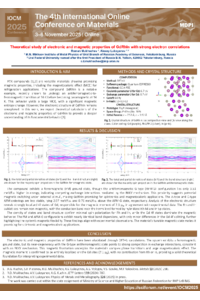
In recent decades, ternary intermetallic compounds of the equiatomic RTX-type, which are composed of a rare earth, a transition metal and a p-element, have been studied intensively due to a variety of possible chemical compositions, crystal structure types and outstanding physical properties. Our study presents a theoretical investigation of the electronic and magnetic properties of the intermetallic compound GdRhIn using the DFT+U method. Strong electron correlations in the 4f shell of gadolinium were accounted for using the GGA+U approach, with structural optimization confirming a hexagonal Fe₂P-type lattice and equilibrium parameters. The compound exhibits a ferromagnetic (FM) ground state, though the antiferromagnetic G-type (AFM-G) configuration lies only 3.51 meV/f.u. higher in energy, indicating competing exchange interactions mediated by the RKKY mechanism. This proximity suggests potential magnetic switching under external stimuli, making GdRhIn promising for spintronics and magnetocaloric applications. The A-type and C-type AFM orderings are less stable, lying 2.97 meV/f.u. and 0.76 meV/f.u. above the AFM-G state, respectively. Analysis of the electronic structure reveals strongly localized 4f states of Gd, responsible for the magnetic moment of 7.1 μB, in agreement with experimental data. The Rh and In sublattices remain non-magnetic, with the conduction band near the Fermi level formed by hybridized Rh 4d and In 5p states. The density of states and band structure confirm minimal spin polarization for Rh and In, while the Gd 4f states dominate the magnetic behavior. The FM and AFM-G configurations exhibit nearly identical band dispersions, with only minor differences in the Gd 4f splitting, further highlighting the system’s magnetic flexibility. These findings align with experimental observations. The material’s tunable magnetic state makes it promising for spintronic and magnetocaloric applications. This work was supported by the state assignment of the Ministry of Science and Higher Education of the Russian Federation for IMP UrB RAS.
Keywords
magnetic ordering
electronic structure
intermetallics
Poster
IOCM_poster Roman.pdf
Relationship between biopolymer properties
Investigating the 8CB Liquid Crystal–Insulin Interaction: The Role of the Smectic A Phase in Enhancing Detection Sensitivity