Event submissions
Published
This submission belongs to the session S1. Optical, Electric and Magnetic Materials and Their Characterization of the event The 4th International Online Conference on Materials
Published date
29 Oct, 2025
Academic Editor
'%3e%3cpath%20d='M12.6657%2010.9104C12.4185%2010.325%2012.0599%209.79327%2011.6097%209.34482C11.1609%208.89508%2010.6293%208.5365%2010.0442%208.28888C10.0389%208.28626%2010.0337%208.28495%2010.0285%208.28233C10.8446%207.69279%2011.3752%206.73249%2011.3752%205.64904C11.3752%203.8542%209.92103%202.39999%208.1262%202.39999C6.33136%202.39999%204.87715%203.8542%204.87715%205.64904C4.87715%206.73249%205.40774%207.69279%206.22393%208.28364C6.21869%208.28626%206.21345%208.28757%206.20821%208.29019C5.62129%208.5378%205.09463%208.89284%204.64265%209.34613C4.1929%209.79493%203.83432%2010.3266%203.58671%2010.9117C3.34345%2011.4845%203.21226%2012.0987%203.20023%2012.7209C3.19988%2012.7349%203.20233%2012.7488%203.20744%2012.7619C3.21255%2012.7749%203.22022%2012.7867%203.22998%2012.7968C3.23975%2012.8068%203.25142%2012.8147%203.26431%2012.8202C3.2772%2012.8256%203.29105%2012.8284%203.30504%2012.8284H4.09109C4.14874%2012.8284%204.19459%2012.7825%204.1959%2012.7262C4.2221%2011.7148%204.62823%2010.7676%205.34617%2010.0497C6.08899%209.30683%207.0755%208.89808%208.1262%208.89808C9.17689%208.89808%2010.1634%209.30683%2010.9062%2010.0497C11.6242%2010.7676%2012.0303%2011.7148%2012.0565%2012.7262C12.0578%2012.7838%2012.1037%2012.8284%2012.1613%2012.8284H12.9474C12.9613%2012.8284%2012.9752%2012.8256%2012.9881%2012.8202C13.001%2012.8147%2013.0126%2012.8068%2013.0224%2012.7968C13.0322%2012.7867%2013.0398%2012.7749%2013.0449%2012.7619C13.0501%2012.7488%2013.0525%2012.7349%2013.0522%2012.7209C13.0391%2012.0947%2012.9094%2011.4855%2012.6657%2010.9104ZM8.1262%207.9024C7.52486%207.9024%206.9589%207.6679%206.53312%207.24211C6.10733%206.81633%205.87283%206.25037%205.87283%205.64904C5.87283%205.0477%206.10733%204.48174%206.53312%204.05596C6.9589%203.63018%207.52486%203.39567%208.1262%203.39567C8.72753%203.39567%209.29349%203.63018%209.71927%204.05596C10.1451%204.48174%2010.3796%205.0477%2010.3796%205.64904C10.3796%206.25037%2010.1451%206.81633%209.71927%207.24211C9.29349%207.6679%208.72753%207.9024%208.1262%207.9024Z'%20fill='%235D1EE1'/%3e%3c/g%3e%3c/svg%3e) Weili Zhang
Weili ZhangCitation
Muhammad Aminu Auwalu, Zhang Yuanwei, PFOS and PFOA Interaction with Organic Chromophore-Bound Serum Albumin, in Proceedings of The 4th International Online Conference on Materials, 3 November–6 November 2025, MDPI: Basel, Switzerland
Share
Email
Facebook
Twitter
LinkedIn
PFOS and PFOA Interaction with Organic Chromophore-Bound Serum Albumin

Muhammad Aminu Auwalu 1

Zhang Yuanwei 1
1. Department of Chemistry and Environmental Science, New Jersey Institute of Technology, Newark, NJ 07102, USA
Abstract
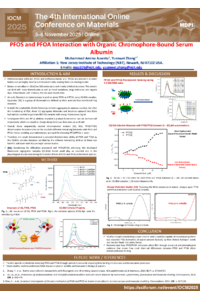
PFOS and PFOA are persistent in nearly all water bodies and are very thermally and chemically stable, making them non-biodegradable and posing health risks. When bound with proteins, this relationship can affect human health. Several detection methods involving gas chromatography, mass spectrometry, and other PFOS detection procedures are time-consuming and require expensive instrumentation. Consequently, fluorescence spectroscopy was used to quantify PFOS by utilizing an SQ-BSA complex based on the sulfonated-squaraine dye (SQ) absorption and fluorescence properties. The SQ dye (blue-solid) was prepared by reacting with squaric acid and the synthesis of 3-(2-Methylbenzo[D]Thiazol-3-ium-3-yl)-propane-1-sulfonate in a Dean-Stark apparatus containing 5 mL of anhydrous pyridine, 4 mL of n-butanol, and 4 mL of toluene. The system was refluxed at 175°C for 5 hours, after which the reaction mixture was purified via recrystallization in methanol twice and then finally characterized by 1H NMR. It interacted with bovine serum albumin (BSA) to form the SQ-BSA complex, which was then investigated separately and showed fluorescence turn-on. The complex emission continuously increases as the BSA concentration rises, accompanied by a corresponding wavelength shift from 640 nm to 660 nm due to a non-covalent interaction. However, subsequent PFOS and PFOA additions revealed a gradual fluorescence turn-on and turn-off, respectively, which continued to increase along these two directions up to a 20 µM concentration. Overall, the detection of these sequentially studied tri-component systems (SQ, BSA, PFOS/PFOA) relies on the different interacting behaviors of SQ with PFOS and PFOA, thereby providing a complementary approach for detecting PFOS and PFOA in water. Therefore, the demonstrated very strong discrimination ability of PFOS and PFOA by the SQ-BSA complex becomes ascribed to the obviously known differing interacting abilities of these two harmful pollutants with BSA amongst various studies.
Keywords
squaraine dye
BSA
PFOS and PFOA
fluorescence
circular dichroism.
Poster
IOCM 2025 - poster template 2.pdf
Investigating the 8CB Liquid Crystal–Insulin Interaction: The Role of the Smectic A Phase in Enhancing Detection Sensitivity
Spin transitions of [FeII(phen)2(NCS)2] spin crossover complex in ethylene glycol matrix