Event submissions
Published
This submission belongs to the session S1. Optical, Electric and Magnetic Materials and Their Characterization of the event The 4th International Online Conference on Materials
Published date
29 Oct, 2025
Academic Editor
'%3e%3cpath%20d='M12.6657%2010.9104C12.4185%2010.325%2012.0599%209.79327%2011.6097%209.34482C11.1609%208.89508%2010.6293%208.5365%2010.0442%208.28888C10.0389%208.28626%2010.0337%208.28495%2010.0285%208.28233C10.8446%207.69279%2011.3752%206.73249%2011.3752%205.64904C11.3752%203.8542%209.92103%202.39999%208.1262%202.39999C6.33136%202.39999%204.87715%203.8542%204.87715%205.64904C4.87715%206.73249%205.40774%207.69279%206.22393%208.28364C6.21869%208.28626%206.21345%208.28757%206.20821%208.29019C5.62129%208.5378%205.09463%208.89284%204.64265%209.34613C4.1929%209.79493%203.83432%2010.3266%203.58671%2010.9117C3.34345%2011.4845%203.21226%2012.0987%203.20023%2012.7209C3.19988%2012.7349%203.20233%2012.7488%203.20744%2012.7619C3.21255%2012.7749%203.22022%2012.7867%203.22998%2012.7968C3.23975%2012.8068%203.25142%2012.8147%203.26431%2012.8202C3.2772%2012.8256%203.29105%2012.8284%203.30504%2012.8284H4.09109C4.14874%2012.8284%204.19459%2012.7825%204.1959%2012.7262C4.2221%2011.7148%204.62823%2010.7676%205.34617%2010.0497C6.08899%209.30683%207.0755%208.89808%208.1262%208.89808C9.17689%208.89808%2010.1634%209.30683%2010.9062%2010.0497C11.6242%2010.7676%2012.0303%2011.7148%2012.0565%2012.7262C12.0578%2012.7838%2012.1037%2012.8284%2012.1613%2012.8284H12.9474C12.9613%2012.8284%2012.9752%2012.8256%2012.9881%2012.8202C13.001%2012.8147%2013.0126%2012.8068%2013.0224%2012.7968C13.0322%2012.7867%2013.0398%2012.7749%2013.0449%2012.7619C13.0501%2012.7488%2013.0525%2012.7349%2013.0522%2012.7209C13.0391%2012.0947%2012.9094%2011.4855%2012.6657%2010.9104ZM8.1262%207.9024C7.52486%207.9024%206.9589%207.6679%206.53312%207.24211C6.10733%206.81633%205.87283%206.25037%205.87283%205.64904C5.87283%205.0477%206.10733%204.48174%206.53312%204.05596C6.9589%203.63018%207.52486%203.39567%208.1262%203.39567C8.72753%203.39567%209.29349%203.63018%209.71927%204.05596C10.1451%204.48174%2010.3796%205.0477%2010.3796%205.64904C10.3796%206.25037%2010.1451%206.81633%209.71927%207.24211C9.29349%207.6679%208.72753%207.9024%208.1262%207.9024Z'%20fill='%235D1EE1'/%3e%3c/g%3e%3c/svg%3e) Weili Zhang
Weili ZhangCitation
Cleyton Moreira, Daniela Santos, Michelle Mothé, Maria Marques, Photophysical investigation of furanyl-substituted PVK derivatives: Substitution Effects, Aggregation Behavior, and Solid-State Emission, in Proceedings of The 4th International Online Conference on Materials, 3 November–6 November 2025, MDPI: Basel, Switzerland
Share
Email
Facebook
Twitter
LinkedIn
Photophysical investigation of furanyl-substituted PVK derivatives: Substitution Effects, Aggregation Behavior, and Solid-State Emission
'%3e%3cpath%20d='M12.6647%2010.9104C12.4176%2010.325%2012.0589%209.7933%2011.6088%209.34485C11.16%208.89511%2010.6283%208.53653%2010.0432%208.28891C10.038%208.28629%2010.0327%208.28498%2010.0275%208.28236C10.8437%207.69282%2011.3743%206.73252%2011.3743%205.64907C11.3743%203.85423%209.92005%202.40002%208.12522%202.40002C6.33038%202.40002%204.87618%203.85423%204.87618%205.64907C4.87618%206.73252%205.40677%207.69282%206.22296%208.28367C6.21772%208.28629%206.21248%208.2876%206.20724%208.29022C5.62031%208.53783%205.09365%208.89287%204.64167%209.34616C4.19192%209.79496%203.83334%2010.3266%203.58573%2010.9117C3.34247%2011.4846%203.21128%2012.0987%203.19925%2012.721C3.1989%2012.735%203.20135%2012.7489%203.20646%2012.7619C3.21157%2012.7749%203.21924%2012.7868%203.22901%2012.7968C3.23877%2012.8068%203.25045%2012.8148%203.26334%2012.8202C3.27623%2012.8256%203.29007%2012.8284%203.30406%2012.8284H4.09012C4.14776%2012.8284%204.19362%2012.7825%204.19493%2012.7262C4.22113%2011.7148%204.62726%2010.7676%205.34519%2010.0497C6.08802%209.30686%207.07452%208.89811%208.12522%208.89811C9.17592%208.89811%2010.1624%209.30686%2010.9052%2010.0497C11.6232%2010.7676%2012.0293%2011.7148%2012.0555%2012.7262C12.0568%2012.7839%2012.1027%2012.8284%2012.1603%2012.8284H12.9464C12.9604%2012.8284%2012.9742%2012.8256%2012.9871%2012.8202C13%2012.8148%2013.0117%2012.8068%2013.0214%2012.7968C13.0312%2012.7868%2013.0389%2012.7749%2013.044%2012.7619C13.0491%2012.7489%2013.0515%2012.735%2013.0512%2012.721C13.0381%2012.0947%2012.9084%2011.4856%2012.6647%2010.9104ZM8.12522%207.90243C7.52388%207.90243%206.95792%207.66793%206.53214%207.24215C6.10636%206.81636%205.87185%206.2504%205.87185%205.64907C5.87185%205.04773%206.10636%204.48177%206.53214%204.05599C6.95792%203.63021%207.52388%203.3957%208.12522%203.3957C8.72655%203.3957%209.29252%203.63021%209.7183%204.05599C10.1441%204.48177%2010.3786%205.04773%2010.3786%205.64907C10.3786%206.2504%2010.1441%206.81636%209.7183%207.24215C9.29252%207.66793%208.72655%207.90243%208.12522%207.90243Z'%20fill='%235D1EE1'/%3e%3c/g%3e%3c/svg%3e)
Cleyton Moreira 1
Daniela Santos 1

Michelle Mothé 1

Maria Marques 1
1. Instituto de Macromoleculas Professora Eloisa Mano, IMA, Universidade Federal do Rio de Janeiro, IMA—UFRJ, Av. Horacio Macedo 2030, Rio de Janeiro 21941-598, RJ, Brazil
Abstract
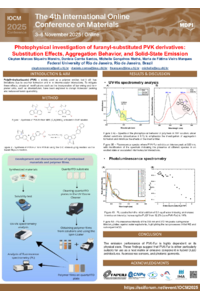
The development of light-emitting polymers for optoelectronic devices requires the fine tuning of photophysical properties in solution and in the solid state. Poly(N-vinylcarbazole) (PVK) is widely used, but its solid-state emission is limited by aggregation-caused quenching (ACQ). This study investigated the effects of chemical substitution with bromine (PVK-Br) and furanyl (PVK-Fur) groups, focusing on emission spectra, aggregation behavior, and photoluminescence quantum yield (PLQY). PVK, PVK-Br, and PVK-Fur were synthesized and characterized in THF solution, as films (pure and with PMMA), and as powdered material. Under UV excitation (285–320 nm), the emission spectra and PLQY were measured, and the effect of aggregation was evaluated by titration with water. In THF, PVK-Fur showed intense emission with a narrower band (smaller FWHM), indicating greater color purity and less environmental disorder. The presence of the furanyl group promoted greater electronic conjugation and delocalization, shifting the emission to the blue region (hypochromic shift) and narrowing the band gap. The addition of small amounts of water (0.1 eq) increased the PLQY from 12.2% to 13.99%, indicating aggregation-induced emission (AIE), attributed to the restriction of intramolecular movements and the suppression of non-radiative pathways. However, larger volumes of water (>5 eq) caused intense aggregation, π–π stacking, and a sharp drop in PLQY, evidencing ACQ. In the solid state, even with PMMA, PVK-Fur showed low emission due to the strong suppression of excitons by aggregation. Thus, PVK-Fur stands out as a promising candidate for fluorescent sensors in aqueous media or microenvironments, where controlled aggregation favors emission.
Keywords
PVK
photoluminescence
furanyl substitution
AIE
ACQ
fluorescent sensors
emissive polymers
Poster
IOCM 2025 - Cleyton_Moreira.pdf
Influence of Pr₆O₁₁ concentration on the thermal, structural, physical and optical behavior of SNW glass systems
Characterization of Biodegradable Films from Holocellulose of Natural Polymers via Electrospinning