Event submissions
Published
This submission belongs to the session S1. Optical, Electric and Magnetic Materials and Their Characterization of the event The 4th International Online Conference on Materials
Published date
29 Oct, 2025
Academic Editor
'%3e%3cpath%20d='M12.6657%2010.9104C12.4185%2010.325%2012.0599%209.79327%2011.6097%209.34482C11.1609%208.89508%2010.6293%208.5365%2010.0442%208.28888C10.0389%208.28626%2010.0337%208.28495%2010.0285%208.28233C10.8446%207.69279%2011.3752%206.73249%2011.3752%205.64904C11.3752%203.8542%209.92103%202.39999%208.1262%202.39999C6.33136%202.39999%204.87715%203.8542%204.87715%205.64904C4.87715%206.73249%205.40774%207.69279%206.22393%208.28364C6.21869%208.28626%206.21345%208.28757%206.20821%208.29019C5.62129%208.5378%205.09463%208.89284%204.64265%209.34613C4.1929%209.79493%203.83432%2010.3266%203.58671%2010.9117C3.34345%2011.4845%203.21226%2012.0987%203.20023%2012.7209C3.19988%2012.7349%203.20233%2012.7488%203.20744%2012.7619C3.21255%2012.7749%203.22022%2012.7867%203.22998%2012.7968C3.23975%2012.8068%203.25142%2012.8147%203.26431%2012.8202C3.2772%2012.8256%203.29105%2012.8284%203.30504%2012.8284H4.09109C4.14874%2012.8284%204.19459%2012.7825%204.1959%2012.7262C4.2221%2011.7148%204.62823%2010.7676%205.34617%2010.0497C6.08899%209.30683%207.0755%208.89808%208.1262%208.89808C9.17689%208.89808%2010.1634%209.30683%2010.9062%2010.0497C11.6242%2010.7676%2012.0303%2011.7148%2012.0565%2012.7262C12.0578%2012.7838%2012.1037%2012.8284%2012.1613%2012.8284H12.9474C12.9613%2012.8284%2012.9752%2012.8256%2012.9881%2012.8202C13.001%2012.8147%2013.0126%2012.8068%2013.0224%2012.7968C13.0322%2012.7867%2013.0398%2012.7749%2013.0449%2012.7619C13.0501%2012.7488%2013.0525%2012.7349%2013.0522%2012.7209C13.0391%2012.0947%2012.9094%2011.4855%2012.6657%2010.9104ZM8.1262%207.9024C7.52486%207.9024%206.9589%207.6679%206.53312%207.24211C6.10733%206.81633%205.87283%206.25037%205.87283%205.64904C5.87283%205.0477%206.10733%204.48174%206.53312%204.05596C6.9589%203.63018%207.52486%203.39567%208.1262%203.39567C8.72753%203.39567%209.29349%203.63018%209.71927%204.05596C10.1451%204.48174%2010.3796%205.0477%2010.3796%205.64904C10.3796%206.25037%2010.1451%206.81633%209.71927%207.24211C9.29349%207.6679%208.72753%207.9024%208.1262%207.9024Z'%20fill='%235D1EE1'/%3e%3c/g%3e%3c/svg%3e) Weili Zhang
Weili ZhangCitation
SURAJ JOSHI, Rajiv Manohar, From Nanotubes to Neuromorphic Networks: Proposing Hybrid SWCNT–Liquid Crystal Materials for Adaptive Photonic and Electro-Optic Devices, in Proceedings of The 4th International Online Conference on Materials, 3 November–6 November 2025, MDPI: Basel, Switzerland
Share
Email
Facebook
Twitter
LinkedIn
From Nanotubes to Neuromorphic Networks: Proposing Hybrid SWCNT–Liquid Crystal Materials for Adaptive Photonic and Electro-Optic Devices
'%3e%3cpath%20d='M12.6647%2010.9104C12.4176%2010.325%2012.0589%209.7933%2011.6088%209.34485C11.16%208.89511%2010.6283%208.53653%2010.0432%208.28891C10.038%208.28629%2010.0327%208.28498%2010.0275%208.28236C10.8437%207.69282%2011.3743%206.73252%2011.3743%205.64907C11.3743%203.85423%209.92005%202.40002%208.12522%202.40002C6.33038%202.40002%204.87618%203.85423%204.87618%205.64907C4.87618%206.73252%205.40677%207.69282%206.22296%208.28367C6.21772%208.28629%206.21248%208.2876%206.20724%208.29022C5.62031%208.53783%205.09365%208.89287%204.64167%209.34616C4.19192%209.79496%203.83334%2010.3266%203.58573%2010.9117C3.34247%2011.4846%203.21128%2012.0987%203.19925%2012.721C3.1989%2012.735%203.20135%2012.7489%203.20646%2012.7619C3.21157%2012.7749%203.21924%2012.7868%203.22901%2012.7968C3.23877%2012.8068%203.25045%2012.8148%203.26334%2012.8202C3.27623%2012.8256%203.29007%2012.8284%203.30406%2012.8284H4.09012C4.14776%2012.8284%204.19362%2012.7825%204.19493%2012.7262C4.22113%2011.7148%204.62726%2010.7676%205.34519%2010.0497C6.08802%209.30686%207.07452%208.89811%208.12522%208.89811C9.17592%208.89811%2010.1624%209.30686%2010.9052%2010.0497C11.6232%2010.7676%2012.0293%2011.7148%2012.0555%2012.7262C12.0568%2012.7839%2012.1027%2012.8284%2012.1603%2012.8284H12.9464C12.9604%2012.8284%2012.9742%2012.8256%2012.9871%2012.8202C13%2012.8148%2013.0117%2012.8068%2013.0214%2012.7968C13.0312%2012.7868%2013.0389%2012.7749%2013.044%2012.7619C13.0491%2012.7489%2013.0515%2012.735%2013.0512%2012.721C13.0381%2012.0947%2012.9084%2011.4856%2012.6647%2010.9104ZM8.12522%207.90243C7.52388%207.90243%206.95792%207.66793%206.53214%207.24215C6.10636%206.81636%205.87185%206.2504%205.87185%205.64907C5.87185%205.04773%206.10636%204.48177%206.53214%204.05599C6.95792%203.63021%207.52388%203.3957%208.12522%203.3957C8.72655%203.3957%209.29252%203.63021%209.7183%204.05599C10.1441%204.48177%2010.3786%205.04773%2010.3786%205.64907C10.3786%206.2504%2010.1441%206.81636%209.7183%207.24215C9.29252%207.66793%208.72655%207.90243%208.12522%207.90243Z'%20fill='%235D1EE1'/%3e%3c/g%3e%3c/svg%3e)
SURAJ JOSHI 1
Rajiv Manohar 1
1. Liquid Crystal Research Laboratory, Department of Physics, University of Lucknow
Abstract
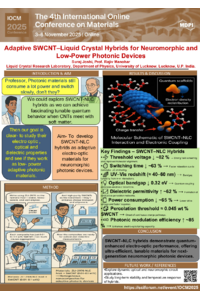
The increasing need for energy-efficient and tunable photonic materials drives the investigation of hybrid systems that integrate the distinctive properties of carbon nanotubes with liquid crystals. Composites made from single-walled carbon nanotubes (SWCNTs) and nematic liquid crystals (NLCs) exhibit multifunctional behaviors that make them highly promising for photonic and electro-optic device applications. This study explores these hybrids and proposes their potential role as adaptive materials for future neuromorphic photonic technologies, based on their enhanced electro-optic and optical characteristics.
SWCNTs were dispersed at low concentrations in a nematic liquid crystal matrix to fabricate hybrid materials. Electro-optic characteristics were assessed by measuring threshold voltage and switching times. Optical behavior was analyzed via UV–Vis absorption spectroscopy, while dielectric spectroscopy was used to investigate conductive percolation networks within the composites.
Compared to pure NLC, the hybrids exhibited an 82% reduction in electro-optic threshold voltage and a 63% acceleration in switching time, indicating improved molecular alignment and reduced energy consumption. UV–Vis spectra showed tunable optical bandgaps with redshifted absorption peaks, evidencing enhanced electronic transitions and ordering. Dielectric studies confirmed the formation of conductive percolation networks above critical SWCNT loadings, significantly increasing charge transport and dielectric permittivity. The observed tunable electro-optic and dielectric responses may be influenced by quantum confinement and charge transport phenomena intrinsic to SWCNTs, supporting their multifunctionality.
SWCNT–NLC hybrids demonstrate ultra-efficient photonic switching and modulation capabilities. Based on their multifunctional electro-optic, optical, and dielectric properties—coupled with their potential quantum mechanical effects—these materials are proposed as promising adaptive platforms for future neuromorphic photonic devices. Their fast responses, low power requirements, and tunability provide a solid scientific foundation for integration into brain-inspired photonic architectures.
Keywords
SWCNT–NLC Hybrids
Electro-Optic Performance
Optical Bandgap Tunability
Conductive Percolation Networks
Neuromorphic Photonic Materials
Poster
Suraj Joshi Poster.pdf
Tunable Plasma-Induced Wrinkle Morphologies on PDMS Thin Films for Functional Surface Engineering
Simulation of a High Sensitive Surface Plasmon Resonance Biosensor for Detection of Biomolecules: effect of metal index