Event submissions
Published
This submission belongs to the session S3. Soft Matter, Biomaterials, Composites and Interfaces of the event The 4th International Online Conference on Materials
Published date
29 Oct, 2025
Academic Editor
'%3e%3cpath%20d='M12.6657%2010.9104C12.4185%2010.325%2012.0599%209.79327%2011.6097%209.34482C11.1609%208.89508%2010.6293%208.5365%2010.0442%208.28888C10.0389%208.28626%2010.0337%208.28495%2010.0285%208.28233C10.8446%207.69279%2011.3752%206.73249%2011.3752%205.64904C11.3752%203.8542%209.92103%202.39999%208.1262%202.39999C6.33136%202.39999%204.87715%203.8542%204.87715%205.64904C4.87715%206.73249%205.40774%207.69279%206.22393%208.28364C6.21869%208.28626%206.21345%208.28757%206.20821%208.29019C5.62129%208.5378%205.09463%208.89284%204.64265%209.34613C4.1929%209.79493%203.83432%2010.3266%203.58671%2010.9117C3.34345%2011.4845%203.21226%2012.0987%203.20023%2012.7209C3.19988%2012.7349%203.20233%2012.7488%203.20744%2012.7619C3.21255%2012.7749%203.22022%2012.7867%203.22998%2012.7968C3.23975%2012.8068%203.25142%2012.8147%203.26431%2012.8202C3.2772%2012.8256%203.29105%2012.8284%203.30504%2012.8284H4.09109C4.14874%2012.8284%204.19459%2012.7825%204.1959%2012.7262C4.2221%2011.7148%204.62823%2010.7676%205.34617%2010.0497C6.08899%209.30683%207.0755%208.89808%208.1262%208.89808C9.17689%208.89808%2010.1634%209.30683%2010.9062%2010.0497C11.6242%2010.7676%2012.0303%2011.7148%2012.0565%2012.7262C12.0578%2012.7838%2012.1037%2012.8284%2012.1613%2012.8284H12.9474C12.9613%2012.8284%2012.9752%2012.8256%2012.9881%2012.8202C13.001%2012.8147%2013.0126%2012.8068%2013.0224%2012.7968C13.0322%2012.7867%2013.0398%2012.7749%2013.0449%2012.7619C13.0501%2012.7488%2013.0525%2012.7349%2013.0522%2012.7209C13.0391%2012.0947%2012.9094%2011.4855%2012.6657%2010.9104ZM8.1262%207.9024C7.52486%207.9024%206.9589%207.6679%206.53312%207.24211C6.10733%206.81633%205.87283%206.25037%205.87283%205.64904C5.87283%205.0477%206.10733%204.48174%206.53312%204.05596C6.9589%203.63018%207.52486%203.39567%208.1262%203.39567C8.72753%203.39567%209.29349%203.63018%209.71927%204.05596C10.1451%204.48174%2010.3796%205.0477%2010.3796%205.64904C10.3796%206.25037%2010.1451%206.81633%209.71927%207.24211C9.29349%207.6679%208.72753%207.9024%208.1262%207.9024Z'%20fill='%235D1EE1'/%3e%3c/g%3e%3c/svg%3e) Ingo Dierking
Ingo DierkingCitation
Ganna Kovtun, Dionisio Rodrigo, Geraldine Mariel Collado, Demetrio Fuentes, Krzysztof Łukowicz, Agnieszka Basta-Kaim, Beata Kaczmarek-Szczepańska, Teresa Cuberes, Structural and Nanomechanical Homogeneity of FDM 3D-Printed PVA Tablets: Drug Incorporation for Controlled Release, in Proceedings of The 4th International Online Conference on Materials, 3 November–6 November 2025, MDPI: Basel, Switzerland
Share
Email
Facebook
Twitter
LinkedIn
Structural and Nanomechanical Homogeneity of FDM 3D-Printed PVA Tablets: Drug Incorporation for Controlled Release
'%3e%3cpath%20d='M12.6647%2010.9104C12.4176%2010.325%2012.0589%209.7933%2011.6088%209.34485C11.16%208.89511%2010.6283%208.53653%2010.0432%208.28891C10.038%208.28629%2010.0327%208.28498%2010.0275%208.28236C10.8437%207.69282%2011.3743%206.73252%2011.3743%205.64907C11.3743%203.85423%209.92005%202.40002%208.12522%202.40002C6.33038%202.40002%204.87618%203.85423%204.87618%205.64907C4.87618%206.73252%205.40677%207.69282%206.22296%208.28367C6.21772%208.28629%206.21248%208.2876%206.20724%208.29022C5.62031%208.53783%205.09365%208.89287%204.64167%209.34616C4.19192%209.79496%203.83334%2010.3266%203.58573%2010.9117C3.34247%2011.4846%203.21128%2012.0987%203.19925%2012.721C3.1989%2012.735%203.20135%2012.7489%203.20646%2012.7619C3.21157%2012.7749%203.21924%2012.7868%203.22901%2012.7968C3.23877%2012.8068%203.25045%2012.8148%203.26334%2012.8202C3.27623%2012.8256%203.29007%2012.8284%203.30406%2012.8284H4.09012C4.14776%2012.8284%204.19362%2012.7825%204.19493%2012.7262C4.22113%2011.7148%204.62726%2010.7676%205.34519%2010.0497C6.08802%209.30686%207.07452%208.89811%208.12522%208.89811C9.17592%208.89811%2010.1624%209.30686%2010.9052%2010.0497C11.6232%2010.7676%2012.0293%2011.7148%2012.0555%2012.7262C12.0568%2012.7839%2012.1027%2012.8284%2012.1603%2012.8284H12.9464C12.9604%2012.8284%2012.9742%2012.8256%2012.9871%2012.8202C13%2012.8148%2013.0117%2012.8068%2013.0214%2012.7968C13.0312%2012.7868%2013.0389%2012.7749%2013.044%2012.7619C13.0491%2012.7489%2013.0515%2012.735%2013.0512%2012.721C13.0381%2012.0947%2012.9084%2011.4856%2012.6647%2010.9104ZM8.12522%207.90243C7.52388%207.90243%206.95792%207.66793%206.53214%207.24215C6.10636%206.81636%205.87185%206.2504%205.87185%205.64907C5.87185%205.04773%206.10636%204.48177%206.53214%204.05599C6.95792%203.63021%207.52388%203.3957%208.12522%203.3957C8.72655%203.3957%209.29252%203.63021%209.7183%204.05599C10.1441%204.48177%2010.3786%205.04773%2010.3786%205.64907C10.3786%206.2504%2010.1441%206.81636%209.7183%207.24215C9.29252%207.66793%208.72655%207.90243%208.12522%207.90243Z'%20fill='%235D1EE1'/%3e%3c/g%3e%3c/svg%3e)
Ganna Kovtun 1,2
Dionisio Rodrigo 1
Geraldine Mariel Collado 1
Demetrio Fuentes 1
Krzysztof Łukowicz 3
Agnieszka Basta-Kaim 3

Beata Kaczmarek-Szczepańska 4

Teresa Cuberes 1
1. Department of Applied Mechanics and Project Engineering, Mining and Engineering School of Almadén, University of Castilla-La Mancha, 13400 Almadén, Spain
2. V.G. Baryakhtar Institute of Magnetism of the NAS of Ukraine, 03142 Kyiv, Ukraine
3. Department of Experimental Neuroendocrinology, Laboratory of Immunoendocrinology, Maj Institute of Pharmacology, Polish Academy of Sciences, 31-343 Kraków, Poland
4. Laboratory for Functional Polymeric Materials, Faculty of Chemistry, Nicolaus Copernicus University in Torun, 87-100 Toruń, Poland
Abstract
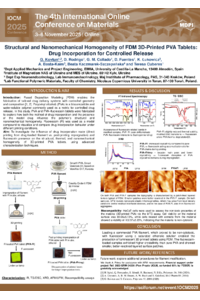
The use of 3D-printed tablets for drug delivery has recently gained significant attention [1]. In this study, we have used commercially available polyvinyl alcohol (PVA) filaments (Smartfil PVA, Smart Materials 3D, based on Mowiflex C17, Kuraray) to incorporate model drugs from saturated solutions in absolute ethanol. Biocompatibility assays were conducted on the filament using HaCaT cells to confirm its non-toxic properties using an MTS assay. Cell viability on the material surface was 80.96 ± 5.13%, while cells treated with extracts from the material showed a viability of 102.57 ± 5.23%, indicating that the material is non-cytotoxic. Loading the filament with fluorescein using a saturated ethanolic solution enabled the production of luminescent printed tablets using a Creality Ender 6 FDM 3D Printer [2]. However, when attempting to load previously printed pristine PVA tablets, the printed layers disaggregated when the immersion time was prolonged. Thermogravimetric Analysis (TGA) and Differential Thermal Analysis (DTA) of 3D-printed tablets made from pure PVA and fluorescein-loaded PVA filaments revealed differences in their thermal degradation behavior. X-ray photoelectron spectroscopy (XPS) data confirmed the semicrystalline nature of the pristine PVA tablets. The percentage of crystallinity decreased when the sample was loaded with fluorescein by immersion, but increased when using a fluorescein-loaded PVA filament to obtain the fluorescein-loaded tablets. Fast Fourier Transform Infrared Spectroscopy (FT-IR) on the 3D-printed tablets allowed us to identify the incorporation of fluorescein and its impact on the PVA chemical structure for the different tablets. Atomic Force Microscopy (AFM) and Ultrasonic Force Microscopy (UFM) provided valuable insights into the nanoscale morphology and elastic homogeneity of the 3D-printed samples.
[1] H. Iqbal, Q. Fernandes, S. Idoudi, R. Basineni, N. Billa, Polymers 16, 386 (2024).
[2] A. Goyanes, A. B. M. Buanz, A. W. Basit and S. Gaisford, Int J Pharm 88 (2014)
Keywords
Fused deposition modeling (FDM)
polyvinyl alcohol tablets
atomic force microscopy
ultrasonic force microscopy
drug release
Poster
IOCM 2025 - poster_ID-144852.pdf
Simulation of a High Sensitive Surface Plasmon Resonance Biosensor for Detection of Biomolecules: effect of metal index
Biomedical Applications of Polymer-Based Nano/Micromotors Synthesized by Electropolymerization Method