Event submissions
Published

This submission belongs to the session b. Bioorganic, Medicinal and Natural Products Chemistry of the event The 18th International Electronic Conference on Synthetic Organic Chemistry
Published date
03 Nov, 2014
Citation
María Julia Castro, Ana Paula Murray, María Belén Faraoni, Lupane Triterpenoids, Selective Butyrylcholinesterase Inhibitors, in Proceedings of The 18th International Electronic Conference on Synthetic Organic Chemistry, 1 November–30 November 2014, MDPI: Basel, Switzerland, doi: 10.3390/ecsoc-18-b035
Share
Email
Facebook
Twitter
LinkedIn
Lupane Triterpenoids, Selective Butyrylcholinesterase Inhibitors
'%3e%3cpath%20d='M12.6647%2010.9104C12.4176%2010.325%2012.0589%209.7933%2011.6088%209.34485C11.16%208.89511%2010.6283%208.53653%2010.0432%208.28891C10.038%208.28629%2010.0327%208.28498%2010.0275%208.28236C10.8437%207.69282%2011.3743%206.73252%2011.3743%205.64907C11.3743%203.85423%209.92005%202.40002%208.12522%202.40002C6.33038%202.40002%204.87618%203.85423%204.87618%205.64907C4.87618%206.73252%205.40677%207.69282%206.22296%208.28367C6.21772%208.28629%206.21248%208.2876%206.20724%208.29022C5.62031%208.53783%205.09365%208.89287%204.64167%209.34616C4.19192%209.79496%203.83334%2010.3266%203.58573%2010.9117C3.34247%2011.4846%203.21128%2012.0987%203.19925%2012.721C3.1989%2012.735%203.20135%2012.7489%203.20646%2012.7619C3.21157%2012.7749%203.21924%2012.7868%203.22901%2012.7968C3.23877%2012.8068%203.25045%2012.8148%203.26334%2012.8202C3.27623%2012.8256%203.29007%2012.8284%203.30406%2012.8284H4.09012C4.14776%2012.8284%204.19362%2012.7825%204.19493%2012.7262C4.22113%2011.7148%204.62726%2010.7676%205.34519%2010.0497C6.08802%209.30686%207.07452%208.89811%208.12522%208.89811C9.17592%208.89811%2010.1624%209.30686%2010.9052%2010.0497C11.6232%2010.7676%2012.0293%2011.7148%2012.0555%2012.7262C12.0568%2012.7839%2012.1027%2012.8284%2012.1603%2012.8284H12.9464C12.9604%2012.8284%2012.9742%2012.8256%2012.9871%2012.8202C13%2012.8148%2013.0117%2012.8068%2013.0214%2012.7968C13.0312%2012.7868%2013.0389%2012.7749%2013.044%2012.7619C13.0491%2012.7489%2013.0515%2012.735%2013.0512%2012.721C13.0381%2012.0947%2012.9084%2011.4856%2012.6647%2010.9104ZM8.12522%207.90243C7.52388%207.90243%206.95792%207.66793%206.53214%207.24215C6.10636%206.81636%205.87185%206.2504%205.87185%205.64907C5.87185%205.04773%206.10636%204.48177%206.53214%204.05599C6.95792%203.63021%207.52388%203.3957%208.12522%203.3957C8.72655%203.3957%209.29252%203.63021%209.7183%204.05599C10.1441%204.48177%2010.3786%205.04773%2010.3786%205.64907C10.3786%206.2504%2010.1441%206.81636%209.7183%207.24215C9.29252%207.66793%208.72655%207.90243%208.12522%207.90243Z'%20fill='%235D1EE1'/%3e%3c/g%3e%3c/svg%3e)
María Julia Castro 1

Ana Paula Murray 1
María Belén Faraoni 1
1. INQUISUR, Departamento de Química, Universidad Nacional del Sur (UNS)-CONICET, Av. Alem 1253, 8000 Bahía Blanca, Argentina
Abstract
Alzheimer´s disease (AD) is a progressive neurodegenerative disorder associated with memory impairment and cognitive deficit. It is characterized by low levels of the neurotransmitter acetylcholine (ACh) in the brain of AD patients. The inhibition of acetylcholinesterase (AChE), the enzyme that catalyzes ACh hydrolysis, is the main therapeutic strategy used to treat AD. In the healthy brain, another enzyme, namely butyrylcholinesterase (BChE), is involved in the metabolic degradation of ACh. BChE activity increases as AD progresses, which suggests that BChE may play an important role at the latter stages of AD. Therefore, selective BChE inhibitors attract interest nowadays. The chemistry of lupane-type triterpenoids has been actively explored due to their biological and pharmacological properties. Abundant in many plants, these metabolites are valuable natural raw materials to perform chemical modifications. In the present work, we aimed to evaluate of natural and semisynthetic lupanes as potential in vitro cholinesterase inhibitors. Lupeol (1) (lup-20(29)-en-3β-ol) and calenduladiol (2) (lup-20(29)-en-3β,16β-diol) have been isolated from Chuquiraga erinacea subsp. erinacea (Asteraceae), an endemic species growing wildly in our region. Semisynthetic lupanes 3-16 have been prepared from them. All of them failed to inhibit AChE, but we found that most of them exhibited BChE inhibition. The best BChE inhibitors were 16-oxolup-20(29)-en-3β-ol and 3,16,30-trioxolup-20(29)-ene with IC50 values of 28.9 and 21.5 µM respectively, an interesting result considering that the role of BChE is more relevant as the disease progresses.
Keywords
Alzheimer’s disease
cholinesterase inhibitors
lupane derivatives
triterpenoids
Manuscript
Faraoni M.B. RESUMEN ECSOC 2014.pdf
Poster
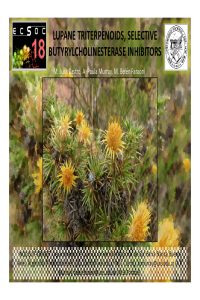
ECSOC- 2014 PP.pdf
Synthesis and Antifungal Activity of Perylene Bisimide Derivatives
Preparation of Dental Polymeric Nano-Adhesives with Silica Nano-Porous (MCM-41) as Novel Fillers for Improving the Adhesive Mechanical Properties: Synthesis and Application