Event submissions
Published
This submission belongs to the session S6. Green Materials, Synthesis, Characterization and Recycling of the event The 4th International Online Conference on Materials
Published date
29 Oct, 2025
Academic Editor
'%3e%3cpath%20d='M12.6657%2010.9104C12.4185%2010.325%2012.0599%209.79327%2011.6097%209.34482C11.1609%208.89508%2010.6293%208.5365%2010.0442%208.28888C10.0389%208.28626%2010.0337%208.28495%2010.0285%208.28233C10.8446%207.69279%2011.3752%206.73249%2011.3752%205.64904C11.3752%203.8542%209.92103%202.39999%208.1262%202.39999C6.33136%202.39999%204.87715%203.8542%204.87715%205.64904C4.87715%206.73249%205.40774%207.69279%206.22393%208.28364C6.21869%208.28626%206.21345%208.28757%206.20821%208.29019C5.62129%208.5378%205.09463%208.89284%204.64265%209.34613C4.1929%209.79493%203.83432%2010.3266%203.58671%2010.9117C3.34345%2011.4845%203.21226%2012.0987%203.20023%2012.7209C3.19988%2012.7349%203.20233%2012.7488%203.20744%2012.7619C3.21255%2012.7749%203.22022%2012.7867%203.22998%2012.7968C3.23975%2012.8068%203.25142%2012.8147%203.26431%2012.8202C3.2772%2012.8256%203.29105%2012.8284%203.30504%2012.8284H4.09109C4.14874%2012.8284%204.19459%2012.7825%204.1959%2012.7262C4.2221%2011.7148%204.62823%2010.7676%205.34617%2010.0497C6.08899%209.30683%207.0755%208.89808%208.1262%208.89808C9.17689%208.89808%2010.1634%209.30683%2010.9062%2010.0497C11.6242%2010.7676%2012.0303%2011.7148%2012.0565%2012.7262C12.0578%2012.7838%2012.1037%2012.8284%2012.1613%2012.8284H12.9474C12.9613%2012.8284%2012.9752%2012.8256%2012.9881%2012.8202C13.001%2012.8147%2013.0126%2012.8068%2013.0224%2012.7968C13.0322%2012.7867%2013.0398%2012.7749%2013.0449%2012.7619C13.0501%2012.7488%2013.0525%2012.7349%2013.0522%2012.7209C13.0391%2012.0947%2012.9094%2011.4855%2012.6657%2010.9104ZM8.1262%207.9024C7.52486%207.9024%206.9589%207.6679%206.53312%207.24211C6.10733%206.81633%205.87283%206.25037%205.87283%205.64904C5.87283%205.0477%206.10733%204.48174%206.53312%204.05596C6.9589%203.63018%207.52486%203.39567%208.1262%203.39567C8.72753%203.39567%209.29349%203.63018%209.71927%204.05596C10.1451%204.48174%2010.3796%205.0477%2010.3796%205.64904C10.3796%206.25037%2010.1451%206.81633%209.71927%207.24211C9.29349%207.6679%208.72753%207.9024%208.1262%207.9024Z'%20fill='%235D1EE1'/%3e%3c/g%3e%3c/svg%3e) SARA GARCIA BALLESTEROS
SARA GARCIA BALLESTEROSCitation
Adriana Rodrigues Machado, Carolina Cassoni, Gonçalo Sá, João Nunes, Manuela Pintado, Synthesis for obtaining Natural Deep Eutectic Solvents (NADESs) and their Physicochemical Characterizations, in Proceedings of The 4th International Online Conference on Materials, 3 November–6 November 2025, MDPI: Basel, Switzerland
Share
Email
Facebook
Twitter
LinkedIn
Synthesis for obtaining Natural Deep Eutectic Solvents (NADESs) and their Physicochemical Characterizations
'%3e%3cpath%20d='M12.6647%2010.9104C12.4176%2010.325%2012.0589%209.7933%2011.6088%209.34485C11.16%208.89511%2010.6283%208.53653%2010.0432%208.28891C10.038%208.28629%2010.0327%208.28498%2010.0275%208.28236C10.8437%207.69282%2011.3743%206.73252%2011.3743%205.64907C11.3743%203.85423%209.92005%202.40002%208.12522%202.40002C6.33038%202.40002%204.87618%203.85423%204.87618%205.64907C4.87618%206.73252%205.40677%207.69282%206.22296%208.28367C6.21772%208.28629%206.21248%208.2876%206.20724%208.29022C5.62031%208.53783%205.09365%208.89287%204.64167%209.34616C4.19192%209.79496%203.83334%2010.3266%203.58573%2010.9117C3.34247%2011.4846%203.21128%2012.0987%203.19925%2012.721C3.1989%2012.735%203.20135%2012.7489%203.20646%2012.7619C3.21157%2012.7749%203.21924%2012.7868%203.22901%2012.7968C3.23877%2012.8068%203.25045%2012.8148%203.26334%2012.8202C3.27623%2012.8256%203.29007%2012.8284%203.30406%2012.8284H4.09012C4.14776%2012.8284%204.19362%2012.7825%204.19493%2012.7262C4.22113%2011.7148%204.62726%2010.7676%205.34519%2010.0497C6.08802%209.30686%207.07452%208.89811%208.12522%208.89811C9.17592%208.89811%2010.1624%209.30686%2010.9052%2010.0497C11.6232%2010.7676%2012.0293%2011.7148%2012.0555%2012.7262C12.0568%2012.7839%2012.1027%2012.8284%2012.1603%2012.8284H12.9464C12.9604%2012.8284%2012.9742%2012.8256%2012.9871%2012.8202C13%2012.8148%2013.0117%2012.8068%2013.0214%2012.7968C13.0312%2012.7868%2013.0389%2012.7749%2013.044%2012.7619C13.0491%2012.7489%2013.0515%2012.735%2013.0512%2012.721C13.0381%2012.0947%2012.9084%2011.4856%2012.6647%2010.9104ZM8.12522%207.90243C7.52388%207.90243%206.95792%207.66793%206.53214%207.24215C6.10636%206.81636%205.87185%206.2504%205.87185%205.64907C5.87185%205.04773%206.10636%204.48177%206.53214%204.05599C6.95792%203.63021%207.52388%203.3957%208.12522%203.3957C8.72655%203.3957%209.29252%203.63021%209.7183%204.05599C10.1441%204.48177%2010.3786%205.04773%2010.3786%205.64907C10.3786%206.2504%2010.1441%206.81636%209.7183%207.24215C9.29252%207.66793%208.72655%207.90243%208.12522%207.90243Z'%20fill='%235D1EE1'/%3e%3c/g%3e%3c/svg%3e)
Adriana Rodrigues Machado 1
Carolina Cassoni 2
Gonçalo Sá 1
João Nunes 1

Manuela Pintado 2
1. Associação CECOLAB, Collaborative Laboratory Towards Circular Economy, Business Centre, Rua Nossa Senhora da Conceição, 2, Oliveira do Hospital, 3405-155 Coimbra, Portugal
2. Universidade Católica Portuguesa, CBQF - Centro de Biotecnologia e Química Fina – Laboratório Associado, Escola Superior de Biotecnologia, Rua Diogo Botelho 1327, Porto 4169-005, Portugal
Abstract
Natural Deep Eutectic Solvents (NADESs) are formed through hydrogen bonding interactions between a hydrogen bond acceptor (HBA) and a hydrogen bond donor (HBD), resulting in a stable, homogeneous liquid. In this work, preliminary analyses were conducted to evaluate the influence of the synthesis method on the physicochemical properties of NADESs. Two preparation techniques, mechanical agitation and ultrasound, were applied to four NADES systems composed of choline chloride (ChCl), urea (Ur), citric acid (CA), and glycerol (Gly): N1 (CA: Gly, 1:3 M), N2 (ChCl: Ur, 2:1 M), N3 (ChCl: CA, 1:1 M), and N4 (ChCl: Gly, 1:1 M), all with 20% (w/w) water. Properties assessed included pH, electrical conductivity, density, and refractive index. Results showed variable pH values without a consistent trend. Electrical conductivity was higher in NADESs synthesized via agitation, notably in N2 (37.7 mS/cm vs. 16.4 mS/cm with ultrasound), suggesting enhanced ionic mobility. Ultrasound-assisted synthesis generally yielded NADESs with greater density, as observed in N1 and N4 (1.155 vs. 1.084 g/cm³ and 1.154 vs. 1.138 g/cm³, respectively), potentially due to improved molecular packing. Refractive index values remained relatively stable across methods, though slight deviations were observed. These findings indicate that mechanical agitation favors higher conductivity, whereas ultrasound may promote greater homogeneity and compactness. Therefore, the choice of synthesis method should be tailored to the targeted physicochemical profile for specific applications.
Keywords
conductivity
Glycerol
urea
Poster
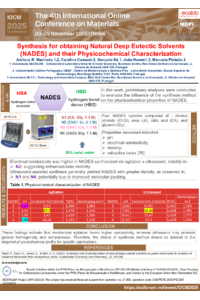
CECOLAB_poster NADES IOCMS 1010.pdf
Solvent Choice Matters: Structural Transformations in Ni-BTC MOFs
Stress Distribution in Magnetoelectric Composites: Insights from Representative Volume Element Modeling