Event submissions
Published
This submission belongs to the session S3. Soft Matter, Biomaterials, Composites and Interfaces of the event The 4th International Online Conference on Materials
Published date
29 Oct, 2025
Academic Editor
'%3e%3cpath%20d='M12.6657%2010.9104C12.4185%2010.325%2012.0599%209.79327%2011.6097%209.34482C11.1609%208.89508%2010.6293%208.5365%2010.0442%208.28888C10.0389%208.28626%2010.0337%208.28495%2010.0285%208.28233C10.8446%207.69279%2011.3752%206.73249%2011.3752%205.64904C11.3752%203.8542%209.92103%202.39999%208.1262%202.39999C6.33136%202.39999%204.87715%203.8542%204.87715%205.64904C4.87715%206.73249%205.40774%207.69279%206.22393%208.28364C6.21869%208.28626%206.21345%208.28757%206.20821%208.29019C5.62129%208.5378%205.09463%208.89284%204.64265%209.34613C4.1929%209.79493%203.83432%2010.3266%203.58671%2010.9117C3.34345%2011.4845%203.21226%2012.0987%203.20023%2012.7209C3.19988%2012.7349%203.20233%2012.7488%203.20744%2012.7619C3.21255%2012.7749%203.22022%2012.7867%203.22998%2012.7968C3.23975%2012.8068%203.25142%2012.8147%203.26431%2012.8202C3.2772%2012.8256%203.29105%2012.8284%203.30504%2012.8284H4.09109C4.14874%2012.8284%204.19459%2012.7825%204.1959%2012.7262C4.2221%2011.7148%204.62823%2010.7676%205.34617%2010.0497C6.08899%209.30683%207.0755%208.89808%208.1262%208.89808C9.17689%208.89808%2010.1634%209.30683%2010.9062%2010.0497C11.6242%2010.7676%2012.0303%2011.7148%2012.0565%2012.7262C12.0578%2012.7838%2012.1037%2012.8284%2012.1613%2012.8284H12.9474C12.9613%2012.8284%2012.9752%2012.8256%2012.9881%2012.8202C13.001%2012.8147%2013.0126%2012.8068%2013.0224%2012.7968C13.0322%2012.7867%2013.0398%2012.7749%2013.0449%2012.7619C13.0501%2012.7488%2013.0525%2012.7349%2013.0522%2012.7209C13.0391%2012.0947%2012.9094%2011.4855%2012.6657%2010.9104ZM8.1262%207.9024C7.52486%207.9024%206.9589%207.6679%206.53312%207.24211C6.10733%206.81633%205.87283%206.25037%205.87283%205.64904C5.87283%205.0477%206.10733%204.48174%206.53312%204.05596C6.9589%203.63018%207.52486%203.39567%208.1262%203.39567C8.72753%203.39567%209.29349%203.63018%209.71927%204.05596C10.1451%204.48174%2010.3796%205.0477%2010.3796%205.64904C10.3796%206.25037%2010.1451%206.81633%209.71927%207.24211C9.29349%207.6679%208.72753%207.9024%208.1262%207.9024Z'%20fill='%235D1EE1'/%3e%3c/g%3e%3c/svg%3e) Qingchun Yuan
Qingchun YuanCitation
Emir Oncu, Image-Driven Prediction of Mechanical Properties in Fiber-Reinforced Nylon Composites Fabricated via 3D Printing Using YOLOv8 and CNN, in Proceedings of The 4th International Online Conference on Materials, 3 November–6 November 2025, MDPI: Basel, Switzerland
Share
Email
Facebook
Twitter
LinkedIn
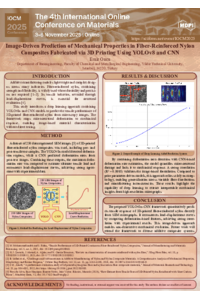
Image-Driven Prediction of Mechanical Properties in Fiber-Reinforced Nylon Composites Fabricated via 3D Printing Using YOLOv8 and CNN

Emir Oncu 1
1. Department of Bioengineering, Faculty of Chemical and Metallurgical Engineering, Yildiz Technical University, Istanbul, 34220, Turkey
Abstract
Background
The mechanical characterization of fiber-reinforced composites is crucial for advancing materials engineering but traditionally relies on destructive, time-consuming testing protocols. The emergence of deep learning provides opportunities for non-destructive, image-based evaluation methods that can accelerate material design and performance assessment.
Methods
This study proposes a novel image-driven framework that integrates a YOLOv8n-based object detection model with a Convolutional Neural Network (CNN) to predict tensile behavior in 3D-printed fiber-reinforced nylon composites from scanning electron microscopy (SEM) images. The YOLOv8n model was used to identify and quantify deformation regions before and after tensile testing, while the CNN predicted deformation rates directly from raw image features. By combining these outputs, the framework computes deformation change, maximum deformation rate, and ultimate tensile load. Model interpretability was further enhanced using Gradient-weighted Class Activation Mapping (Grad-CAM).
Results
The predictive framework was validated against 50 load–displacement curves representing the full spectrum of experimentally observed behaviors in 3D-printed nylon fiber composites. The YOLOv8n model achieved an accuracy of 0.937, while the CNN reached an accuracy of 0.961 in predicting deformation rates. Image-based predictions demonstrated excellent agreement with experimental measurements (R² = 0.9995, Pearson r = 0.9998). Furthermore, ultimate tensile loads derived from model outputs enabled the virtual reconstruction of load–displacement responses, effectively bridging microstructural imaging with macroscopic mechanical performance.
Conclusion
The proposed framework establishes a scalable, non-destructive approach for predicting tensile behavior in fiber-reinforced composites. By integrating high-resolution SEM analysis with deep learning models, this methodology provides a reliable pathway for virtual material testing, reducing experimental demands and accelerating the evaluation and design of advanced composite systems.
Keywords
3D Printed Composites
Fiber Reinforced Nylon
Scanning Electron Microscopy (SEM)
YOLOv8
Deformation Detection
Convolutional Neural Network
Poster
EmirOncu_mdpi_poster.pdf
Stress Distribution in Magnetoelectric Composites: Insights from Representative Volume Element Modeling
Multi-Principal Rare Earth Substitution and Entropy Effects in BiFeO3: Structural, Dielectric, and Magnetic Properties