Event submissions
Published
This submission belongs to the session S1. Optical, Electric and Magnetic Materials and Their Characterization of the event The 4th International Online Conference on Materials
Published date
29 Oct, 2025
Academic Editor
'%3e%3cpath%20d='M12.6657%2010.9104C12.4185%2010.325%2012.0599%209.79327%2011.6097%209.34482C11.1609%208.89508%2010.6293%208.5365%2010.0442%208.28888C10.0389%208.28626%2010.0337%208.28495%2010.0285%208.28233C10.8446%207.69279%2011.3752%206.73249%2011.3752%205.64904C11.3752%203.8542%209.92103%202.39999%208.1262%202.39999C6.33136%202.39999%204.87715%203.8542%204.87715%205.64904C4.87715%206.73249%205.40774%207.69279%206.22393%208.28364C6.21869%208.28626%206.21345%208.28757%206.20821%208.29019C5.62129%208.5378%205.09463%208.89284%204.64265%209.34613C4.1929%209.79493%203.83432%2010.3266%203.58671%2010.9117C3.34345%2011.4845%203.21226%2012.0987%203.20023%2012.7209C3.19988%2012.7349%203.20233%2012.7488%203.20744%2012.7619C3.21255%2012.7749%203.22022%2012.7867%203.22998%2012.7968C3.23975%2012.8068%203.25142%2012.8147%203.26431%2012.8202C3.2772%2012.8256%203.29105%2012.8284%203.30504%2012.8284H4.09109C4.14874%2012.8284%204.19459%2012.7825%204.1959%2012.7262C4.2221%2011.7148%204.62823%2010.7676%205.34617%2010.0497C6.08899%209.30683%207.0755%208.89808%208.1262%208.89808C9.17689%208.89808%2010.1634%209.30683%2010.9062%2010.0497C11.6242%2010.7676%2012.0303%2011.7148%2012.0565%2012.7262C12.0578%2012.7838%2012.1037%2012.8284%2012.1613%2012.8284H12.9474C12.9613%2012.8284%2012.9752%2012.8256%2012.9881%2012.8202C13.001%2012.8147%2013.0126%2012.8068%2013.0224%2012.7968C13.0322%2012.7867%2013.0398%2012.7749%2013.0449%2012.7619C13.0501%2012.7488%2013.0525%2012.7349%2013.0522%2012.7209C13.0391%2012.0947%2012.9094%2011.4855%2012.6657%2010.9104ZM8.1262%207.9024C7.52486%207.9024%206.9589%207.6679%206.53312%207.24211C6.10733%206.81633%205.87283%206.25037%205.87283%205.64904C5.87283%205.0477%206.10733%204.48174%206.53312%204.05596C6.9589%203.63018%207.52486%203.39567%208.1262%203.39567C8.72753%203.39567%209.29349%203.63018%209.71927%204.05596C10.1451%204.48174%2010.3796%205.0477%2010.3796%205.64904C10.3796%206.25037%2010.1451%206.81633%209.71927%207.24211C9.29349%207.6679%208.72753%207.9024%208.1262%207.9024Z'%20fill='%235D1EE1'/%3e%3c/g%3e%3c/svg%3e) Weili Zhang
Weili ZhangCitation
Saba Aziz, Anna Grazia Monteduro, Silvia Rizzato, Ritu Rawat, Giuseppe Maruccio, Multi-Principal Rare Earth Substitution and Entropy Effects in BiFeO₃: Structural, Dielectric, and Magnetic Properties, in Proceedings of The 4th International Online Conference on Materials, 3 November–6 November 2025, MDPI: Basel, Switzerland
Share
Email
Facebook
Twitter
LinkedIn
Multi-Principal Rare Earth Substitution and Entropy Effects in BiFeO3: Structural, Dielectric, and Magnetic Properties
'%3e%3cpath%20d='M12.6647%2010.9104C12.4176%2010.325%2012.0589%209.7933%2011.6088%209.34485C11.16%208.89511%2010.6283%208.53653%2010.0432%208.28891C10.038%208.28629%2010.0327%208.28498%2010.0275%208.28236C10.8437%207.69282%2011.3743%206.73252%2011.3743%205.64907C11.3743%203.85423%209.92005%202.40002%208.12522%202.40002C6.33038%202.40002%204.87618%203.85423%204.87618%205.64907C4.87618%206.73252%205.40677%207.69282%206.22296%208.28367C6.21772%208.28629%206.21248%208.2876%206.20724%208.29022C5.62031%208.53783%205.09365%208.89287%204.64167%209.34616C4.19192%209.79496%203.83334%2010.3266%203.58573%2010.9117C3.34247%2011.4846%203.21128%2012.0987%203.19925%2012.721C3.1989%2012.735%203.20135%2012.7489%203.20646%2012.7619C3.21157%2012.7749%203.21924%2012.7868%203.22901%2012.7968C3.23877%2012.8068%203.25045%2012.8148%203.26334%2012.8202C3.27623%2012.8256%203.29007%2012.8284%203.30406%2012.8284H4.09012C4.14776%2012.8284%204.19362%2012.7825%204.19493%2012.7262C4.22113%2011.7148%204.62726%2010.7676%205.34519%2010.0497C6.08802%209.30686%207.07452%208.89811%208.12522%208.89811C9.17592%208.89811%2010.1624%209.30686%2010.9052%2010.0497C11.6232%2010.7676%2012.0293%2011.7148%2012.0555%2012.7262C12.0568%2012.7839%2012.1027%2012.8284%2012.1603%2012.8284H12.9464C12.9604%2012.8284%2012.9742%2012.8256%2012.9871%2012.8202C13%2012.8148%2013.0117%2012.8068%2013.0214%2012.7968C13.0312%2012.7868%2013.0389%2012.7749%2013.044%2012.7619C13.0491%2012.7489%2013.0515%2012.735%2013.0512%2012.721C13.0381%2012.0947%2012.9084%2011.4856%2012.6647%2010.9104ZM8.12522%207.90243C7.52388%207.90243%206.95792%207.66793%206.53214%207.24215C6.10636%206.81636%205.87185%206.2504%205.87185%205.64907C5.87185%205.04773%206.10636%204.48177%206.53214%204.05599C6.95792%203.63021%207.52388%203.3957%208.12522%203.3957C8.72655%203.3957%209.29252%203.63021%209.7183%204.05599C10.1441%204.48177%2010.3786%205.04773%2010.3786%205.64907C10.3786%206.2504%2010.1441%206.81636%209.7183%207.24215C9.29252%207.66793%208.72655%207.90243%208.12522%207.90243Z'%20fill='%235D1EE1'/%3e%3c/g%3e%3c/svg%3e)
Saba Aziz 1

Anna Grazia Monteduro 1

Silvia Rizzato 1
Ritu Rawat 1

Giuseppe Maruccio 1
1. Department of Mathematics and Physics, University of Salento, CNR NANOTEC – Institute of Nanotechnology, c/o Ecotekne Campus, Via Monteroni, 73100 Lecce, Italy
Abstract
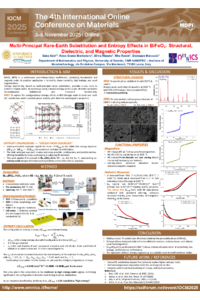
BiFeO₃ (BFO) is a widely studied room-temperature multiferroic; however, phase instability, leakage, and weak ferromagnetism have motivated the adoption of strategies such as doping and entropy engineering to enhance its performance. Building on our earlier report of the high-entropy oxide Bi₀.₅La₀.₁In₀.₁Y₀.₁Nd₀.₁Gd₀.₁FeO₃, which exhibited room-temperature ferromagnetism and excellent dielectric performance, we now investigate configurational entropy effects on the A site via multi-principal rare earth (RE) substitution to stabilize the perovskite phase and improve functional response. Bi0.9(RE)0.1FeO3 (RE = La, Nd, Gd, Eu, Y; 2% each) was prepared by a conventional solid-state route and pre-calcined at 600 °C, followed by sintering at 950 and 1000 °C. Phase purity and microstructure were examined by X-ray diffraction (XRD) and scanning electron microscopy (SEM). Room-temperature magnetic behavior was evaluated using vibrating sample magnetometry (VSM), and dielectric response (ε′, tan δ), together with AC conductivity (σ), was measured at 1 kHz. XRD spectra confirmed perovskite formation at both temperatures, with sharper peaks at 1000 °C indicating higher crystallinity and minor secondary peaks, while SEM showed denser and more uniform grains. Magnetic measurements revealed weak ferromagnetism with coercivity in the range of 80–120 Oe, consistent with partial disruption of the spin cycloid. Dielectric response was also increased from ~960 (950 °C) to ~1500 at 1000 °C, while tan δ decreased from 0.77 to 0.69 at 1 kHz. Moreover, a slight rise in AC conductivity at 1000 °C (from 4.05×10⁻⁵ to 5.08×10⁻⁵ S cm⁻¹) was attributed to oxygen vacancy formation driven by Bi volatility, Fe²⁺/Fe³⁺ hopping, and reduced grain boundary resistance due to more continuous grain networks. These results indicate that configurational entropy, together with careful control of thermal processing, can be used to stabilize BiFeO₃ and improve its multifunctional properties.
Keywords
BiFeO₃
multiferroics
high-entropy oxides
rare-earth substitution
dielectric properties
magnetic properties
entropy stabilization
Poster
IOCM 2025 - ID 149478-Saba AZIZ.pdf
Image-Driven Prediction of Mechanical Properties in Fiber-Reinforced Nylon Composites Fabricated via 3D Printing Using YOLOv8 and CNN
Synthesis and characterization of alginic acid scaffolds with possible tissue regeneration applications