Event submissions
Published
This submission belongs to the session S1. Optical, Electric and Magnetic Materials and Their Characterization of the event The 4th International Online Conference on Materials
Published date
29 Oct, 2025
Academic Editor
'%3e%3cpath%20d='M12.6657%2010.9104C12.4185%2010.325%2012.0599%209.79327%2011.6097%209.34482C11.1609%208.89508%2010.6293%208.5365%2010.0442%208.28888C10.0389%208.28626%2010.0337%208.28495%2010.0285%208.28233C10.8446%207.69279%2011.3752%206.73249%2011.3752%205.64904C11.3752%203.8542%209.92103%202.39999%208.1262%202.39999C6.33136%202.39999%204.87715%203.8542%204.87715%205.64904C4.87715%206.73249%205.40774%207.69279%206.22393%208.28364C6.21869%208.28626%206.21345%208.28757%206.20821%208.29019C5.62129%208.5378%205.09463%208.89284%204.64265%209.34613C4.1929%209.79493%203.83432%2010.3266%203.58671%2010.9117C3.34345%2011.4845%203.21226%2012.0987%203.20023%2012.7209C3.19988%2012.7349%203.20233%2012.7488%203.20744%2012.7619C3.21255%2012.7749%203.22022%2012.7867%203.22998%2012.7968C3.23975%2012.8068%203.25142%2012.8147%203.26431%2012.8202C3.2772%2012.8256%203.29105%2012.8284%203.30504%2012.8284H4.09109C4.14874%2012.8284%204.19459%2012.7825%204.1959%2012.7262C4.2221%2011.7148%204.62823%2010.7676%205.34617%2010.0497C6.08899%209.30683%207.0755%208.89808%208.1262%208.89808C9.17689%208.89808%2010.1634%209.30683%2010.9062%2010.0497C11.6242%2010.7676%2012.0303%2011.7148%2012.0565%2012.7262C12.0578%2012.7838%2012.1037%2012.8284%2012.1613%2012.8284H12.9474C12.9613%2012.8284%2012.9752%2012.8256%2012.9881%2012.8202C13.001%2012.8147%2013.0126%2012.8068%2013.0224%2012.7968C13.0322%2012.7867%2013.0398%2012.7749%2013.0449%2012.7619C13.0501%2012.7488%2013.0525%2012.7349%2013.0522%2012.7209C13.0391%2012.0947%2012.9094%2011.4855%2012.6657%2010.9104ZM8.1262%207.9024C7.52486%207.9024%206.9589%207.6679%206.53312%207.24211C6.10733%206.81633%205.87283%206.25037%205.87283%205.64904C5.87283%205.0477%206.10733%204.48174%206.53312%204.05596C6.9589%203.63018%207.52486%203.39567%208.1262%203.39567C8.72753%203.39567%209.29349%203.63018%209.71927%204.05596C10.1451%204.48174%2010.3796%205.0477%2010.3796%205.64904C10.3796%206.25037%2010.1451%206.81633%209.71927%207.24211C9.29349%207.6679%208.72753%207.9024%208.1262%207.9024Z'%20fill='%235D1EE1'/%3e%3c/g%3e%3c/svg%3e) Weili Zhang
Weili ZhangCitation
Tatyana Koutzarova, Petya Peneva, Svetoslav Kolev, Kiril Krezhov, Borislava Georgieva, Lan Maria Tran, Michal Babij, Tanya Malakova, Petar Tzvetkov, Benedicte Vertruyen, Comparative studies of properties of hexaferrites obtained by modified co-precipitation methods, in Proceedings of The 4th International Online Conference on Materials, 3 November–6 November 2025, MDPI: Basel, Switzerland
Share
Email
Facebook
Twitter
LinkedIn
Comparative studies of properties of hexaferrites obtained by modified co-precipitation methods

Tatyana Koutzarova 1
'%3e%3cpath%20d='M12.6647%2010.9104C12.4176%2010.325%2012.0589%209.7933%2011.6088%209.34485C11.16%208.89511%2010.6283%208.53653%2010.0432%208.28891C10.038%208.28629%2010.0327%208.28498%2010.0275%208.28236C10.8437%207.69282%2011.3743%206.73252%2011.3743%205.64907C11.3743%203.85423%209.92005%202.40002%208.12522%202.40002C6.33038%202.40002%204.87618%203.85423%204.87618%205.64907C4.87618%206.73252%205.40677%207.69282%206.22296%208.28367C6.21772%208.28629%206.21248%208.2876%206.20724%208.29022C5.62031%208.53783%205.09365%208.89287%204.64167%209.34616C4.19192%209.79496%203.83334%2010.3266%203.58573%2010.9117C3.34247%2011.4846%203.21128%2012.0987%203.19925%2012.721C3.1989%2012.735%203.20135%2012.7489%203.20646%2012.7619C3.21157%2012.7749%203.21924%2012.7868%203.22901%2012.7968C3.23877%2012.8068%203.25045%2012.8148%203.26334%2012.8202C3.27623%2012.8256%203.29007%2012.8284%203.30406%2012.8284H4.09012C4.14776%2012.8284%204.19362%2012.7825%204.19493%2012.7262C4.22113%2011.7148%204.62726%2010.7676%205.34519%2010.0497C6.08802%209.30686%207.07452%208.89811%208.12522%208.89811C9.17592%208.89811%2010.1624%209.30686%2010.9052%2010.0497C11.6232%2010.7676%2012.0293%2011.7148%2012.0555%2012.7262C12.0568%2012.7839%2012.1027%2012.8284%2012.1603%2012.8284H12.9464C12.9604%2012.8284%2012.9742%2012.8256%2012.9871%2012.8202C13%2012.8148%2013.0117%2012.8068%2013.0214%2012.7968C13.0312%2012.7868%2013.0389%2012.7749%2013.044%2012.7619C13.0491%2012.7489%2013.0515%2012.735%2013.0512%2012.721C13.0381%2012.0947%2012.9084%2011.4856%2012.6647%2010.9104ZM8.12522%207.90243C7.52388%207.90243%206.95792%207.66793%206.53214%207.24215C6.10636%206.81636%205.87185%206.2504%205.87185%205.64907C5.87185%205.04773%206.10636%204.48177%206.53214%204.05599C6.95792%203.63021%207.52388%203.3957%208.12522%203.3957C8.72655%203.3957%209.29252%203.63021%209.7183%204.05599C10.1441%204.48177%2010.3786%205.04773%2010.3786%205.64907C10.3786%206.2504%2010.1441%206.81636%209.7183%207.24215C9.29252%207.66793%208.72655%207.90243%208.12522%207.90243Z'%20fill='%235D1EE1'/%3e%3c/g%3e%3c/svg%3e)
Petya Peneva 1
Svetoslav Kolev 1,2
Kiril Krezhov 1
Borislava Georgieva 1
Lan Maria Tran 3
Michal Babij 3
Tanya Malakova 1
Petar Tzvetkov 4
Benedicte Vertruyen 5
1. Institute of Electronics, Bulgarian Academy of Sciences, 72 Tsarigradsko Chaussee, 1784 Sofia, Bulgaria
2. Department of Physics, Faculty of Mathematics and Natural Science, Neofit Rilski South-Western University, 66 Ivan Mihailov Str., 2700 Blagoevgrad, Bulgaria
3. Institute of Low Temperature and Structure Research, Polish Academy of Sciences, Ul. Okólna 2, 50-422 Wroclaw, Poland
4. Institute of General and Inorganic Chemistry, Bulgarian Academy of Sciences, Acad. Georgi Bonchev Str., bld. 11, 1113 Sofia, Bulgaria
5. Greenmat, Chemistry Department, University of Liege, 11 Allée du 6 Août, 4000 Liège, Belgium
Abstract
M-type hexaferrites are one of the most important magnetic materials due to their applications as permanent magnets, magnetic recording media, microwave components and devices, etc. We report a study on the correlation between the synthesis procedure on the microstructure and the magnetic properties of BaFe12O19 nanopowders. These were synthesized by two modified co-precipitation methods: microemulsion co-precipitation and sonochemical co-precipitation (sonochemistry). We used a water-in-oil reverse microemulsion system with CTAB (24 wt.%) as a cationic surfactant, n-butanol (16 wt.%) as a co-surfactant, n-hexanol (20 wt.%) as a continuous oil phase, and an aqueous solution of metallic ions (40 wt.%) for the microemulsion method. In the case of sonochemical co-precipitation, high-power ultrasound stirring was applied during the co-precipitation process. The obtained precursors were subjected to high-temperature synthesis. The BaFe12O19 powders consisted of particles exhibiting an irregular shape between a sphere and a hexagonal platelet, as the process of formation of the platelet shape typical of the BaFe12O19 hexagonal structure was interrupted due to the small particle size. The average particle size of BaFe12O19 nanopowders is 140 nm and 86 nm for microemulsion and sonochemistry, respectively. The magnetic hysteresis loops were measured at room temperature in an applied magnetic field of 30 kOe. The sample obtained by microemulsion had a high coercivity value of 4 kOe, while the powder obtained by sonochemical co-precipitation was 140 Oe. The BaFe12O19 powders consisted of particles with a size below 150 nm and exhibited an irregular shape between a sphere and a hexagonal platelet, as the process of formation of the platelet shape typical of the BaFe12O19 hexagonal structure was interrupted due to the small particle size.
Keywords
hexaferrites
co-precipitation
microemulsion
sonochemistry
Poster
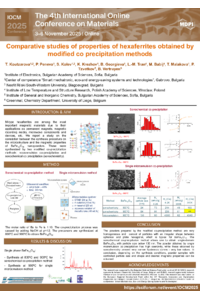
Poster sciforum-149578 TKoutzarova.pdf
REMOVAL OF MICROPLASTICS IN FULL-CYCLE WATER TREATMENT PLANTS
Comparative evaluation of Cu- and Fe-doped TiO2 photocatalyst under visible light