Event submissions
Published
This submission belongs to the session S3. Soft Matter, Biomaterials, Composites and Interfaces of the event The 4th International Online Conference on Materials
Published date
29 Oct, 2025
Academic Editor
'%3e%3cpath%20d='M12.6657%2010.9104C12.4185%2010.325%2012.0599%209.79327%2011.6097%209.34482C11.1609%208.89508%2010.6293%208.5365%2010.0442%208.28888C10.0389%208.28626%2010.0337%208.28495%2010.0285%208.28233C10.8446%207.69279%2011.3752%206.73249%2011.3752%205.64904C11.3752%203.8542%209.92103%202.39999%208.1262%202.39999C6.33136%202.39999%204.87715%203.8542%204.87715%205.64904C4.87715%206.73249%205.40774%207.69279%206.22393%208.28364C6.21869%208.28626%206.21345%208.28757%206.20821%208.29019C5.62129%208.5378%205.09463%208.89284%204.64265%209.34613C4.1929%209.79493%203.83432%2010.3266%203.58671%2010.9117C3.34345%2011.4845%203.21226%2012.0987%203.20023%2012.7209C3.19988%2012.7349%203.20233%2012.7488%203.20744%2012.7619C3.21255%2012.7749%203.22022%2012.7867%203.22998%2012.7968C3.23975%2012.8068%203.25142%2012.8147%203.26431%2012.8202C3.2772%2012.8256%203.29105%2012.8284%203.30504%2012.8284H4.09109C4.14874%2012.8284%204.19459%2012.7825%204.1959%2012.7262C4.2221%2011.7148%204.62823%2010.7676%205.34617%2010.0497C6.08899%209.30683%207.0755%208.89808%208.1262%208.89808C9.17689%208.89808%2010.1634%209.30683%2010.9062%2010.0497C11.6242%2010.7676%2012.0303%2011.7148%2012.0565%2012.7262C12.0578%2012.7838%2012.1037%2012.8284%2012.1613%2012.8284H12.9474C12.9613%2012.8284%2012.9752%2012.8256%2012.9881%2012.8202C13.001%2012.8147%2013.0126%2012.8068%2013.0224%2012.7968C13.0322%2012.7867%2013.0398%2012.7749%2013.0449%2012.7619C13.0501%2012.7488%2013.0525%2012.7349%2013.0522%2012.7209C13.0391%2012.0947%2012.9094%2011.4855%2012.6657%2010.9104ZM8.1262%207.9024C7.52486%207.9024%206.9589%207.6679%206.53312%207.24211C6.10733%206.81633%205.87283%206.25037%205.87283%205.64904C5.87283%205.0477%206.10733%204.48174%206.53312%204.05596C6.9589%203.63018%207.52486%203.39567%208.1262%203.39567C8.72753%203.39567%209.29349%203.63018%209.71927%204.05596C10.1451%204.48174%2010.3796%205.0477%2010.3796%205.64904C10.3796%206.25037%2010.1451%206.81633%209.71927%207.24211C9.29349%207.6679%208.72753%207.9024%208.1262%207.9024Z'%20fill='%235D1EE1'/%3e%3c/g%3e%3c/svg%3e) Ingo Dierking
Ingo DierkingCitation
Ehsan MehmandoustEsfahani, Antonio Nieto-Márquez, José Antonio Díaz López, Comparative evaluation of Cu- and Fe-doped TiO₂ photocatalyst under visible light, in Proceedings of The 4th International Online Conference on Materials, 3 November–6 November 2025, MDPI: Basel, Switzerland
Share
Email
Facebook
Twitter
LinkedIn
Comparative evaluation of Cu- and Fe-doped TiO2 photocatalyst under visible light
'%3e%3cpath%20d='M12.6647%2010.9104C12.4176%2010.325%2012.0589%209.7933%2011.6088%209.34485C11.16%208.89511%2010.6283%208.53653%2010.0432%208.28891C10.038%208.28629%2010.0327%208.28498%2010.0275%208.28236C10.8437%207.69282%2011.3743%206.73252%2011.3743%205.64907C11.3743%203.85423%209.92005%202.40002%208.12522%202.40002C6.33038%202.40002%204.87618%203.85423%204.87618%205.64907C4.87618%206.73252%205.40677%207.69282%206.22296%208.28367C6.21772%208.28629%206.21248%208.2876%206.20724%208.29022C5.62031%208.53783%205.09365%208.89287%204.64167%209.34616C4.19192%209.79496%203.83334%2010.3266%203.58573%2010.9117C3.34247%2011.4846%203.21128%2012.0987%203.19925%2012.721C3.1989%2012.735%203.20135%2012.7489%203.20646%2012.7619C3.21157%2012.7749%203.21924%2012.7868%203.22901%2012.7968C3.23877%2012.8068%203.25045%2012.8148%203.26334%2012.8202C3.27623%2012.8256%203.29007%2012.8284%203.30406%2012.8284H4.09012C4.14776%2012.8284%204.19362%2012.7825%204.19493%2012.7262C4.22113%2011.7148%204.62726%2010.7676%205.34519%2010.0497C6.08802%209.30686%207.07452%208.89811%208.12522%208.89811C9.17592%208.89811%2010.1624%209.30686%2010.9052%2010.0497C11.6232%2010.7676%2012.0293%2011.7148%2012.0555%2012.7262C12.0568%2012.7839%2012.1027%2012.8284%2012.1603%2012.8284H12.9464C12.9604%2012.8284%2012.9742%2012.8256%2012.9871%2012.8202C13%2012.8148%2013.0117%2012.8068%2013.0214%2012.7968C13.0312%2012.7868%2013.0389%2012.7749%2013.044%2012.7619C13.0491%2012.7489%2013.0515%2012.735%2013.0512%2012.721C13.0381%2012.0947%2012.9084%2011.4856%2012.6647%2010.9104ZM8.12522%207.90243C7.52388%207.90243%206.95792%207.66793%206.53214%207.24215C6.10636%206.81636%205.87185%206.2504%205.87185%205.64907C5.87185%205.04773%206.10636%204.48177%206.53214%204.05599C6.95792%203.63021%207.52388%203.3957%208.12522%203.3957C8.72655%203.3957%209.29252%203.63021%209.7183%204.05599C10.1441%204.48177%2010.3786%205.04773%2010.3786%205.64907C10.3786%206.2504%2010.1441%206.81636%209.7183%207.24215C9.29252%207.66793%208.72655%207.90243%208.12522%207.90243Z'%20fill='%235D1EE1'/%3e%3c/g%3e%3c/svg%3e)
Ehsan MehmandoustEsfahani 1
Antonio Nieto-Márquez 1
José Antonio Díaz López 1
1. Mechanical, Chemical and Industrial Design Engineering Department, School of Engineering and Industrial Design, Polythechnic University of Madrid, Madrid, 28012, Spain
Abstract
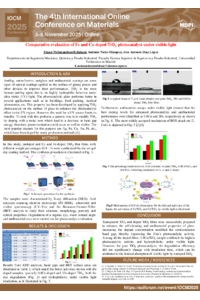
The purpose of this study was to prepare Cu- and Fe-doped TiO2 thin films using the sol-gel dipping method, thus determining how the addition of different dopants influenced its optical and antibacterial effectiveness. The structural and optical properties of the resulting photocatalysts were characterized using X-ray diffraction (XRD), field emission scanning electron microscopy (FE-SEM), and UV–Vis spectroscopy. The photocatalytic performance was evaluated through the degradation of methylene blue (MB) and the inactivation of Escherichia coli (E.Coli) under visible light irradiation. XRD analysis confirmed that the dominant crystalline phase for both pure and doped TiO2 calcined at 500 °C was anatase, with crystallite sizes ranging from 11 to 40 nm. The optical properties were studied by UV-vis spectroscopy to measure the band gaps in the wavelength range of 300 to 800 nm. The absorbance spectrum of doped TiO2 films shows that the absorption edge shifted towards longer wavelengths (redshifted) from 380 nm to 440 nm by increasing the amount of dopants. Tauc plot analysis revealed a band gap narrowing from 3.20 eV for pure TiO2 to 2.65 eV and 2.40 eV for Fe–TiO2 and Cu–TiO2, respectively. In terms of photocatalytic activity, both dopants demonstrated greater MB degradation efficiency than pure TiO2. Furthermore, antibacterial assays under visible light showed that 0.8Cu–TiO2 possessed superior antimicrobial activity against E.Coli compared to both pure and Fe-doped TiO2. The optimal doping levels for enhanced photocatalytic and antibacterial performance were identified as 0.8% Cu and 3.0% Fe, respectively.
Keywords
TiO2
Photocatalysis
glass
Antibactrial
Thin film
Methylene Blue
Escherichia coli
Poster
148169.pdf
Comparative studies of properties of hexaferrites obtained by modified co-precipitation methods
Rapid thermal annealing induced recrystallization led modification in structural and optical properties of Cu implanted MgTiO3 thin films