Event submissions
Published
This submission belongs to the session S2. Nanomaterials, Nanotechnology and Quantum Materials of the event The 4th International Online Conference on Materials
Published date
29 Oct, 2025
Academic Editor
'%3e%3cpath%20d='M12.6657%2010.9104C12.4185%2010.325%2012.0599%209.79327%2011.6097%209.34482C11.1609%208.89508%2010.6293%208.5365%2010.0442%208.28888C10.0389%208.28626%2010.0337%208.28495%2010.0285%208.28233C10.8446%207.69279%2011.3752%206.73249%2011.3752%205.64904C11.3752%203.8542%209.92103%202.39999%208.1262%202.39999C6.33136%202.39999%204.87715%203.8542%204.87715%205.64904C4.87715%206.73249%205.40774%207.69279%206.22393%208.28364C6.21869%208.28626%206.21345%208.28757%206.20821%208.29019C5.62129%208.5378%205.09463%208.89284%204.64265%209.34613C4.1929%209.79493%203.83432%2010.3266%203.58671%2010.9117C3.34345%2011.4845%203.21226%2012.0987%203.20023%2012.7209C3.19988%2012.7349%203.20233%2012.7488%203.20744%2012.7619C3.21255%2012.7749%203.22022%2012.7867%203.22998%2012.7968C3.23975%2012.8068%203.25142%2012.8147%203.26431%2012.8202C3.2772%2012.8256%203.29105%2012.8284%203.30504%2012.8284H4.09109C4.14874%2012.8284%204.19459%2012.7825%204.1959%2012.7262C4.2221%2011.7148%204.62823%2010.7676%205.34617%2010.0497C6.08899%209.30683%207.0755%208.89808%208.1262%208.89808C9.17689%208.89808%2010.1634%209.30683%2010.9062%2010.0497C11.6242%2010.7676%2012.0303%2011.7148%2012.0565%2012.7262C12.0578%2012.7838%2012.1037%2012.8284%2012.1613%2012.8284H12.9474C12.9613%2012.8284%2012.9752%2012.8256%2012.9881%2012.8202C13.001%2012.8147%2013.0126%2012.8068%2013.0224%2012.7968C13.0322%2012.7867%2013.0398%2012.7749%2013.0449%2012.7619C13.0501%2012.7488%2013.0525%2012.7349%2013.0522%2012.7209C13.0391%2012.0947%2012.9094%2011.4855%2012.6657%2010.9104ZM8.1262%207.9024C7.52486%207.9024%206.9589%207.6679%206.53312%207.24211C6.10733%206.81633%205.87283%206.25037%205.87283%205.64904C5.87283%205.0477%206.10733%204.48174%206.53312%204.05596C6.9589%203.63018%207.52486%203.39567%208.1262%203.39567C8.72753%203.39567%209.29349%203.63018%209.71927%204.05596C10.1451%204.48174%2010.3796%205.0477%2010.3796%205.64904C10.3796%206.25037%2010.1451%206.81633%209.71927%207.24211C9.29349%207.6679%208.72753%207.9024%208.1262%207.9024Z'%20fill='%235D1EE1'/%3e%3c/g%3e%3c/svg%3e) Xinyu Liu
Xinyu LiuCitation
Marianna V. Kharlamova, Preparation and electronic properties of nickel chloride-filled single-walled carbon nanotubes, in Proceedings of The 4th International Online Conference on Materials, 3 November–6 November 2025, MDPI: Basel, Switzerland
Share
Email
Facebook
Twitter
LinkedIn
Preparation and electronic properties of nickel chloride-filled single-walled carbon nanotubes

Marianna V. Kharlamova 1
1. Department of Materials Science, Lomonosov Moscow State University, Moscow, Russia
Abstract
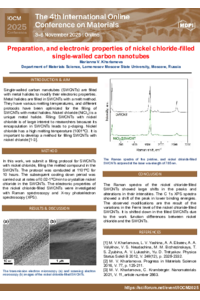
Single-walled carbon nanotubes (SWCNTs) are filled with metal halides to modify their electronic properties. Metal halides are filled in SWCNTs with a melt method. They have various melting temperatures, and different protocols have beenoptimized for the filling of SWCNTs with metal halides. Nickel chloride (NiCl2) is a unique metal halide. Filling SWCNTs with nickel chloride is of large interest to researchers because its encapsulation in SWCNTs leads to p-doping. Nickel chloride has a high melting temperature (1001ºC). It is important to develop a method for filling SWCNTs with nickel chloride. In this work, we submit a filling protocol forSWCNTs with nickel chloride, filling the melted compound in the SWCNTs. The protocol was conducted at 1101ºC for 10 hours. The subsequent cooling down period was carried out at rates of 0.02-1ºC/min to crystallize nickel chloride in the SWCNTs. The electronic properties of the nickel chloride-filled SWCNTs were investigated with Raman spectroscopy and X-ray photoelectron spectroscopy (XPS). The Raman spectra of the nickel chloride-filled SWCNTs showed large shifts in the peaks and alterations in their intensities. The C 1s XPS spectra showed a shift of the peak in lower binding energies. The observed modifications are the result of the variations in the Fermi level of the nickel chloride-filled SWCNTs. It is shifted down in the filled SWCNTs due to the work function differences between nickel chloride and the SWCNTs.
Keywords
carbon nanotube
nickel chloride
preparation
electronic properties
Poster
KharlamovaMV_sciforum-117937.pdf
Rapid thermal annealing induced recrystallization led modification in structural and optical properties of Cu implanted MgTiO3 thin films
Compressive strength, wettability, setting time, and setting expansion of type II dental gypsum modified with bentonite-activated carbon fillers