Event submissions
Published
This submission belongs to the session S2. Nanomaterials, Nanotechnology and Quantum Materials of the event The 4th International Online Conference on Materials
Published date
29 Oct, 2025
Academic Editor
'%3e%3cpath%20d='M12.6657%2010.9104C12.4185%2010.325%2012.0599%209.79327%2011.6097%209.34482C11.1609%208.89508%2010.6293%208.5365%2010.0442%208.28888C10.0389%208.28626%2010.0337%208.28495%2010.0285%208.28233C10.8446%207.69279%2011.3752%206.73249%2011.3752%205.64904C11.3752%203.8542%209.92103%202.39999%208.1262%202.39999C6.33136%202.39999%204.87715%203.8542%204.87715%205.64904C4.87715%206.73249%205.40774%207.69279%206.22393%208.28364C6.21869%208.28626%206.21345%208.28757%206.20821%208.29019C5.62129%208.5378%205.09463%208.89284%204.64265%209.34613C4.1929%209.79493%203.83432%2010.3266%203.58671%2010.9117C3.34345%2011.4845%203.21226%2012.0987%203.20023%2012.7209C3.19988%2012.7349%203.20233%2012.7488%203.20744%2012.7619C3.21255%2012.7749%203.22022%2012.7867%203.22998%2012.7968C3.23975%2012.8068%203.25142%2012.8147%203.26431%2012.8202C3.2772%2012.8256%203.29105%2012.8284%203.30504%2012.8284H4.09109C4.14874%2012.8284%204.19459%2012.7825%204.1959%2012.7262C4.2221%2011.7148%204.62823%2010.7676%205.34617%2010.0497C6.08899%209.30683%207.0755%208.89808%208.1262%208.89808C9.17689%208.89808%2010.1634%209.30683%2010.9062%2010.0497C11.6242%2010.7676%2012.0303%2011.7148%2012.0565%2012.7262C12.0578%2012.7838%2012.1037%2012.8284%2012.1613%2012.8284H12.9474C12.9613%2012.8284%2012.9752%2012.8256%2012.9881%2012.8202C13.001%2012.8147%2013.0126%2012.8068%2013.0224%2012.7968C13.0322%2012.7867%2013.0398%2012.7749%2013.0449%2012.7619C13.0501%2012.7488%2013.0525%2012.7349%2013.0522%2012.7209C13.0391%2012.0947%2012.9094%2011.4855%2012.6657%2010.9104ZM8.1262%207.9024C7.52486%207.9024%206.9589%207.6679%206.53312%207.24211C6.10733%206.81633%205.87283%206.25037%205.87283%205.64904C5.87283%205.0477%206.10733%204.48174%206.53312%204.05596C6.9589%203.63018%207.52486%203.39567%208.1262%203.39567C8.72753%203.39567%209.29349%203.63018%209.71927%204.05596C10.1451%204.48174%2010.3796%205.0477%2010.3796%205.64904C10.3796%206.25037%2010.1451%206.81633%209.71927%207.24211C9.29349%207.6679%208.72753%207.9024%208.1262%207.9024Z'%20fill='%235D1EE1'/%3e%3c/g%3e%3c/svg%3e) Xinyu Liu
Xinyu LiuCitation
Marianna V. Kharlamova, Lead chloride-filled single-walled carbon nanotubes, in Proceedings of The 4th International Online Conference on Materials, 3 November–6 November 2025, MDPI: Basel, Switzerland
Share
Email
Facebook
Twitter
LinkedIn
Lead chloride-filled single-walled carbon nanotubes

Marianna V. Kharlamova 1
1. Department of Materials Science, Lomonosov Moscow State University, Moscow, Russia
Abstract
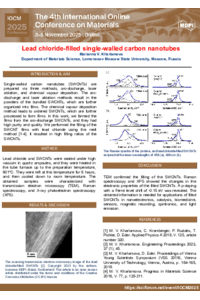
Single-walled carbon nanotubes (SWCNTs) are prepared via three methods, arc-discharge, laser ablation, and chemical vapour deposition. The arc-discharge and laser ablation methods result in the powders of the bundled SWCNTs, which are further organized into films. The chemical vapour deposition method leads to ordered SWCNTs, which are further processed to form films. In this work, we formed the films from the arc-discharge SWCNTs, and they had high purity and quality. We performed the filling of the SWCNT films with lead chloride using the melt method. It resulted in high filling ratios of the SWCNTs. Lead chloride and SWCNTs were sealed under high vacuum in quartz ampoules, and they were heated in the tube furnace up to the preparation temperature, 601°C. They were left at this temperature for 6 hours, and then cooled down to room temperature. The obtained samples were characterized with transmission electron microscopy (TEM), Raman spectroscopy, and X-ray photoelectron spectroscopy (XPS). TEM confirmed the filling of the SWCNTs. Raman spectroscopy and XPS showed the changes in the electronic properties of the filled SWCNTs. A p-doping with a Fermi level shift of -0.15 eV was revealed. The obtained information is needed for applications of filled SWCNTs in nanoelectronics, catalysis, biomedicine, sensors, magnetic recording, spintronics, and light emission.
Keywords
carbon nanotube
filling
lead chloride
Poster
KharlamovaMV_sciforum-119330.pdf
Compressive strength, wettability, setting time, and setting expansion of type II dental gypsum modified with bentonite-activated carbon fillers
Ecofriendly Synthesis and Multiscale Characterization of Abies marocana Needle-Derived Biosorbent for Wastewater Remediation