Event submissions
Published
This submission belongs to the session S2. Nanomaterials, Nanotechnology and Quantum Materials of the event The 4th International Online Conference on Materials
Published date
29 Oct, 2025
Academic Editor
'%3e%3cpath%20d='M12.6657%2010.9104C12.4185%2010.325%2012.0599%209.79327%2011.6097%209.34482C11.1609%208.89508%2010.6293%208.5365%2010.0442%208.28888C10.0389%208.28626%2010.0337%208.28495%2010.0285%208.28233C10.8446%207.69279%2011.3752%206.73249%2011.3752%205.64904C11.3752%203.8542%209.92103%202.39999%208.1262%202.39999C6.33136%202.39999%204.87715%203.8542%204.87715%205.64904C4.87715%206.73249%205.40774%207.69279%206.22393%208.28364C6.21869%208.28626%206.21345%208.28757%206.20821%208.29019C5.62129%208.5378%205.09463%208.89284%204.64265%209.34613C4.1929%209.79493%203.83432%2010.3266%203.58671%2010.9117C3.34345%2011.4845%203.21226%2012.0987%203.20023%2012.7209C3.19988%2012.7349%203.20233%2012.7488%203.20744%2012.7619C3.21255%2012.7749%203.22022%2012.7867%203.22998%2012.7968C3.23975%2012.8068%203.25142%2012.8147%203.26431%2012.8202C3.2772%2012.8256%203.29105%2012.8284%203.30504%2012.8284H4.09109C4.14874%2012.8284%204.19459%2012.7825%204.1959%2012.7262C4.2221%2011.7148%204.62823%2010.7676%205.34617%2010.0497C6.08899%209.30683%207.0755%208.89808%208.1262%208.89808C9.17689%208.89808%2010.1634%209.30683%2010.9062%2010.0497C11.6242%2010.7676%2012.0303%2011.7148%2012.0565%2012.7262C12.0578%2012.7838%2012.1037%2012.8284%2012.1613%2012.8284H12.9474C12.9613%2012.8284%2012.9752%2012.8256%2012.9881%2012.8202C13.001%2012.8147%2013.0126%2012.8068%2013.0224%2012.7968C13.0322%2012.7867%2013.0398%2012.7749%2013.0449%2012.7619C13.0501%2012.7488%2013.0525%2012.7349%2013.0522%2012.7209C13.0391%2012.0947%2012.9094%2011.4855%2012.6657%2010.9104ZM8.1262%207.9024C7.52486%207.9024%206.9589%207.6679%206.53312%207.24211C6.10733%206.81633%205.87283%206.25037%205.87283%205.64904C5.87283%205.0477%206.10733%204.48174%206.53312%204.05596C6.9589%203.63018%207.52486%203.39567%208.1262%203.39567C8.72753%203.39567%209.29349%203.63018%209.71927%204.05596C10.1451%204.48174%2010.3796%205.0477%2010.3796%205.64904C10.3796%206.25037%2010.1451%206.81633%209.71927%207.24211C9.29349%207.6679%208.72753%207.9024%208.1262%207.9024Z'%20fill='%235D1EE1'/%3e%3c/g%3e%3c/svg%3e) Xinyu Liu
Xinyu LiuCitation
Olga V. Akopova, Natalya Rybalchenko, Svitlana Zahorodnia, ANTIBACTERIAL AND ANTI-CANCER PROPERTIES OF Ag, Ni, AND Co NANOCOMPOSITES OBTAINED in situ IN A HYBRID POLYMER–INORGANIC CARRIER, in Proceedings of The 4th International Online Conference on Materials, 3 November–6 November 2025, MDPI: Basel, Switzerland
Share
Email
Facebook
Twitter
LinkedIn
ANTIBACTERIAL AND ANTI-CANCER PROPERTIES OF Ag, Ni, AND Co NANOCOMPOSITES OBTAINED in situ IN A HYBRID POLYMER–INORGANIC CARRIER

Olga V. Akopova 1,2
'%3e%3cpath%20d='M12.6647%2010.9104C12.4176%2010.325%2012.0589%209.7933%2011.6088%209.34485C11.16%208.89511%2010.6283%208.53653%2010.0432%208.28891C10.038%208.28629%2010.0327%208.28498%2010.0275%208.28236C10.8437%207.69282%2011.3743%206.73252%2011.3743%205.64907C11.3743%203.85423%209.92005%202.40002%208.12522%202.40002C6.33038%202.40002%204.87618%203.85423%204.87618%205.64907C4.87618%206.73252%205.40677%207.69282%206.22296%208.28367C6.21772%208.28629%206.21248%208.2876%206.20724%208.29022C5.62031%208.53783%205.09365%208.89287%204.64167%209.34616C4.19192%209.79496%203.83334%2010.3266%203.58573%2010.9117C3.34247%2011.4846%203.21128%2012.0987%203.19925%2012.721C3.1989%2012.735%203.20135%2012.7489%203.20646%2012.7619C3.21157%2012.7749%203.21924%2012.7868%203.22901%2012.7968C3.23877%2012.8068%203.25045%2012.8148%203.26334%2012.8202C3.27623%2012.8256%203.29007%2012.8284%203.30406%2012.8284H4.09012C4.14776%2012.8284%204.19362%2012.7825%204.19493%2012.7262C4.22113%2011.7148%204.62726%2010.7676%205.34519%2010.0497C6.08802%209.30686%207.07452%208.89811%208.12522%208.89811C9.17592%208.89811%2010.1624%209.30686%2010.9052%2010.0497C11.6232%2010.7676%2012.0293%2011.7148%2012.0555%2012.7262C12.0568%2012.7839%2012.1027%2012.8284%2012.1603%2012.8284H12.9464C12.9604%2012.8284%2012.9742%2012.8256%2012.9871%2012.8202C13%2012.8148%2013.0117%2012.8068%2013.0214%2012.7968C13.0312%2012.7868%2013.0389%2012.7749%2013.044%2012.7619C13.0491%2012.7489%2013.0515%2012.735%2013.0512%2012.721C13.0381%2012.0947%2012.9084%2011.4856%2012.6647%2010.9104ZM8.12522%207.90243C7.52388%207.90243%206.95792%207.66793%206.53214%207.24215C6.10636%206.81636%205.87185%206.2504%205.87185%205.64907C5.87185%205.04773%206.10636%204.48177%206.53214%204.05599C6.95792%203.63021%207.52388%203.3957%208.12522%203.3957C8.72655%203.3957%209.29252%203.63021%209.7183%204.05599C10.1441%204.48177%2010.3786%205.04773%2010.3786%205.64907C10.3786%206.2504%2010.1441%206.81636%209.7183%207.24215C9.29252%207.66793%208.72655%207.90243%208.12522%207.90243Z'%20fill='%235D1EE1'/%3e%3c/g%3e%3c/svg%3e)
Natalya Rybalchenko 3
Svitlana Zahorodnia 3
1. Bogomoletz Institute of Physiology NAS of Ukraine, 01601 Bogomoletz Str., 4, Kiev, Ukraine
2. Institute of Macromolecular Chemistry NAS of Ukraine48 Kharkivske Shosse, 02160 Kyiv, Ukraine
3. Zabolotny Institute of Microbiology and Virology NAS of Ukraine 154 Acad. Zabolotny Str., 03143 Kyiv Ukraine
Abstract
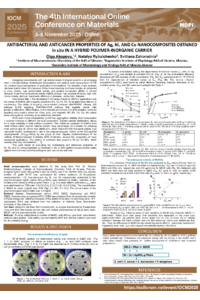
Introduction: Polymer-stabilized metal nanocomposites (MeNP) showed great nanobiotechnological potential. In addition to the widely studied AgNPs, magnetic MeNPs used for targeted drug delivery are of growing interest. Aims: We aimed to perform in vitro evaluation of the antibacterial and anti-cancer properties of low-nanometer-scale size Ag, Ni, and Co nanoparticles obtained for this study via borohydride reduction in situin a hybrid matrix SiO2-grafted polyacrilamide (SiO2-g-PAAm); SiO2 core rav 7 nm, MvPAA ~ 800 kDa, and mean particle diameters (dav) 6.1 (Ag), 2.7 (Ni), and 1.9 (Co) nm (Zheltonozhskaya et al. 2021; 2023; 2025). Methods: The Bacterial strains Escherichia coli (ATCC 25922), Staphylococcus aureus (ATCC 25923), and cancer cell lines B95-8 and Wish were used; MDCK cells were used as the control. Antibacterial activity was studied by serial dilutions and well diffusion methods; the MTT test was used for cell viability assay. Results: Antibacterial activity was inherent to AgNP only. For both microbial strains, the MIC of 11.0 µg/ml was at the level of tetracycline. The cytotoxicity was dependent on Me, but not on the cell type. The highest toxicity against B95-8 and Wish cancer cells was found in NiNP (IC50 1.9 and 2.5 µg/ml, respectively). CoNP exhibited moderate toxicity (IC50 6.3 and 5.31 µg/ml), while AgNP showed the least toxicity (IC50 9.2 µg/ml for both cell lines). In MDCK cells, IC50 20.6 µg/ml was reached by NiNP only. The matrix contributed to cytotoxicity in B95-8 cells but was not toxic to other cell types. Conclusions: Nanocomposites of low-nanometer-scale size MeNPs in a hybrid polymer–inorganic matrix SiO2-g-PAAm showed high antibacterial and anti-cancer efficiency and were much less toxic in their control of MDCK cells, which makes them promising for anti-bacterial and anti-cancer applications; however, the dependence of their effectiveness on Me and cell typesis in need of further study.
Keywords
polymer-inorganic hybrid
nanocomposites
metal nanoparticles
antibacterial properties
anticancer activity
nanomedicine
Poster
Akopova et al, Materials 2025 poster.pdf
Ecofriendly Synthesis and Multiscale Characterization of Abies marocana Needle-Derived Biosorbent for Wastewater Remediation
Role of Nanoparticle Geometry in the Electro-Optical Properties of Nematic Phases