Event submissions
Published
This submission belongs to the session S3. Soft Matter, Biomaterials, Composites and Interfaces of the event The 4th International Online Conference on Materials
Published date
29 Oct, 2025
Academic Editor
'%3e%3cpath%20d='M12.6657%2010.9104C12.4185%2010.325%2012.0599%209.79327%2011.6097%209.34482C11.1609%208.89508%2010.6293%208.5365%2010.0442%208.28888C10.0389%208.28626%2010.0337%208.28495%2010.0285%208.28233C10.8446%207.69279%2011.3752%206.73249%2011.3752%205.64904C11.3752%203.8542%209.92103%202.39999%208.1262%202.39999C6.33136%202.39999%204.87715%203.8542%204.87715%205.64904C4.87715%206.73249%205.40774%207.69279%206.22393%208.28364C6.21869%208.28626%206.21345%208.28757%206.20821%208.29019C5.62129%208.5378%205.09463%208.89284%204.64265%209.34613C4.1929%209.79493%203.83432%2010.3266%203.58671%2010.9117C3.34345%2011.4845%203.21226%2012.0987%203.20023%2012.7209C3.19988%2012.7349%203.20233%2012.7488%203.20744%2012.7619C3.21255%2012.7749%203.22022%2012.7867%203.22998%2012.7968C3.23975%2012.8068%203.25142%2012.8147%203.26431%2012.8202C3.2772%2012.8256%203.29105%2012.8284%203.30504%2012.8284H4.09109C4.14874%2012.8284%204.19459%2012.7825%204.1959%2012.7262C4.2221%2011.7148%204.62823%2010.7676%205.34617%2010.0497C6.08899%209.30683%207.0755%208.89808%208.1262%208.89808C9.17689%208.89808%2010.1634%209.30683%2010.9062%2010.0497C11.6242%2010.7676%2012.0303%2011.7148%2012.0565%2012.7262C12.0578%2012.7838%2012.1037%2012.8284%2012.1613%2012.8284H12.9474C12.9613%2012.8284%2012.9752%2012.8256%2012.9881%2012.8202C13.001%2012.8147%2013.0126%2012.8068%2013.0224%2012.7968C13.0322%2012.7867%2013.0398%2012.7749%2013.0449%2012.7619C13.0501%2012.7488%2013.0525%2012.7349%2013.0522%2012.7209C13.0391%2012.0947%2012.9094%2011.4855%2012.6657%2010.9104ZM8.1262%207.9024C7.52486%207.9024%206.9589%207.6679%206.53312%207.24211C6.10733%206.81633%205.87283%206.25037%205.87283%205.64904C5.87283%205.0477%206.10733%204.48174%206.53312%204.05596C6.9589%203.63018%207.52486%203.39567%208.1262%203.39567C8.72753%203.39567%209.29349%203.63018%209.71927%204.05596C10.1451%204.48174%2010.3796%205.0477%2010.3796%205.64904C10.3796%206.25037%2010.1451%206.81633%209.71927%207.24211C9.29349%207.6679%208.72753%207.9024%208.1262%207.9024Z'%20fill='%235D1EE1'/%3e%3c/g%3e%3c/svg%3e) Qingchun Yuan
Qingchun YuanCitation
Saleimah Ahmed Alyammahi, Fesmi Majeed, Wasseel Al Abbas, Amino-Functionalized MWCNT/Ecoflex Nanocomposites for Stimuli-Responsive Soft Robotic Actuation and Interfaces, in Proceedings of The 4th International Online Conference on Materials, 3 November–6 November 2025, MDPI: Basel, Switzerland
Share
Email
Facebook
Twitter
LinkedIn
Amino-Functionalized MWCNT/Ecoflex Nanocomposites for Stimuli-Responsive Soft Robotic Actuation and Interfaces
'%3e%3cpath%20d='M12.6647%2010.9104C12.4176%2010.325%2012.0589%209.7933%2011.6088%209.34485C11.16%208.89511%2010.6283%208.53653%2010.0432%208.28891C10.038%208.28629%2010.0327%208.28498%2010.0275%208.28236C10.8437%207.69282%2011.3743%206.73252%2011.3743%205.64907C11.3743%203.85423%209.92005%202.40002%208.12522%202.40002C6.33038%202.40002%204.87618%203.85423%204.87618%205.64907C4.87618%206.73252%205.40677%207.69282%206.22296%208.28367C6.21772%208.28629%206.21248%208.2876%206.20724%208.29022C5.62031%208.53783%205.09365%208.89287%204.64167%209.34616C4.19192%209.79496%203.83334%2010.3266%203.58573%2010.9117C3.34247%2011.4846%203.21128%2012.0987%203.19925%2012.721C3.1989%2012.735%203.20135%2012.7489%203.20646%2012.7619C3.21157%2012.7749%203.21924%2012.7868%203.22901%2012.7968C3.23877%2012.8068%203.25045%2012.8148%203.26334%2012.8202C3.27623%2012.8256%203.29007%2012.8284%203.30406%2012.8284H4.09012C4.14776%2012.8284%204.19362%2012.7825%204.19493%2012.7262C4.22113%2011.7148%204.62726%2010.7676%205.34519%2010.0497C6.08802%209.30686%207.07452%208.89811%208.12522%208.89811C9.17592%208.89811%2010.1624%209.30686%2010.9052%2010.0497C11.6232%2010.7676%2012.0293%2011.7148%2012.0555%2012.7262C12.0568%2012.7839%2012.1027%2012.8284%2012.1603%2012.8284H12.9464C12.9604%2012.8284%2012.9742%2012.8256%2012.9871%2012.8202C13%2012.8148%2013.0117%2012.8068%2013.0214%2012.7968C13.0312%2012.7868%2013.0389%2012.7749%2013.044%2012.7619C13.0491%2012.7489%2013.0515%2012.735%2013.0512%2012.721C13.0381%2012.0947%2012.9084%2011.4856%2012.6647%2010.9104ZM8.12522%207.90243C7.52388%207.90243%206.95792%207.66793%206.53214%207.24215C6.10636%206.81636%205.87185%206.2504%205.87185%205.64907C5.87185%205.04773%206.10636%204.48177%206.53214%204.05599C6.95792%203.63021%207.52388%203.3957%208.12522%203.3957C8.72655%203.3957%209.29252%203.63021%209.7183%204.05599C10.1441%204.48177%2010.3786%205.04773%2010.3786%205.64907C10.3786%206.2504%2010.1441%206.81636%209.7183%207.24215C9.29252%207.66793%208.72655%207.90243%208.12522%207.90243Z'%20fill='%235D1EE1'/%3e%3c/g%3e%3c/svg%3e)
Saleimah Ahmed Alyammahi 1
Fesmi Majeed 1
Wasseel Al Abbas 2
1. Department of Mechanical Engineering Technology, Engineering Technology & Science division, Faculty of engineering, Fujairah campus, Higher Colleges of Technology, Abu Dhabi, P.O.Box 25026, UAE.
2. Department of Electrical Engineering Technology, Engineering Technology & Science division, Faculty of engineering, Fujairah campus, Higher Colleges of Technology, Abu Dhabi, P.O.Box 25026, UAE.
Abstract
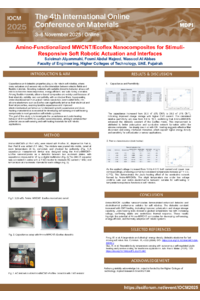
Soft polymer–nanotube composites are of growing interest for robotic and biomedical systems that require flexibility, conductivity, and adaptability. In this work, Ecoflex silicone elastomers were combined with commercially available amino-functionalized multi-walled carbon nanotubes to develop conductive and mechanically resilient nanocomposites. The amino groups are expected to enhance compatibility with the polymer, facilitating better dispersion and the formation of conductive pathways. Electrical conductivity will be modeled and measured across CNT concentrations to map percolation, while the composite’s thermal response will be experimentally characterized via Joule (self-)heating and external heating, recording ΔT–power and resistance–temperature (TCR) curves. Mechanical testing and cyclic actuation studies will assess flexibility and durability. Stimuli responsiveness will be evaluated under three inputs: (i) mechanical/pneumatic loading for strain and contact sensing in bending actuators; (ii) electrical input for on-demand thermal modulation and defogging; and (iii) thermal/photothermal input to characterize the resistance–temperature response and recovery. Preliminary trials indicate that conductivity remains limited at low CNT contents, highlighting the importance of optimizing dispersion and curing strategies. Early actuator prototypes exhibited pneumatic bending and measurable resistance variation under deformation, supporting integrated actuation–sensing. Overall, Ecoflex/amino-MWCNT composites show promise as a scalable, tunable platform for stimuli-responsive soft materials, bridging processing, percolation, and function and enabling applications in soft robotics, rehabilitation devices, and wearable adaptive systems.
Keywords
Soft nanocomposites
Ecoflex
Amino-functionalized carbon nanotubes
Soft robotics
Stimuli-responsive materials
Poster
conference poster.pdf
Regulation of the rate of biocorrosion and cytotoxicity of magnesium alloys by atomic layer deposition of oxide nanocoatings using
Determination the material properties of twill-woven glass fabric polymer composite using experimental modal analysis and numerical technique