Event submissions
Published
This submission belongs to the session S2. Nanomaterials, Nanotechnology and Quantum Materials of the event The 4th International Online Conference on Materials
Published date
29 Oct, 2025
Academic Editor
'%3e%3cpath%20d='M12.6657%2010.9104C12.4185%2010.325%2012.0599%209.79327%2011.6097%209.34482C11.1609%208.89508%2010.6293%208.5365%2010.0442%208.28888C10.0389%208.28626%2010.0337%208.28495%2010.0285%208.28233C10.8446%207.69279%2011.3752%206.73249%2011.3752%205.64904C11.3752%203.8542%209.92103%202.39999%208.1262%202.39999C6.33136%202.39999%204.87715%203.8542%204.87715%205.64904C4.87715%206.73249%205.40774%207.69279%206.22393%208.28364C6.21869%208.28626%206.21345%208.28757%206.20821%208.29019C5.62129%208.5378%205.09463%208.89284%204.64265%209.34613C4.1929%209.79493%203.83432%2010.3266%203.58671%2010.9117C3.34345%2011.4845%203.21226%2012.0987%203.20023%2012.7209C3.19988%2012.7349%203.20233%2012.7488%203.20744%2012.7619C3.21255%2012.7749%203.22022%2012.7867%203.22998%2012.7968C3.23975%2012.8068%203.25142%2012.8147%203.26431%2012.8202C3.2772%2012.8256%203.29105%2012.8284%203.30504%2012.8284H4.09109C4.14874%2012.8284%204.19459%2012.7825%204.1959%2012.7262C4.2221%2011.7148%204.62823%2010.7676%205.34617%2010.0497C6.08899%209.30683%207.0755%208.89808%208.1262%208.89808C9.17689%208.89808%2010.1634%209.30683%2010.9062%2010.0497C11.6242%2010.7676%2012.0303%2011.7148%2012.0565%2012.7262C12.0578%2012.7838%2012.1037%2012.8284%2012.1613%2012.8284H12.9474C12.9613%2012.8284%2012.9752%2012.8256%2012.9881%2012.8202C13.001%2012.8147%2013.0126%2012.8068%2013.0224%2012.7968C13.0322%2012.7867%2013.0398%2012.7749%2013.0449%2012.7619C13.0501%2012.7488%2013.0525%2012.7349%2013.0522%2012.7209C13.0391%2012.0947%2012.9094%2011.4855%2012.6657%2010.9104ZM8.1262%207.9024C7.52486%207.9024%206.9589%207.6679%206.53312%207.24211C6.10733%206.81633%205.87283%206.25037%205.87283%205.64904C5.87283%205.0477%206.10733%204.48174%206.53312%204.05596C6.9589%203.63018%207.52486%203.39567%208.1262%203.39567C8.72753%203.39567%209.29349%203.63018%209.71927%204.05596C10.1451%204.48174%2010.3796%205.0477%2010.3796%205.64904C10.3796%206.25037%2010.1451%206.81633%209.71927%207.24211C9.29349%207.6679%208.72753%207.9024%208.1262%207.9024Z'%20fill='%235D1EE1'/%3e%3c/g%3e%3c/svg%3e) Xinyu Liu
Xinyu LiuCitation
Chiara Maccato, Davide Barreca, Alberto Gasparotto, Naida El Habra, Andraž Šuligoj, Urška Lavrenčič Štangar, Gian Andrea Rizzi, Tailoring wettability and photocatalytic properties of NiO nanosystems fabricated by plasma-assisted vapor deposition, in Proceedings of The 4th International Online Conference on Materials, 3 November–6 November 2025, MDPI: Basel, Switzerland
Share
Email
Facebook
Twitter
LinkedIn
Tailoring wettability and photocatalytic properties of NiO nanosystems fabricated by plasma-assisted vapor deposition

Chiara Maccato 1,2

Davide Barreca 2
'%3e%3cpath%20d='M12.6647%2010.9104C12.4176%2010.325%2012.0589%209.7933%2011.6088%209.34485C11.16%208.89511%2010.6283%208.53653%2010.0432%208.28891C10.038%208.28629%2010.0327%208.28498%2010.0275%208.28236C10.8437%207.69282%2011.3743%206.73252%2011.3743%205.64907C11.3743%203.85423%209.92005%202.40002%208.12522%202.40002C6.33038%202.40002%204.87618%203.85423%204.87618%205.64907C4.87618%206.73252%205.40677%207.69282%206.22296%208.28367C6.21772%208.28629%206.21248%208.2876%206.20724%208.29022C5.62031%208.53783%205.09365%208.89287%204.64167%209.34616C4.19192%209.79496%203.83334%2010.3266%203.58573%2010.9117C3.34247%2011.4846%203.21128%2012.0987%203.19925%2012.721C3.1989%2012.735%203.20135%2012.7489%203.20646%2012.7619C3.21157%2012.7749%203.21924%2012.7868%203.22901%2012.7968C3.23877%2012.8068%203.25045%2012.8148%203.26334%2012.8202C3.27623%2012.8256%203.29007%2012.8284%203.30406%2012.8284H4.09012C4.14776%2012.8284%204.19362%2012.7825%204.19493%2012.7262C4.22113%2011.7148%204.62726%2010.7676%205.34519%2010.0497C6.08802%209.30686%207.07452%208.89811%208.12522%208.89811C9.17592%208.89811%2010.1624%209.30686%2010.9052%2010.0497C11.6232%2010.7676%2012.0293%2011.7148%2012.0555%2012.7262C12.0568%2012.7839%2012.1027%2012.8284%2012.1603%2012.8284H12.9464C12.9604%2012.8284%2012.9742%2012.8256%2012.9871%2012.8202C13%2012.8148%2013.0117%2012.8068%2013.0214%2012.7968C13.0312%2012.7868%2013.0389%2012.7749%2013.044%2012.7619C13.0491%2012.7489%2013.0515%2012.735%2013.0512%2012.721C13.0381%2012.0947%2012.9084%2011.4856%2012.6647%2010.9104ZM8.12522%207.90243C7.52388%207.90243%206.95792%207.66793%206.53214%207.24215C6.10636%206.81636%205.87185%206.2504%205.87185%205.64907C5.87185%205.04773%206.10636%204.48177%206.53214%204.05599C6.95792%203.63021%207.52388%203.3957%208.12522%203.3957C8.72655%203.3957%209.29252%203.63021%209.7183%204.05599C10.1441%204.48177%2010.3786%205.04773%2010.3786%205.64907C10.3786%206.2504%2010.1441%206.81636%209.7183%207.24215C9.29252%207.66793%208.72655%207.90243%208.12522%207.90243Z'%20fill='%235D1EE1'/%3e%3c/g%3e%3c/svg%3e)
Alberto Gasparotto 1,2

Naida El Habra 2

Andraž Šuligoj 3,4
Urška Lavrenčič Štangar 4

Gian Andrea Rizzi 1,2
1. Department of Chemical Sciences, Padova University and INSTM, 35131 Padova, Italy
2. CNR-ICMATE and INSTM, 35127 Padova, Italy
3. National Institute of Chemistry, Ljubljana SI-1000, Slovenia
4. Faculty of Chemistry and Chemical Technology, University of Ljubljana, Ljubljana SI-1000, Slovenia
Abstract
Thin films and nanomaterials of p-type nickel(II) oxide are attractive candidates for a plethora of technological end-uses, among which heterogeneous (photo)catalysts for various applications and hydrophobic coatings for protection against corrosion, yielding also anti-fouling, self-cleaning, and frost prevention properties [1,2].
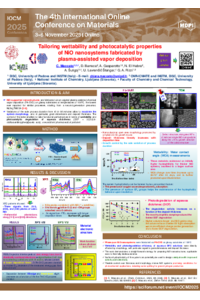
In this work, phase-pure NiO supported nanostructures were fabricated via an original plasma assisted-chemical vapor deposition (PA-CVD) on glassy substrates at temperatures of 100°C, the lowest ever reported for similar processes, starting from a second-generation precursor, Ni(tfa)2TMEDA (Htfa = 1,1,1-trifluoro-2,4-pentanedione; TMEDA = N,N,N’,N’-tetramethylethylenediamine) [3]. Variations of the sole process duration from 10 to 90 minutes allowed to modulate the system morphology, and, in particular, grain dimensions and deposit thickness. The control of the latter enabled to tailor the ultimate functional performances in terms of wettability and photocatalytic degradation of aqueous diclofenac {DCF = 2-[2-(2,6-dichloroanilino)phenyl]acetic acid}, a recalcitrant pharmaceutical pollutant. Material behavior is discussed in relation to material structure, composition and morphology, investigated based on a comprehensive characterization performed by complementary analytical tools. The present outcomes open the door to the fabrication of NiO nanostructures with modular features even on thermally sensitive substrates for a variety of functional applications.
[1] D. Barreca, E. Scattolin, C. Maccato, A. Gasparotto, L. Signorin, N. El Habra, A. Šuligoj, U. Lavrenčič Štangar, G.A. Rizzi, Chem. Commun., 2025, 61, 2945.
[2] D. Barreca C. Maccato, A. Gasparotto, G.A. Rizzi, Surf. Sci. Spectra, 2025, 32, 024005.
[3] M. Benedet, D. Barreca, E. Fois, R. Seraglia, G. Tabacchi, M. Roverso, G. Pagot, C. Invernizzi, A. Gasparotto, A.A. Heidecker, A. Pöthig, E. Callone, S. Dirè, S. Bogialli, V. Di Noto, and C. Maccato, Dalton Trans., 2023, 52, 10677.
Keywords
NiO
nanosystems
plasma assisted-chemical vapor deposition
wettability
photocatalytic degradation
Poster
IOCM 2025 - sciforum-137903_Maccato.pdf
The influence of the titanium dioxide surface modification on the selected physicochemical and biological characteristics of the biopolymer foams.
Synthesis and Characterization of Dual-Responsive Hydrogels for Biomedical Use