Event submissions
Published
This submission belongs to the session S3. Soft Matter, Biomaterials, Composites and Interfaces of the event The 4th International Online Conference on Materials
Published date
29 Oct, 2025
Academic Editor
'%3e%3cpath%20d='M12.6657%2010.9104C12.4185%2010.325%2012.0599%209.79327%2011.6097%209.34482C11.1609%208.89508%2010.6293%208.5365%2010.0442%208.28888C10.0389%208.28626%2010.0337%208.28495%2010.0285%208.28233C10.8446%207.69279%2011.3752%206.73249%2011.3752%205.64904C11.3752%203.8542%209.92103%202.39999%208.1262%202.39999C6.33136%202.39999%204.87715%203.8542%204.87715%205.64904C4.87715%206.73249%205.40774%207.69279%206.22393%208.28364C6.21869%208.28626%206.21345%208.28757%206.20821%208.29019C5.62129%208.5378%205.09463%208.89284%204.64265%209.34613C4.1929%209.79493%203.83432%2010.3266%203.58671%2010.9117C3.34345%2011.4845%203.21226%2012.0987%203.20023%2012.7209C3.19988%2012.7349%203.20233%2012.7488%203.20744%2012.7619C3.21255%2012.7749%203.22022%2012.7867%203.22998%2012.7968C3.23975%2012.8068%203.25142%2012.8147%203.26431%2012.8202C3.2772%2012.8256%203.29105%2012.8284%203.30504%2012.8284H4.09109C4.14874%2012.8284%204.19459%2012.7825%204.1959%2012.7262C4.2221%2011.7148%204.62823%2010.7676%205.34617%2010.0497C6.08899%209.30683%207.0755%208.89808%208.1262%208.89808C9.17689%208.89808%2010.1634%209.30683%2010.9062%2010.0497C11.6242%2010.7676%2012.0303%2011.7148%2012.0565%2012.7262C12.0578%2012.7838%2012.1037%2012.8284%2012.1613%2012.8284H12.9474C12.9613%2012.8284%2012.9752%2012.8256%2012.9881%2012.8202C13.001%2012.8147%2013.0126%2012.8068%2013.0224%2012.7968C13.0322%2012.7867%2013.0398%2012.7749%2013.0449%2012.7619C13.0501%2012.7488%2013.0525%2012.7349%2013.0522%2012.7209C13.0391%2012.0947%2012.9094%2011.4855%2012.6657%2010.9104ZM8.1262%207.9024C7.52486%207.9024%206.9589%207.6679%206.53312%207.24211C6.10733%206.81633%205.87283%206.25037%205.87283%205.64904C5.87283%205.0477%206.10733%204.48174%206.53312%204.05596C6.9589%203.63018%207.52486%203.39567%208.1262%203.39567C8.72753%203.39567%209.29349%203.63018%209.71927%204.05596C10.1451%204.48174%2010.3796%205.0477%2010.3796%205.64904C10.3796%206.25037%2010.1451%206.81633%209.71927%207.24211C9.29349%207.6679%208.72753%207.9024%208.1262%207.9024Z'%20fill='%235D1EE1'/%3e%3c/g%3e%3c/svg%3e) Qingchun Yuan
Qingchun YuanCitation
Avdhesh Kumar, Ankit Singh, Sarva Shakti Singh, Naveen Chaurasia, Manish Pratap Singh, Graphene–MXene Heterostructure for Combating Bacterial Infections: A Step Toward Safer Health and Environment, in Proceedings of The 4th International Online Conference on Materials, 3 November–6 November 2025, MDPI: Basel, Switzerland
Share
Email
Facebook
Twitter
LinkedIn
Graphene–MXene Heterostructure for Combating Bacterial Infections: A Step Toward Safer Health and Environment

Avdhesh Kumar 1
'%3e%3cpath%20d='M12.6647%2010.9104C12.4176%2010.325%2012.0589%209.7933%2011.6088%209.34485C11.16%208.89511%2010.6283%208.53653%2010.0432%208.28891C10.038%208.28629%2010.0327%208.28498%2010.0275%208.28236C10.8437%207.69282%2011.3743%206.73252%2011.3743%205.64907C11.3743%203.85423%209.92005%202.40002%208.12522%202.40002C6.33038%202.40002%204.87618%203.85423%204.87618%205.64907C4.87618%206.73252%205.40677%207.69282%206.22296%208.28367C6.21772%208.28629%206.21248%208.2876%206.20724%208.29022C5.62031%208.53783%205.09365%208.89287%204.64167%209.34616C4.19192%209.79496%203.83334%2010.3266%203.58573%2010.9117C3.34247%2011.4846%203.21128%2012.0987%203.19925%2012.721C3.1989%2012.735%203.20135%2012.7489%203.20646%2012.7619C3.21157%2012.7749%203.21924%2012.7868%203.22901%2012.7968C3.23877%2012.8068%203.25045%2012.8148%203.26334%2012.8202C3.27623%2012.8256%203.29007%2012.8284%203.30406%2012.8284H4.09012C4.14776%2012.8284%204.19362%2012.7825%204.19493%2012.7262C4.22113%2011.7148%204.62726%2010.7676%205.34519%2010.0497C6.08802%209.30686%207.07452%208.89811%208.12522%208.89811C9.17592%208.89811%2010.1624%209.30686%2010.9052%2010.0497C11.6232%2010.7676%2012.0293%2011.7148%2012.0555%2012.7262C12.0568%2012.7839%2012.1027%2012.8284%2012.1603%2012.8284H12.9464C12.9604%2012.8284%2012.9742%2012.8256%2012.9871%2012.8202C13%2012.8148%2013.0117%2012.8068%2013.0214%2012.7968C13.0312%2012.7868%2013.0389%2012.7749%2013.044%2012.7619C13.0491%2012.7489%2013.0515%2012.735%2013.0512%2012.721C13.0381%2012.0947%2012.9084%2011.4856%2012.6647%2010.9104ZM8.12522%207.90243C7.52388%207.90243%206.95792%207.66793%206.53214%207.24215C6.10636%206.81636%205.87185%206.2504%205.87185%205.64907C5.87185%205.04773%206.10636%204.48177%206.53214%204.05599C6.95792%203.63021%207.52388%203.3957%208.12522%203.3957C8.72655%203.3957%209.29252%203.63021%209.7183%204.05599C10.1441%204.48177%2010.3786%205.04773%2010.3786%205.64907C10.3786%206.2504%2010.1441%206.81636%209.7183%207.24215C9.29252%207.66793%208.72655%207.90243%208.12522%207.90243Z'%20fill='%235D1EE1'/%3e%3c/g%3e%3c/svg%3e)
Ankit Singh 1
Sarva Shakti Singh 2
Naveen Chaurasia 3
Manish Pratap Singh 1
1. Department of Physics, Faculty of Engineering and Technology, Veer Bahadur Singh Purvanchal University, Jaunpur-222003, India
2. Department of Physics, Chowdhary Mahadeo Prasad Degree College, University of Allahabad, Allahabad 211002, India
3. Department of Mechanical Engineering, Faculty of Engineering and Technology, Veer Bahadur Singh Purvanchal University, Jaunpur-222003, India
Abstract
The increasing threat of bacterial infections and the limitations of conventional antibiotics have intensified the search for innovative antimicrobial substances. This study examines a heterostructure nanomaterial of single layer graphene (SLG) and delaminated MXene (d-Ti3C2Tx), designed to efficiently inhibit bacterial growth. MXene was synthesised using selective etching and delamination, while the SLG/d-Ti3C2Tx composite was prepared via ultrasonication to ensure uniform dispersion and interfacial interaction between the materials. Powder X-ray diffraction (PXRD), FTIR, and FE-SEM confirmed the successful integration of the 2D d-Ti3C2Tx and SLG. Antibacterial activity was assessed using two methods: optical density and colony-forming unit (CFU) quantification. At 500 µg/mL, the SLG/d-Ti3C2Tx heterostructure demonstrated the strongest antibacterial activity among all materials investigated. Low CFU counts and significant inhibition of bacterial growth were observed. The enhanced activity is attributed to the large surface area of graphene and the sharp edges and surface functionalities of d-Ti3C2Tx, which damage microbial membranes and obstruct cellular processes. The results clearly demonstrate that SLG/d-Ti3C2Tx acts as an effective antibacterial agent. This study opens new avenues for the future development of 2D heterostructures engineered for microbial resistance under diverse conditions. Thus, the designing of the 2D/2D heterostructure SLG/d-Ti3C2Tx is a promising strategy to achieve the antimicrobial activity for various applications.
Keywords
antimicrobial
single layer
heterostructure
bacteria
Poster
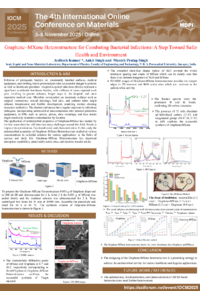
IOCM 2025 - poster Avdhesh.pdf
Microwave spectral analysis of watermelon fruit juice using time-domain reflectrometry
Surface-Engineered Graphene Oxide–MXene–SLG Composite with Enhanced Bactericidal Properties.