Event submissions
Published
This submission belongs to the session S3. Soft Matter, Biomaterials, Composites and Interfaces of the event The 4th International Online Conference on Materials
Published date
29 Oct, 2025
Academic Editor
'%3e%3cpath%20d='M12.6657%2010.9104C12.4185%2010.325%2012.0599%209.79327%2011.6097%209.34482C11.1609%208.89508%2010.6293%208.5365%2010.0442%208.28888C10.0389%208.28626%2010.0337%208.28495%2010.0285%208.28233C10.8446%207.69279%2011.3752%206.73249%2011.3752%205.64904C11.3752%203.8542%209.92103%202.39999%208.1262%202.39999C6.33136%202.39999%204.87715%203.8542%204.87715%205.64904C4.87715%206.73249%205.40774%207.69279%206.22393%208.28364C6.21869%208.28626%206.21345%208.28757%206.20821%208.29019C5.62129%208.5378%205.09463%208.89284%204.64265%209.34613C4.1929%209.79493%203.83432%2010.3266%203.58671%2010.9117C3.34345%2011.4845%203.21226%2012.0987%203.20023%2012.7209C3.19988%2012.7349%203.20233%2012.7488%203.20744%2012.7619C3.21255%2012.7749%203.22022%2012.7867%203.22998%2012.7968C3.23975%2012.8068%203.25142%2012.8147%203.26431%2012.8202C3.2772%2012.8256%203.29105%2012.8284%203.30504%2012.8284H4.09109C4.14874%2012.8284%204.19459%2012.7825%204.1959%2012.7262C4.2221%2011.7148%204.62823%2010.7676%205.34617%2010.0497C6.08899%209.30683%207.0755%208.89808%208.1262%208.89808C9.17689%208.89808%2010.1634%209.30683%2010.9062%2010.0497C11.6242%2010.7676%2012.0303%2011.7148%2012.0565%2012.7262C12.0578%2012.7838%2012.1037%2012.8284%2012.1613%2012.8284H12.9474C12.9613%2012.8284%2012.9752%2012.8256%2012.9881%2012.8202C13.001%2012.8147%2013.0126%2012.8068%2013.0224%2012.7968C13.0322%2012.7867%2013.0398%2012.7749%2013.0449%2012.7619C13.0501%2012.7488%2013.0525%2012.7349%2013.0522%2012.7209C13.0391%2012.0947%2012.9094%2011.4855%2012.6657%2010.9104ZM8.1262%207.9024C7.52486%207.9024%206.9589%207.6679%206.53312%207.24211C6.10733%206.81633%205.87283%206.25037%205.87283%205.64904C5.87283%205.0477%206.10733%204.48174%206.53312%204.05596C6.9589%203.63018%207.52486%203.39567%208.1262%203.39567C8.72753%203.39567%209.29349%203.63018%209.71927%204.05596C10.1451%204.48174%2010.3796%205.0477%2010.3796%205.64904C10.3796%206.25037%2010.1451%206.81633%209.71927%207.24211C9.29349%207.6679%208.72753%207.9024%208.1262%207.9024Z'%20fill='%235D1EE1'/%3e%3c/g%3e%3c/svg%3e) Ingo Dierking
Ingo DierkingCitation
Krzysztof Szymkiewicz, Optimization of a Porous Graded Ti-HAP Osteosynthesis Plate for Tibia Fracture Fixation, in Proceedings of The 4th International Online Conference on Materials, 3 November–6 November 2025, MDPI: Basel, Switzerland
Share
Email
Facebook
Twitter
LinkedIn
Optimization of a Porous Graded Ti-HAP Osteosynthesis Plate for Tibia Fracture Fixation

Krzysztof Szymkiewicz 1
1. Faculty of Mechanical Engineering, Cracow University of Technology, Kraków, 31-155, Poland
Abstract
Introduction
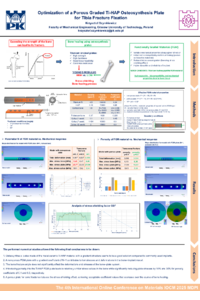
Bone structures that have fractured due to exceeding their strength limits are often treated using osteosynthesis plates. They are usually produced using titanium alloys, due to their high strength and biocompatibility. Nevertheless, their relatively high Young’s modulus compared to the bone can lead to excessive offloading of the bone and the phenomenon known as stress shielding. Therefore, a good replacement material seems to be a metal–ceramic functionally graded (FGM) Ti-HAP material, which exhibits anisotropic mechanical properties along a specific direction. Moreover, ceramic hydroxyapatite has properties close to bone, which is an additional advantage of this material approach. A promising extension of FGM is the incorporation of structural porosity, especially in biomedical applications, as it can have a beneficial effect on bone healing processes. However, understanding the effect of a porous Ti-HAP FGM plate on the properties of the bone–plate interface is essential. Therefore, the aim of this study was to assess the influence of the gradient bone plate on deformation, strain, and the stress shielding phenomenon in a bone model.
Methods
A typical osteosynthesis plate was modelled. The isotropic properties of the graded Ti-HAP material were calculated using the Power Law. The different porosity properties including number and size of pores were considered. The prepared plate was attached to a simplified tibia bone model represented as a cylinder, consisting of cortical and trabecular parts. The different boundary conditions like type and angle of fracture or bone healing level were analysed.
Results and conclusions
The performed findings revealed that porosity can positively affect the reduction stress shielding. The porous graded Ti-HAP plate was characterized by slightly reduced mechanical properties compared to the system with a dense plate and may promote the remodeling process of the fractured bone. Numerical simulations showed the model can be further optimized using topology methods.
Keywords
osteosynthesis plate
functionally graded material
FGM
porous bone plate
fractured bone fixation
Poster
Poster K.Szymkiewicz-MDPI conference.pdf
Ultrasensitive and rapid Detection of LPG Below Sub-LEL Using MoTe₂ Thin Films: A Room Temperature Approach
Synthesis of Zn-Co Bimetallic MOFs on Polymeric Membranes for Selective Direct Lithium Extraction from Brines