Event submissions
Published
This submission belongs to the session S2. Nanomaterials, Nanotechnology and Quantum Materials of the event The 4th International Online Conference on Materials
Published date
29 Oct, 2025
Academic Editor
'%3e%3cpath%20d='M12.6657%2010.9104C12.4185%2010.325%2012.0599%209.79327%2011.6097%209.34482C11.1609%208.89508%2010.6293%208.5365%2010.0442%208.28888C10.0389%208.28626%2010.0337%208.28495%2010.0285%208.28233C10.8446%207.69279%2011.3752%206.73249%2011.3752%205.64904C11.3752%203.8542%209.92103%202.39999%208.1262%202.39999C6.33136%202.39999%204.87715%203.8542%204.87715%205.64904C4.87715%206.73249%205.40774%207.69279%206.22393%208.28364C6.21869%208.28626%206.21345%208.28757%206.20821%208.29019C5.62129%208.5378%205.09463%208.89284%204.64265%209.34613C4.1929%209.79493%203.83432%2010.3266%203.58671%2010.9117C3.34345%2011.4845%203.21226%2012.0987%203.20023%2012.7209C3.19988%2012.7349%203.20233%2012.7488%203.20744%2012.7619C3.21255%2012.7749%203.22022%2012.7867%203.22998%2012.7968C3.23975%2012.8068%203.25142%2012.8147%203.26431%2012.8202C3.2772%2012.8256%203.29105%2012.8284%203.30504%2012.8284H4.09109C4.14874%2012.8284%204.19459%2012.7825%204.1959%2012.7262C4.2221%2011.7148%204.62823%2010.7676%205.34617%2010.0497C6.08899%209.30683%207.0755%208.89808%208.1262%208.89808C9.17689%208.89808%2010.1634%209.30683%2010.9062%2010.0497C11.6242%2010.7676%2012.0303%2011.7148%2012.0565%2012.7262C12.0578%2012.7838%2012.1037%2012.8284%2012.1613%2012.8284H12.9474C12.9613%2012.8284%2012.9752%2012.8256%2012.9881%2012.8202C13.001%2012.8147%2013.0126%2012.8068%2013.0224%2012.7968C13.0322%2012.7867%2013.0398%2012.7749%2013.0449%2012.7619C13.0501%2012.7488%2013.0525%2012.7349%2013.0522%2012.7209C13.0391%2012.0947%2012.9094%2011.4855%2012.6657%2010.9104ZM8.1262%207.9024C7.52486%207.9024%206.9589%207.6679%206.53312%207.24211C6.10733%206.81633%205.87283%206.25037%205.87283%205.64904C5.87283%205.0477%206.10733%204.48174%206.53312%204.05596C6.9589%203.63018%207.52486%203.39567%208.1262%203.39567C8.72753%203.39567%209.29349%203.63018%209.71927%204.05596C10.1451%204.48174%2010.3796%205.0477%2010.3796%205.64904C10.3796%206.25037%2010.1451%206.81633%209.71927%207.24211C9.29349%207.6679%208.72753%207.9024%208.1262%207.9024Z'%20fill='%235D1EE1'/%3e%3c/g%3e%3c/svg%3e) Xinyu Liu
Xinyu LiuCitation
kalyani pathak, Aparoop Das, Jon Jyoti Sahariah, Partha Protim Borthakur, Biomedical Applications of Graphene Oxide Nanomaterials: Progress and Prospects, in Proceedings of The 4th International Online Conference on Materials, 3 November–6 November 2025, MDPI: Basel, Switzerland
Share
Email
Facebook
Twitter
LinkedIn
Biomedical Applications of Graphene Oxide Nanomaterials: Progress and Prospects

kalyani pathak 1
'%3e%3cpath%20d='M12.6647%2010.9104C12.4176%2010.325%2012.0589%209.7933%2011.6088%209.34485C11.16%208.89511%2010.6283%208.53653%2010.0432%208.28891C10.038%208.28629%2010.0327%208.28498%2010.0275%208.28236C10.8437%207.69282%2011.3743%206.73252%2011.3743%205.64907C11.3743%203.85423%209.92005%202.40002%208.12522%202.40002C6.33038%202.40002%204.87618%203.85423%204.87618%205.64907C4.87618%206.73252%205.40677%207.69282%206.22296%208.28367C6.21772%208.28629%206.21248%208.2876%206.20724%208.29022C5.62031%208.53783%205.09365%208.89287%204.64167%209.34616C4.19192%209.79496%203.83334%2010.3266%203.58573%2010.9117C3.34247%2011.4846%203.21128%2012.0987%203.19925%2012.721C3.1989%2012.735%203.20135%2012.7489%203.20646%2012.7619C3.21157%2012.7749%203.21924%2012.7868%203.22901%2012.7968C3.23877%2012.8068%203.25045%2012.8148%203.26334%2012.8202C3.27623%2012.8256%203.29007%2012.8284%203.30406%2012.8284H4.09012C4.14776%2012.8284%204.19362%2012.7825%204.19493%2012.7262C4.22113%2011.7148%204.62726%2010.7676%205.34519%2010.0497C6.08802%209.30686%207.07452%208.89811%208.12522%208.89811C9.17592%208.89811%2010.1624%209.30686%2010.9052%2010.0497C11.6232%2010.7676%2012.0293%2011.7148%2012.0555%2012.7262C12.0568%2012.7839%2012.1027%2012.8284%2012.1603%2012.8284H12.9464C12.9604%2012.8284%2012.9742%2012.8256%2012.9871%2012.8202C13%2012.8148%2013.0117%2012.8068%2013.0214%2012.7968C13.0312%2012.7868%2013.0389%2012.7749%2013.044%2012.7619C13.0491%2012.7489%2013.0515%2012.735%2013.0512%2012.721C13.0381%2012.0947%2012.9084%2011.4856%2012.6647%2010.9104ZM8.12522%207.90243C7.52388%207.90243%206.95792%207.66793%206.53214%207.24215C6.10636%206.81636%205.87185%206.2504%205.87185%205.64907C5.87185%205.04773%206.10636%204.48177%206.53214%204.05599C6.95792%203.63021%207.52388%203.3957%208.12522%203.3957C8.72655%203.3957%209.29252%203.63021%209.7183%204.05599C10.1441%204.48177%2010.3786%205.04773%2010.3786%205.64907C10.3786%206.2504%2010.1441%206.81636%209.7183%207.24215C9.29252%207.66793%208.72655%207.90243%208.12522%207.90243Z'%20fill='%235D1EE1'/%3e%3c/g%3e%3c/svg%3e)
Aparoop Das 1
Jon Jyoti Sahariah 1

Partha Protim Borthakur 2
1. Department of Pharmaceutical Sciences, Dibrugarh University, Dibrugarh, 786004, India
2. Department of Mechanical Engineering, Dibrugarh University, Dibrugarh, 786004, India
Abstract
Introduction:
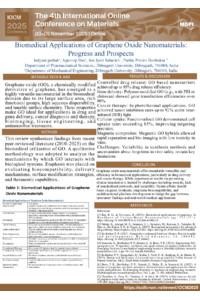
Graphene oxide (GO), a chemically modified derivative of graphene, has emerged as a highly versatile nanomaterial in the biomedical domain due to its large surface area, rich functional groups, high aqueous dispersibility, and tunable surface chemistry. These properties make GO ideal for applications in drug and gene delivery, cancer diagnosis and therapy, bioimaging, tissue engineering, and antimicrobial treatments.
Methods:
This review synthesizes findings from the recent peer-reviewed literature (2010–2025) on the biomedical utilization of GO. A qualitative methodology was adopted to analyze the mechanisms by which GO interacts with biological systems. Emphasis was placed on evaluating biocompatibility, delivery mechanisms, surface modification strategies, and theranostic capabilities.
Results:
GO-based nanocarriers demonstrated controlled drug release efficiencies of up to 95% and gene transfection efficiencies exceeding 80% when modified with polymers like polyethyleneimine (PEI) or chitosan. In cancer photothermal therapy, GO exhibited tumor inhibition rates of up to 92% under near-infrared (NIR) light. Cellular uptake rates of functionalized GO often exceeded 85%, enhancing targeting precision. Additionally, magnetic GO composites enabled rapid separation and imaging, with minimal toxicity in in vitro systems. However, variability in synthesis methods and concerns over long-term in vivo effects were frequently cited.
Conclusion:
Graphene oxide nanomaterials offer remarkable versatility and efficiency in biomedical applications, particularly in drug delivery and cancer therapy. While the experimental results are promising, clinical translation is limited by challenges including toxicity, the lack of standardized protocols, and scalability. Future efforts should focus on green synthesis, long-term biocompatibility, and multifunctional platform development to bridge the gap between laboratory findings and real-world medical applications.
Keywords
Graphene Oxide (GO)
Biomedical Applications
Drug and Gene Delivery
Cancer Theranostics
Nanomaterials
Poster
kalyani.pdf
Nanostructure-Based Voltammetric Biosensors: Versatile Point-of-Care Electrochemical Platform Development
CLAYEY SOIL IMPROVEMENT: SUSTAINABLE SOLUTIONS WITH LADLE FURNACE SLAG AND RECYCLED FIBERS FROM WIND TURBINE BLADE WASTE