Event submissions
Published
This submission belongs to the session S2. Nanomaterials, Nanotechnology and Quantum Materials of the event The 4th International Online Conference on Materials
Published date
29 Oct, 2025
Academic Editor
'%3e%3cpath%20d='M12.6657%2010.9104C12.4185%2010.325%2012.0599%209.79327%2011.6097%209.34482C11.1609%208.89508%2010.6293%208.5365%2010.0442%208.28888C10.0389%208.28626%2010.0337%208.28495%2010.0285%208.28233C10.8446%207.69279%2011.3752%206.73249%2011.3752%205.64904C11.3752%203.8542%209.92103%202.39999%208.1262%202.39999C6.33136%202.39999%204.87715%203.8542%204.87715%205.64904C4.87715%206.73249%205.40774%207.69279%206.22393%208.28364C6.21869%208.28626%206.21345%208.28757%206.20821%208.29019C5.62129%208.5378%205.09463%208.89284%204.64265%209.34613C4.1929%209.79493%203.83432%2010.3266%203.58671%2010.9117C3.34345%2011.4845%203.21226%2012.0987%203.20023%2012.7209C3.19988%2012.7349%203.20233%2012.7488%203.20744%2012.7619C3.21255%2012.7749%203.22022%2012.7867%203.22998%2012.7968C3.23975%2012.8068%203.25142%2012.8147%203.26431%2012.8202C3.2772%2012.8256%203.29105%2012.8284%203.30504%2012.8284H4.09109C4.14874%2012.8284%204.19459%2012.7825%204.1959%2012.7262C4.2221%2011.7148%204.62823%2010.7676%205.34617%2010.0497C6.08899%209.30683%207.0755%208.89808%208.1262%208.89808C9.17689%208.89808%2010.1634%209.30683%2010.9062%2010.0497C11.6242%2010.7676%2012.0303%2011.7148%2012.0565%2012.7262C12.0578%2012.7838%2012.1037%2012.8284%2012.1613%2012.8284H12.9474C12.9613%2012.8284%2012.9752%2012.8256%2012.9881%2012.8202C13.001%2012.8147%2013.0126%2012.8068%2013.0224%2012.7968C13.0322%2012.7867%2013.0398%2012.7749%2013.0449%2012.7619C13.0501%2012.7488%2013.0525%2012.7349%2013.0522%2012.7209C13.0391%2012.0947%2012.9094%2011.4855%2012.6657%2010.9104ZM8.1262%207.9024C7.52486%207.9024%206.9589%207.6679%206.53312%207.24211C6.10733%206.81633%205.87283%206.25037%205.87283%205.64904C5.87283%205.0477%206.10733%204.48174%206.53312%204.05596C6.9589%203.63018%207.52486%203.39567%208.1262%203.39567C8.72753%203.39567%209.29349%203.63018%209.71927%204.05596C10.1451%204.48174%2010.3796%205.0477%2010.3796%205.64904C10.3796%206.25037%2010.1451%206.81633%209.71927%207.24211C9.29349%207.6679%208.72753%207.9024%208.1262%207.9024Z'%20fill='%235D1EE1'/%3e%3c/g%3e%3c/svg%3e) Xinyu Liu
Xinyu LiuCitation
Partha Protim Borthakur, Madhuriya Saikia, Elora Baruah, Keshab Biswakarma, Recent Advances in Carbon Nanotube-Reinforced Epoxy Composites: Enhancing Tensile Strength through Nanoscale Reinforcement, in Proceedings of The 4th International Online Conference on Materials, 3 November–6 November 2025, MDPI: Basel, Switzerland
Share
Email
Facebook
Twitter
LinkedIn
Recent Advances in Carbon Nanotube-Reinforced Epoxy Composites: Enhancing Tensile Strength through Nanoscale Reinforcement

Partha Protim Borthakur 1
'%3e%3cpath%20d='M12.6647%2010.9104C12.4176%2010.325%2012.0589%209.7933%2011.6088%209.34485C11.16%208.89511%2010.6283%208.53653%2010.0432%208.28891C10.038%208.28629%2010.0327%208.28498%2010.0275%208.28236C10.8437%207.69282%2011.3743%206.73252%2011.3743%205.64907C11.3743%203.85423%209.92005%202.40002%208.12522%202.40002C6.33038%202.40002%204.87618%203.85423%204.87618%205.64907C4.87618%206.73252%205.40677%207.69282%206.22296%208.28367C6.21772%208.28629%206.21248%208.2876%206.20724%208.29022C5.62031%208.53783%205.09365%208.89287%204.64167%209.34616C4.19192%209.79496%203.83334%2010.3266%203.58573%2010.9117C3.34247%2011.4846%203.21128%2012.0987%203.19925%2012.721C3.1989%2012.735%203.20135%2012.7489%203.20646%2012.7619C3.21157%2012.7749%203.21924%2012.7868%203.22901%2012.7968C3.23877%2012.8068%203.25045%2012.8148%203.26334%2012.8202C3.27623%2012.8256%203.29007%2012.8284%203.30406%2012.8284H4.09012C4.14776%2012.8284%204.19362%2012.7825%204.19493%2012.7262C4.22113%2011.7148%204.62726%2010.7676%205.34519%2010.0497C6.08802%209.30686%207.07452%208.89811%208.12522%208.89811C9.17592%208.89811%2010.1624%209.30686%2010.9052%2010.0497C11.6232%2010.7676%2012.0293%2011.7148%2012.0555%2012.7262C12.0568%2012.7839%2012.1027%2012.8284%2012.1603%2012.8284H12.9464C12.9604%2012.8284%2012.9742%2012.8256%2012.9871%2012.8202C13%2012.8148%2013.0117%2012.8068%2013.0214%2012.7968C13.0312%2012.7868%2013.0389%2012.7749%2013.044%2012.7619C13.0491%2012.7489%2013.0515%2012.735%2013.0512%2012.721C13.0381%2012.0947%2012.9084%2011.4856%2012.6647%2010.9104ZM8.12522%207.90243C7.52388%207.90243%206.95792%207.66793%206.53214%207.24215C6.10636%206.81636%205.87185%206.2504%205.87185%205.64907C5.87185%205.04773%206.10636%204.48177%206.53214%204.05599C6.95792%203.63021%207.52388%203.3957%208.12522%203.3957C8.72655%203.3957%209.29252%203.63021%209.7183%204.05599C10.1441%204.48177%2010.3786%205.04773%2010.3786%205.64907C10.3786%206.2504%2010.1441%206.81636%209.7183%207.24215C9.29252%207.66793%208.72655%207.90243%208.12522%207.90243Z'%20fill='%235D1EE1'/%3e%3c/g%3e%3c/svg%3e)
Madhuriya Saikia 2
Elora Baruah 2
Keshab Biswakarma 1
1. Mechanical Engineering Department, Dibrugarh University, Dibrugarh, Assam, India, Pin: 786004
2. Department of Mechanical Engineering, Dibrugarh University, Dibrugarh – 786004, India
Abstract
Introduction:
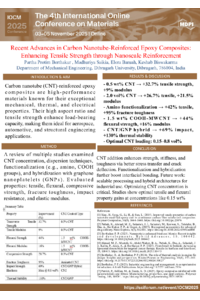
Carbon nanotube (CNT)-reinforced epoxy composites have emerged as high-performance materials due to their ability to significantly enhance mechanical, thermal, and electrical properties. Their nanoscale dimensions, high aspect ratio, and exceptional tensile strength make CNTs ideal candidates for improving load-bearing capacity and structural integrity in epoxy matrices, with applications spanning the aerospace, automotive, and structural engineering industries.
Methods:
This review synthesizes findings from over a dozen recent studies that examined the effects of varying CNT concentrations, functionalization, dispersion techniques, and hybridization with other nanomaterials such as graphene nanoplatelets (GNPs). Data were analyzed in terms of the following key mechanical indicators: tensile strength, flexural strength, compressive strength, fracture toughness, impact resistance, and elastic modulus.
Results:
Significant mechanical enhancements were observed with optimal CNT loadings. A 0.5 wt% CNT addition improved transverse tensile strength by 32.7% and modulus by 9% . At 2.0 vol%, tensile strength and modulus increased by 26.7% and 21.5%, respectively. Functionalization with amino groups led to a 42% improvement in tensile strength and 95% in fracture toughness. Flexural strength rose by 44% and flexural modulus by 16% with 1.5 wt% COOH-MWCN. Synergistic reinforcement using CNT/GNP hybrids improved impact strength by 69%, while thermal stability increased by 130%. Optimal mechanical performance was typically achieved at CNT concentrations between 0.15 wt% and 0.8 vol%.
Conclusion:
CNT incorporation markedly enhances the mechanical properties of epoxy composites through improved stress transfer, crack deflection, and interfacial bonding. Functionalization and hybridization further amplify these effects. However, uniform dispersion and optimal loading remain critical for maximizing benefits. Future research should focus on scalable processing methods and hybrid architectures to overcome current challenges and expand industrial adoption.
Keywords
Carbon Nanotubes (CNTs)
Epoxy Composites
Mechanical Properties
Tensile Strength
Nanocomposite Reinforcement
Poster
PARTHA BORTHAKUR.pdf
CLAYEY SOIL IMPROVEMENT: SUSTAINABLE SOLUTIONS WITH LADLE FURNACE SLAG AND RECYCLED FIBERS FROM WIND TURBINE BLADE WASTE
Tailoring Surface Chemistry of MXenes for High-Performance Energy Storage: A Pathway Toward Sustainable Electrochemical Applications