Event submissions
Published
This submission belongs to the session S5. Materials for Energy Harvesting, Conversion and Storage of the event The 4th International Online Conference on Materials
Published date
29 Oct, 2025
Academic Editor
'%3e%3cpath%20d='M12.6657%2010.9104C12.4185%2010.325%2012.0599%209.79327%2011.6097%209.34482C11.1609%208.89508%2010.6293%208.5365%2010.0442%208.28888C10.0389%208.28626%2010.0337%208.28495%2010.0285%208.28233C10.8446%207.69279%2011.3752%206.73249%2011.3752%205.64904C11.3752%203.8542%209.92103%202.39999%208.1262%202.39999C6.33136%202.39999%204.87715%203.8542%204.87715%205.64904C4.87715%206.73249%205.40774%207.69279%206.22393%208.28364C6.21869%208.28626%206.21345%208.28757%206.20821%208.29019C5.62129%208.5378%205.09463%208.89284%204.64265%209.34613C4.1929%209.79493%203.83432%2010.3266%203.58671%2010.9117C3.34345%2011.4845%203.21226%2012.0987%203.20023%2012.7209C3.19988%2012.7349%203.20233%2012.7488%203.20744%2012.7619C3.21255%2012.7749%203.22022%2012.7867%203.22998%2012.7968C3.23975%2012.8068%203.25142%2012.8147%203.26431%2012.8202C3.2772%2012.8256%203.29105%2012.8284%203.30504%2012.8284H4.09109C4.14874%2012.8284%204.19459%2012.7825%204.1959%2012.7262C4.2221%2011.7148%204.62823%2010.7676%205.34617%2010.0497C6.08899%209.30683%207.0755%208.89808%208.1262%208.89808C9.17689%208.89808%2010.1634%209.30683%2010.9062%2010.0497C11.6242%2010.7676%2012.0303%2011.7148%2012.0565%2012.7262C12.0578%2012.7838%2012.1037%2012.8284%2012.1613%2012.8284H12.9474C12.9613%2012.8284%2012.9752%2012.8256%2012.9881%2012.8202C13.001%2012.8147%2013.0126%2012.8068%2013.0224%2012.7968C13.0322%2012.7867%2013.0398%2012.7749%2013.0449%2012.7619C13.0501%2012.7488%2013.0525%2012.7349%2013.0522%2012.7209C13.0391%2012.0947%2012.9094%2011.4855%2012.6657%2010.9104ZM8.1262%207.9024C7.52486%207.9024%206.9589%207.6679%206.53312%207.24211C6.10733%206.81633%205.87283%206.25037%205.87283%205.64904C5.87283%205.0477%206.10733%204.48174%206.53312%204.05596C6.9589%203.63018%207.52486%203.39567%208.1262%203.39567C8.72753%203.39567%209.29349%203.63018%209.71927%204.05596C10.1451%204.48174%2010.3796%205.0477%2010.3796%205.64904C10.3796%206.25037%2010.1451%206.81633%209.71927%207.24211C9.29349%207.6679%208.72753%207.9024%208.1262%207.9024Z'%20fill='%235D1EE1'/%3e%3c/g%3e%3c/svg%3e) Federico Bella
Federico BellaCitation
Bhabhina Ninnora Meethal, Novel Zinc Selenate Ternary Nanomaterial: Efficient Platform for Photocatalysis and Antibacterial Applications, in Proceedings of The 4th International Online Conference on Materials, 3 November–6 November 2025, MDPI: Basel, Switzerland
Share
Email
Facebook
Twitter
LinkedIn
Novel Zinc Selenate Ternary Nanomaterial: Efficient Platform for Photocatalysis and Antibacterial Applications
'%3e%3cpath%20d='M12.6647%2010.9104C12.4176%2010.325%2012.0589%209.7933%2011.6088%209.34485C11.16%208.89511%2010.6283%208.53653%2010.0432%208.28891C10.038%208.28629%2010.0327%208.28498%2010.0275%208.28236C10.8437%207.69282%2011.3743%206.73252%2011.3743%205.64907C11.3743%203.85423%209.92005%202.40002%208.12522%202.40002C6.33038%202.40002%204.87618%203.85423%204.87618%205.64907C4.87618%206.73252%205.40677%207.69282%206.22296%208.28367C6.21772%208.28629%206.21248%208.2876%206.20724%208.29022C5.62031%208.53783%205.09365%208.89287%204.64167%209.34616C4.19192%209.79496%203.83334%2010.3266%203.58573%2010.9117C3.34247%2011.4846%203.21128%2012.0987%203.19925%2012.721C3.1989%2012.735%203.20135%2012.7489%203.20646%2012.7619C3.21157%2012.7749%203.21924%2012.7868%203.22901%2012.7968C3.23877%2012.8068%203.25045%2012.8148%203.26334%2012.8202C3.27623%2012.8256%203.29007%2012.8284%203.30406%2012.8284H4.09012C4.14776%2012.8284%204.19362%2012.7825%204.19493%2012.7262C4.22113%2011.7148%204.62726%2010.7676%205.34519%2010.0497C6.08802%209.30686%207.07452%208.89811%208.12522%208.89811C9.17592%208.89811%2010.1624%209.30686%2010.9052%2010.0497C11.6232%2010.7676%2012.0293%2011.7148%2012.0555%2012.7262C12.0568%2012.7839%2012.1027%2012.8284%2012.1603%2012.8284H12.9464C12.9604%2012.8284%2012.9742%2012.8256%2012.9871%2012.8202C13%2012.8148%2013.0117%2012.8068%2013.0214%2012.7968C13.0312%2012.7868%2013.0389%2012.7749%2013.044%2012.7619C13.0491%2012.7489%2013.0515%2012.735%2013.0512%2012.721C13.0381%2012.0947%2012.9084%2011.4856%2012.6647%2010.9104ZM8.12522%207.90243C7.52388%207.90243%206.95792%207.66793%206.53214%207.24215C6.10636%206.81636%205.87185%206.2504%205.87185%205.64907C5.87185%205.04773%206.10636%204.48177%206.53214%204.05599C6.95792%203.63021%207.52388%203.3957%208.12522%203.3957C8.72655%203.3957%209.29252%203.63021%209.7183%204.05599C10.1441%204.48177%2010.3786%205.04773%2010.3786%205.64907C10.3786%206.2504%2010.1441%206.81636%209.7183%207.24215C9.29252%207.66793%208.72655%207.90243%208.12522%207.90243Z'%20fill='%235D1EE1'/%3e%3c/g%3e%3c/svg%3e)
Bhabhina Ninnora Meethal 1
1. R. Sankar Memorial S.N.D.P. Yogam Arts & Science College, Kozhikode, 673305, Kerala, India
Abstract
Introduction
Ternary nanomaterials are increasingly receiving attention due to their unique heterostructures, which offer improved performance in various applications. Certain ternary nanomaterials exhibit well-defined compositions based on specific molecular formulas, whereas others are synthesized as doped systems, where one or more elements are partially substituted to tailor their properties. Ternary nanomaterials often display hybrid properties that are superior to those of their individual constituents, owing to synergistic interactions within the composite structure.
Methods
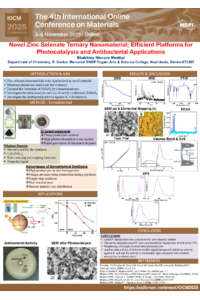
Stable zinc selenate (ZnSeO₄) ternary nanomaterials were synthesized via a simple one-pot solvothermal method using minimal precursors—zinc acetate dihydrate and selenium powder—in an ethylenediamine medium. This single-step, high-yield, and cost-effective approach enabled the efficient formation of a novel ZnSeO₄ ternary nanomaterial. The physico-chemical characteristics of the synthesized nanomaterial were thoroughly analyzed using advanced techniques including X-ray diffraction (XRD), diffuse reflectance spectroscopy (DRS), Fourier-transform infrared spectroscopy (FTIR), dynamic light scattering (DLS), and X-ray photoelectron spectroscopy (XPS). Surface morphology and elemental composition were examined through scanning electron microscopy with energy-dispersive X-ray analysis (SEM–EDAX) and colour mapping. The photocatalytic efficiency of the ZnSeO₄ nanomaterial was assessed through the degradation of a representative textile dye pollutant. Antibacterial activity was evaluated against Escherichia coli, a major foodborne pathogen, using the agar well diffusion method.
Results
The material demonstrated approximately 70% degradation efficiency, while retaining its morphology post-photocatalysis. The nanomaterial exhibited significant inhibitory effects, with a 20 mm zone of inhibition, surpassing that of standard tetracycline (17 mm). Moreover, the panchromatic absorption of ZnSeO₄ suggests excellent light-harvesting efficiency. The presence of surface defects, verified through XPS, plays a crucial role in enhancing the photocatalytic performance of the ZnSeO4 nanomaterial.
Conclusion
The multifunctional properties make ZnSeO₄ a promising candidate for eco-friendly applications, including its incorporation into porcelain floor tiles for self-cleaning, anti-pollutant, and antibacterial functions.
Keywords
ZnSeO4
Photocatalysis
Zinc selenate
Dye degradation
Antibacterial
Poster
IOCM 2025 - Bhabhina Ninnora Meethal.pdf
Electrical resistance and compressive strength properties of cement composites using MWCNT dispersed in polycarboxylic acid superplasticizer
A Rapid, Green and Cost-Effective Synthesis of pH- and Hydroxyl Group-Sensitive Carbon Dots for Sensing Applications