Event submissions
Published
This submission belongs to the session S5. Materials for Energy Harvesting, Conversion and Storage of the event The 4th International Online Conference on Materials
Published date
29 Oct, 2025
Academic Editor
'%3e%3cpath%20d='M12.6657%2010.9104C12.4185%2010.325%2012.0599%209.79327%2011.6097%209.34482C11.1609%208.89508%2010.6293%208.5365%2010.0442%208.28888C10.0389%208.28626%2010.0337%208.28495%2010.0285%208.28233C10.8446%207.69279%2011.3752%206.73249%2011.3752%205.64904C11.3752%203.8542%209.92103%202.39999%208.1262%202.39999C6.33136%202.39999%204.87715%203.8542%204.87715%205.64904C4.87715%206.73249%205.40774%207.69279%206.22393%208.28364C6.21869%208.28626%206.21345%208.28757%206.20821%208.29019C5.62129%208.5378%205.09463%208.89284%204.64265%209.34613C4.1929%209.79493%203.83432%2010.3266%203.58671%2010.9117C3.34345%2011.4845%203.21226%2012.0987%203.20023%2012.7209C3.19988%2012.7349%203.20233%2012.7488%203.20744%2012.7619C3.21255%2012.7749%203.22022%2012.7867%203.22998%2012.7968C3.23975%2012.8068%203.25142%2012.8147%203.26431%2012.8202C3.2772%2012.8256%203.29105%2012.8284%203.30504%2012.8284H4.09109C4.14874%2012.8284%204.19459%2012.7825%204.1959%2012.7262C4.2221%2011.7148%204.62823%2010.7676%205.34617%2010.0497C6.08899%209.30683%207.0755%208.89808%208.1262%208.89808C9.17689%208.89808%2010.1634%209.30683%2010.9062%2010.0497C11.6242%2010.7676%2012.0303%2011.7148%2012.0565%2012.7262C12.0578%2012.7838%2012.1037%2012.8284%2012.1613%2012.8284H12.9474C12.9613%2012.8284%2012.9752%2012.8256%2012.9881%2012.8202C13.001%2012.8147%2013.0126%2012.8068%2013.0224%2012.7968C13.0322%2012.7867%2013.0398%2012.7749%2013.0449%2012.7619C13.0501%2012.7488%2013.0525%2012.7349%2013.0522%2012.7209C13.0391%2012.0947%2012.9094%2011.4855%2012.6657%2010.9104ZM8.1262%207.9024C7.52486%207.9024%206.9589%207.6679%206.53312%207.24211C6.10733%206.81633%205.87283%206.25037%205.87283%205.64904C5.87283%205.0477%206.10733%204.48174%206.53312%204.05596C6.9589%203.63018%207.52486%203.39567%208.1262%203.39567C8.72753%203.39567%209.29349%203.63018%209.71927%204.05596C10.1451%204.48174%2010.3796%205.0477%2010.3796%205.64904C10.3796%206.25037%2010.1451%206.81633%209.71927%207.24211C9.29349%207.6679%208.72753%207.9024%208.1262%207.9024Z'%20fill='%235D1EE1'/%3e%3c/g%3e%3c/svg%3e) Federico Bella
Federico BellaCitation
Davide Barreca, Mattia Brugia, Mattia Benedet, Gian Andrea Rizzi, Alberto Gasparotto, Oleg I. Lebedev, Chiara Maccato, Development of gCN/Pt electrocatalysts for Vis-light-activated ethanol electrochemical valorization, in Proceedings of The 4th International Online Conference on Materials, 3 November–6 November 2025, MDPI: Basel, Switzerland
Share
Email
Facebook
Twitter
LinkedIn
Development of gCN/Pt electrocatalysts for Vis-light-activated ethanol electrochemical valorization

Davide Barreca 1
'%3e%3cpath%20d='M12.6647%2010.9104C12.4176%2010.325%2012.0589%209.7933%2011.6088%209.34485C11.16%208.89511%2010.6283%208.53653%2010.0432%208.28891C10.038%208.28629%2010.0327%208.28498%2010.0275%208.28236C10.8437%207.69282%2011.3743%206.73252%2011.3743%205.64907C11.3743%203.85423%209.92005%202.40002%208.12522%202.40002C6.33038%202.40002%204.87618%203.85423%204.87618%205.64907C4.87618%206.73252%205.40677%207.69282%206.22296%208.28367C6.21772%208.28629%206.21248%208.2876%206.20724%208.29022C5.62031%208.53783%205.09365%208.89287%204.64167%209.34616C4.19192%209.79496%203.83334%2010.3266%203.58573%2010.9117C3.34247%2011.4846%203.21128%2012.0987%203.19925%2012.721C3.1989%2012.735%203.20135%2012.7489%203.20646%2012.7619C3.21157%2012.7749%203.21924%2012.7868%203.22901%2012.7968C3.23877%2012.8068%203.25045%2012.8148%203.26334%2012.8202C3.27623%2012.8256%203.29007%2012.8284%203.30406%2012.8284H4.09012C4.14776%2012.8284%204.19362%2012.7825%204.19493%2012.7262C4.22113%2011.7148%204.62726%2010.7676%205.34519%2010.0497C6.08802%209.30686%207.07452%208.89811%208.12522%208.89811C9.17592%208.89811%2010.1624%209.30686%2010.9052%2010.0497C11.6232%2010.7676%2012.0293%2011.7148%2012.0555%2012.7262C12.0568%2012.7839%2012.1027%2012.8284%2012.1603%2012.8284H12.9464C12.9604%2012.8284%2012.9742%2012.8256%2012.9871%2012.8202C13%2012.8148%2013.0117%2012.8068%2013.0214%2012.7968C13.0312%2012.7868%2013.0389%2012.7749%2013.044%2012.7619C13.0491%2012.7489%2013.0515%2012.735%2013.0512%2012.721C13.0381%2012.0947%2012.9084%2011.4856%2012.6647%2010.9104ZM8.12522%207.90243C7.52388%207.90243%206.95792%207.66793%206.53214%207.24215C6.10636%206.81636%205.87185%206.2504%205.87185%205.64907C5.87185%205.04773%206.10636%204.48177%206.53214%204.05599C6.95792%203.63021%207.52388%203.3957%208.12522%203.3957C8.72655%203.3957%209.29252%203.63021%209.7183%204.05599C10.1441%204.48177%2010.3786%205.04773%2010.3786%205.64907C10.3786%206.2504%2010.1441%206.81636%209.7183%207.24215C9.29252%207.66793%208.72655%207.90243%208.12522%207.90243Z'%20fill='%235D1EE1'/%3e%3c/g%3e%3c/svg%3e)
Mattia Brugia 2
Mattia Benedet 1,2

Gian Andrea Rizzi 1,2
Alberto Gasparotto 1,2

Oleg I. Lebedev 3

Chiara Maccato 1,2
1. CNR-ICMATE and INSTM, Department of Chemical Sciences, Padova University, 35131 Padova, Italy
2. Department of Chemical Sciences, Padova University and INSTM, 35131 Padova, Italy
3. Laboratoire CRISMAT, ENSICAEN-CNRS UMR6508, 14050 Caen Cedex 4, France
Abstract
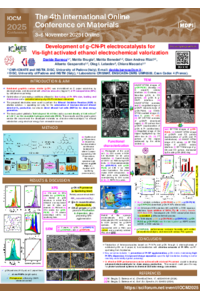
In the search for renewable and sustainable energy resources, a promising fuel is biomass-derived ethanol (EtOH), whose low toxicity, easy handling, and high energy density (29.7 MJxkg-1) have stimulated its valorization in direct ethanol fuel cells (DEFCs), with it eventually being photo-promoted for hydrogen generation [1,2]. Unfortunately, the most used DEFC anodic catalysts based on Pt suffer from high costs, supply shortages, and poor sustainability. In this regard, a key challenge is the reduction of platinum content, and maintaining at the same time an appreciable electrocatalyst activity that can be achieved through a modular dispersion of low-dimensional metal nanoaggregates onto suitable substrates.
In this context, the present work reports on the fabrication of heterocomposites based on platinum nanoparticles and graphitic carbon nitride (gCN), a metal-free Vis-light-active semiconductor (EG=2.7 eV) endowed with the benefits of low cost, eco-friendly characteristics, and high structural and compositional flexibility. In fact, N-containing functional groups in gCN can effectively coordinate metal centers during the nucleation/growth of metal nanoparticles, allowing platinum content to be lowered and simultaneously boosting the system performance. The target materials are fabricated by an original route consisting of the electrophoretic deposition of exfoliated gCN on carbon paper, followed by the dispersion of Pt nanoparticles in ultra-low amounts (ca. μg/cm2) by sputtering from Ar plasmas. Optimization of processing conditions and the amount of deposited Pt yielded appreciable activity and stability towards ethanol oxidation in alkaline aqueous solutions, thanks to the synergistic Pt/gCN interactions. The obtained results highlight that attractive performances can be provided even by electrocatalysts containing very low platinum amounts, a key target that might pave the way to the implementation of photo-functional systems in the fields of chemical and solar energy conversion.
[1] D. Barreca et al., ChemSusChem, 17, e202401041 (2024).
[2] D. Barreca et al., Surf. Sci. Spectra, 31, 024002 (2024).
Keywords
graphitic carbon nitride
Pt nanoparticles
electrophoretic deposition
cold plasma sputtering
ethanol oxidation reaction
Poster
Poster_sciforum-137720_Barreca.pdf
Synthesis and Biosensor Applications of Metal/Metal Oxide Nanoparticles Using Camellia sinensis Cultivated in Rize Region
A Promising Cellulose Nanofibrials-Cyclophosphazene Assembling System for Emulsion Stabilization and Constructing Porous Materials