Event submissions
Published
This submission belongs to the session S2. Nanomaterials, Nanotechnology and Quantum Materials of the event The 4th International Online Conference on Materials
Published date
29 Oct, 2025
Academic Editor
'%3e%3cpath%20d='M12.6657%2010.9104C12.4185%2010.325%2012.0599%209.79327%2011.6097%209.34482C11.1609%208.89508%2010.6293%208.5365%2010.0442%208.28888C10.0389%208.28626%2010.0337%208.28495%2010.0285%208.28233C10.8446%207.69279%2011.3752%206.73249%2011.3752%205.64904C11.3752%203.8542%209.92103%202.39999%208.1262%202.39999C6.33136%202.39999%204.87715%203.8542%204.87715%205.64904C4.87715%206.73249%205.40774%207.69279%206.22393%208.28364C6.21869%208.28626%206.21345%208.28757%206.20821%208.29019C5.62129%208.5378%205.09463%208.89284%204.64265%209.34613C4.1929%209.79493%203.83432%2010.3266%203.58671%2010.9117C3.34345%2011.4845%203.21226%2012.0987%203.20023%2012.7209C3.19988%2012.7349%203.20233%2012.7488%203.20744%2012.7619C3.21255%2012.7749%203.22022%2012.7867%203.22998%2012.7968C3.23975%2012.8068%203.25142%2012.8147%203.26431%2012.8202C3.2772%2012.8256%203.29105%2012.8284%203.30504%2012.8284H4.09109C4.14874%2012.8284%204.19459%2012.7825%204.1959%2012.7262C4.2221%2011.7148%204.62823%2010.7676%205.34617%2010.0497C6.08899%209.30683%207.0755%208.89808%208.1262%208.89808C9.17689%208.89808%2010.1634%209.30683%2010.9062%2010.0497C11.6242%2010.7676%2012.0303%2011.7148%2012.0565%2012.7262C12.0578%2012.7838%2012.1037%2012.8284%2012.1613%2012.8284H12.9474C12.9613%2012.8284%2012.9752%2012.8256%2012.9881%2012.8202C13.001%2012.8147%2013.0126%2012.8068%2013.0224%2012.7968C13.0322%2012.7867%2013.0398%2012.7749%2013.0449%2012.7619C13.0501%2012.7488%2013.0525%2012.7349%2013.0522%2012.7209C13.0391%2012.0947%2012.9094%2011.4855%2012.6657%2010.9104ZM8.1262%207.9024C7.52486%207.9024%206.9589%207.6679%206.53312%207.24211C6.10733%206.81633%205.87283%206.25037%205.87283%205.64904C5.87283%205.0477%206.10733%204.48174%206.53312%204.05596C6.9589%203.63018%207.52486%203.39567%208.1262%203.39567C8.72753%203.39567%209.29349%203.63018%209.71927%204.05596C10.1451%204.48174%2010.3796%205.0477%2010.3796%205.64904C10.3796%206.25037%2010.1451%206.81633%209.71927%207.24211C9.29349%207.6679%208.72753%207.9024%208.1262%207.9024Z'%20fill='%235D1EE1'/%3e%3c/g%3e%3c/svg%3e) Xinyu Liu
Xinyu LiuCitation
Jiang Liu, Zhanpeng Wu, A Promising Cellulose Nanofibrials-Cyclophosphazene Assembling System for Emulsion Stabilization and Constructing Porous Materials, in Proceedings of The 4th International Online Conference on Materials, 3 November–6 November 2025, MDPI: Basel, Switzerland
Share
Email
Facebook
Twitter
LinkedIn
A Promising Cellulose Nanofibrials-Cyclophosphazene Assembling System for Emulsion Stabilization and Constructing Porous Materials
'%3e%3cpath%20d='M12.6647%2010.9104C12.4176%2010.325%2012.0589%209.7933%2011.6088%209.34485C11.16%208.89511%2010.6283%208.53653%2010.0432%208.28891C10.038%208.28629%2010.0327%208.28498%2010.0275%208.28236C10.8437%207.69282%2011.3743%206.73252%2011.3743%205.64907C11.3743%203.85423%209.92005%202.40002%208.12522%202.40002C6.33038%202.40002%204.87618%203.85423%204.87618%205.64907C4.87618%206.73252%205.40677%207.69282%206.22296%208.28367C6.21772%208.28629%206.21248%208.2876%206.20724%208.29022C5.62031%208.53783%205.09365%208.89287%204.64167%209.34616C4.19192%209.79496%203.83334%2010.3266%203.58573%2010.9117C3.34247%2011.4846%203.21128%2012.0987%203.19925%2012.721C3.1989%2012.735%203.20135%2012.7489%203.20646%2012.7619C3.21157%2012.7749%203.21924%2012.7868%203.22901%2012.7968C3.23877%2012.8068%203.25045%2012.8148%203.26334%2012.8202C3.27623%2012.8256%203.29007%2012.8284%203.30406%2012.8284H4.09012C4.14776%2012.8284%204.19362%2012.7825%204.19493%2012.7262C4.22113%2011.7148%204.62726%2010.7676%205.34519%2010.0497C6.08802%209.30686%207.07452%208.89811%208.12522%208.89811C9.17592%208.89811%2010.1624%209.30686%2010.9052%2010.0497C11.6232%2010.7676%2012.0293%2011.7148%2012.0555%2012.7262C12.0568%2012.7839%2012.1027%2012.8284%2012.1603%2012.8284H12.9464C12.9604%2012.8284%2012.9742%2012.8256%2012.9871%2012.8202C13%2012.8148%2013.0117%2012.8068%2013.0214%2012.7968C13.0312%2012.7868%2013.0389%2012.7749%2013.044%2012.7619C13.0491%2012.7489%2013.0515%2012.735%2013.0512%2012.721C13.0381%2012.0947%2012.9084%2011.4856%2012.6647%2010.9104ZM8.12522%207.90243C7.52388%207.90243%206.95792%207.66793%206.53214%207.24215C6.10636%206.81636%205.87185%206.2504%205.87185%205.64907C5.87185%205.04773%206.10636%204.48177%206.53214%204.05599C6.95792%203.63021%207.52388%203.3957%208.12522%203.3957C8.72655%203.3957%209.29252%203.63021%209.7183%204.05599C10.1441%204.48177%2010.3786%205.04773%2010.3786%205.64907C10.3786%206.2504%2010.1441%206.81636%209.7183%207.24215C9.29252%207.66793%208.72655%207.90243%208.12522%207.90243Z'%20fill='%235D1EE1'/%3e%3c/g%3e%3c/svg%3e)
Jiang Liu 1
Zhanpeng Wu 2
1. College of Materials Science and Engineering, Beijing University of Chemical Technology,
Beijing 100029, China
2. State Key Laboratory of Organic−Inorganic
Composites, Beijing University of Chemical Technology,
Beijing 100029, China
Abstract
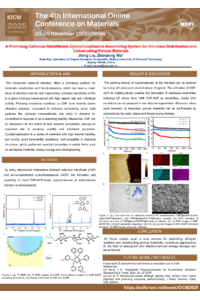
Introduction: The immiscible water-oil interface offers a promising platform for materials construction and functionalization, which has been a major focus of chemical science and engineering. Cellulose nanofibrils (CNF) is a green biomass nanomaterial with high aspect ratio and interfacial activity. Pickering emulsions stabilized by CNF have recently drawn attractive attention. Compared to molecule surfactants, some solid particles like cellulose nanomaterials, are more in demand for emulsification because of an outstanding stability. Meanwhile, CNF can be dispersed into the matrix to form polymer composites, playing an important role in emulsion stability and interfacial properties. Cyclophosphazene is a series of materials with high thermal stability, low toxicity, good flammability resistance, and tuneability in chemical structures, which performed excellent properties in widely fields such as aerospace materials, energy storage and bioengineering.
Method: Here, by using electrostatic interactions between cellulose nanofibrils (CNF) and animo-substituted cyclophosphazene (ACP), the formation and assembly of an novel CNF-ACP-based supramolecular at water-toluene interface is demonstrated.
Result: The packing density of supramolecular at the interface can be tumbled by tuning pH value and concentrations of ligands. The utilization of CNF-ACP as building blocks enables the fabrication of interfacial assemblies including 2D Janus films. With CNF-ACP as emulsifiers, stable O/W emulsions can be prepared in one step homogenization. Moreover, when used emulsion as templates, porous materials can be synthesized by polymerizing the water phase and freeze-drying strategy.
Conclusion: All these results open a new avenue for stabilizing all-liquid systems and constructing porous materials, numerous applications in the field of adsorption and electrochemical energy storage can be achieved.
Keywords
Water-oil interface
Cellulose nanofibrils
Cyclophosphazene
Emulsion
Porous materials
Poster
poster-liujiang-mdpi.pdf
Development of gCN/Pt electrocatalysts for Vis-light-activated ethanol electrochemical valorization
Flexible Thermoset Films from Zein: Transforming Agricultural Waste into Green Materials