Event submissions
Published
This submission belongs to the session S5. Materials for Energy Harvesting, Conversion and Storage of the event The 4th International Online Conference on Materials
Published date
29 Oct, 2025
Academic Editor
'%3e%3cpath%20d='M12.6657%2010.9104C12.4185%2010.325%2012.0599%209.79327%2011.6097%209.34482C11.1609%208.89508%2010.6293%208.5365%2010.0442%208.28888C10.0389%208.28626%2010.0337%208.28495%2010.0285%208.28233C10.8446%207.69279%2011.3752%206.73249%2011.3752%205.64904C11.3752%203.8542%209.92103%202.39999%208.1262%202.39999C6.33136%202.39999%204.87715%203.8542%204.87715%205.64904C4.87715%206.73249%205.40774%207.69279%206.22393%208.28364C6.21869%208.28626%206.21345%208.28757%206.20821%208.29019C5.62129%208.5378%205.09463%208.89284%204.64265%209.34613C4.1929%209.79493%203.83432%2010.3266%203.58671%2010.9117C3.34345%2011.4845%203.21226%2012.0987%203.20023%2012.7209C3.19988%2012.7349%203.20233%2012.7488%203.20744%2012.7619C3.21255%2012.7749%203.22022%2012.7867%203.22998%2012.7968C3.23975%2012.8068%203.25142%2012.8147%203.26431%2012.8202C3.2772%2012.8256%203.29105%2012.8284%203.30504%2012.8284H4.09109C4.14874%2012.8284%204.19459%2012.7825%204.1959%2012.7262C4.2221%2011.7148%204.62823%2010.7676%205.34617%2010.0497C6.08899%209.30683%207.0755%208.89808%208.1262%208.89808C9.17689%208.89808%2010.1634%209.30683%2010.9062%2010.0497C11.6242%2010.7676%2012.0303%2011.7148%2012.0565%2012.7262C12.0578%2012.7838%2012.1037%2012.8284%2012.1613%2012.8284H12.9474C12.9613%2012.8284%2012.9752%2012.8256%2012.9881%2012.8202C13.001%2012.8147%2013.0126%2012.8068%2013.0224%2012.7968C13.0322%2012.7867%2013.0398%2012.7749%2013.0449%2012.7619C13.0501%2012.7488%2013.0525%2012.7349%2013.0522%2012.7209C13.0391%2012.0947%2012.9094%2011.4855%2012.6657%2010.9104ZM8.1262%207.9024C7.52486%207.9024%206.9589%207.6679%206.53312%207.24211C6.10733%206.81633%205.87283%206.25037%205.87283%205.64904C5.87283%205.0477%206.10733%204.48174%206.53312%204.05596C6.9589%203.63018%207.52486%203.39567%208.1262%203.39567C8.72753%203.39567%209.29349%203.63018%209.71927%204.05596C10.1451%204.48174%2010.3796%205.0477%2010.3796%205.64904C10.3796%206.25037%2010.1451%206.81633%209.71927%207.24211C9.29349%207.6679%208.72753%207.9024%208.1262%207.9024Z'%20fill='%235D1EE1'/%3e%3c/g%3e%3c/svg%3e) Federico Bella
Federico BellaCitation
Ritom Bid, Himanshu Bhardwaj, M. Dinachandra Singh, Synthesis And Characterization of Solid-State Electrolyte NASICON (Na₃Zr₂Si₂PO₁₂) from Different Precursor Sources, in Proceedings of The 4th International Online Conference on Materials, 3 November–6 November 2025, MDPI: Basel, Switzerland
Share
Email
Facebook
Twitter
LinkedIn
Synthesis And Characterization of Solid-State Electrolyte NASICON (Na3Zr2Si2PO12) from Different Precursor Sources
'%3e%3cpath%20d='M12.6647%2010.9104C12.4176%2010.325%2012.0589%209.7933%2011.6088%209.34485C11.16%208.89511%2010.6283%208.53653%2010.0432%208.28891C10.038%208.28629%2010.0327%208.28498%2010.0275%208.28236C10.8437%207.69282%2011.3743%206.73252%2011.3743%205.64907C11.3743%203.85423%209.92005%202.40002%208.12522%202.40002C6.33038%202.40002%204.87618%203.85423%204.87618%205.64907C4.87618%206.73252%205.40677%207.69282%206.22296%208.28367C6.21772%208.28629%206.21248%208.2876%206.20724%208.29022C5.62031%208.53783%205.09365%208.89287%204.64167%209.34616C4.19192%209.79496%203.83334%2010.3266%203.58573%2010.9117C3.34247%2011.4846%203.21128%2012.0987%203.19925%2012.721C3.1989%2012.735%203.20135%2012.7489%203.20646%2012.7619C3.21157%2012.7749%203.21924%2012.7868%203.22901%2012.7968C3.23877%2012.8068%203.25045%2012.8148%203.26334%2012.8202C3.27623%2012.8256%203.29007%2012.8284%203.30406%2012.8284H4.09012C4.14776%2012.8284%204.19362%2012.7825%204.19493%2012.7262C4.22113%2011.7148%204.62726%2010.7676%205.34519%2010.0497C6.08802%209.30686%207.07452%208.89811%208.12522%208.89811C9.17592%208.89811%2010.1624%209.30686%2010.9052%2010.0497C11.6232%2010.7676%2012.0293%2011.7148%2012.0555%2012.7262C12.0568%2012.7839%2012.1027%2012.8284%2012.1603%2012.8284H12.9464C12.9604%2012.8284%2012.9742%2012.8256%2012.9871%2012.8202C13%2012.8148%2013.0117%2012.8068%2013.0214%2012.7968C13.0312%2012.7868%2013.0389%2012.7749%2013.044%2012.7619C13.0491%2012.7489%2013.0515%2012.735%2013.0512%2012.721C13.0381%2012.0947%2012.9084%2011.4856%2012.6647%2010.9104ZM8.12522%207.90243C7.52388%207.90243%206.95792%207.66793%206.53214%207.24215C6.10636%206.81636%205.87185%206.2504%205.87185%205.64907C5.87185%205.04773%206.10636%204.48177%206.53214%204.05599C6.95792%203.63021%207.52388%203.3957%208.12522%203.3957C8.72655%203.3957%209.29252%203.63021%209.7183%204.05599C10.1441%204.48177%2010.3786%205.04773%2010.3786%205.64907C10.3786%206.2504%2010.1441%206.81636%209.7183%207.24215C9.29252%207.66793%208.72655%207.90243%208.12522%207.90243Z'%20fill='%235D1EE1'/%3e%3c/g%3e%3c/svg%3e)
Ritom Bid 1
Himanshu Bhardwaj 2
M. Dinachandra Singh 3
1. Department of Physics, Presidency University, Kolkata, India
2. Vikramajit Singh Sanatan Dharma College (VSSD college), Chhatrapati Shahu Ji Maharaj University, Kanpur, India
3. Students Research Exposure Lab (SUREELA), Shiksha Sopan, Kanpur, India
Abstract
The growing demand for sustainable and cost-effective energy storage systems has accelerated research into sodium-ion batteries (SIBs) as viable alternatives to lithium-ion technology. This study focuses on the synthesis and characterization of NASICON-type (Na₃Zr₂Si₂PO₁₂, NZSP) solid-state electrolytes, known for their high ionic conductivity and structural stability. Using a solid-state reaction method, two sets of NZSP samples were synthesized from different precursor sources: high-purity-grade chemicals (Sample-A) and more economical but low-purity-grade chemicals (Sample-B). X-ray diffraction (XRD) analysis confirmed successful phase formation in both cases, although a secondary phase structure was found in NZSP based on sample-B; however, the high-purity sample-A showed higher phase purity and crystallinity. Electrochemical impedance spectroscopy (EIS) analysis showed significantly improved ionic conductivity and reduced grain boundary resistance in the sample-A-based NZSP, while sample-B-based NZSP exhibited increased porosity and higher impedance. These differences are attributed to impurity levels and compositional uniformity in the starting materials. The study demonstrates that precursor quality plays a critical role in determining the electrochemical performance of NASICON electrolytes. Although low-purity (Sample-B)-based chemical sources offer a lower-cost pathway, their impact on structural integrity and conductivity must be addressed for practical application. This research highlights the importance of precursor selection in the scalable development of high-performance solid-state electrolytes for sodium-ion batteries, and contributes toward the realization of safer and more efficient energy storage technologies.
Keywords
Sodium-ion batteries
NASICON
Na₃Zr₂Si₂PO₁₂(NZSP)
solid-state electrolytes
ionic conductivity
precursor purity
phase formation
x-ray diffraction
electrochemical impedance spectroscopy
impedance
porosity
energy storage materials
Poster
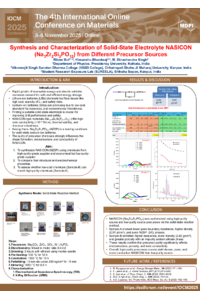
NASICON Poster.pdf
Synthesis of a Molecularly Imprinted Magnetic Core–Shell Photocatalyst for Efficient Micropollutant Removal
Light Scattering from Graphite Powder - an Analog to Asteroid Surfaces