Event submissions
Published
This submission belongs to the session S5. Materials for Energy Harvesting, Conversion and Storage of the event The 4th International Online Conference on Materials
Published date
29 Oct, 2025
Academic Editor
'%3e%3cpath%20d='M12.6657%2010.9104C12.4185%2010.325%2012.0599%209.79327%2011.6097%209.34482C11.1609%208.89508%2010.6293%208.5365%2010.0442%208.28888C10.0389%208.28626%2010.0337%208.28495%2010.0285%208.28233C10.8446%207.69279%2011.3752%206.73249%2011.3752%205.64904C11.3752%203.8542%209.92103%202.39999%208.1262%202.39999C6.33136%202.39999%204.87715%203.8542%204.87715%205.64904C4.87715%206.73249%205.40774%207.69279%206.22393%208.28364C6.21869%208.28626%206.21345%208.28757%206.20821%208.29019C5.62129%208.5378%205.09463%208.89284%204.64265%209.34613C4.1929%209.79493%203.83432%2010.3266%203.58671%2010.9117C3.34345%2011.4845%203.21226%2012.0987%203.20023%2012.7209C3.19988%2012.7349%203.20233%2012.7488%203.20744%2012.7619C3.21255%2012.7749%203.22022%2012.7867%203.22998%2012.7968C3.23975%2012.8068%203.25142%2012.8147%203.26431%2012.8202C3.2772%2012.8256%203.29105%2012.8284%203.30504%2012.8284H4.09109C4.14874%2012.8284%204.19459%2012.7825%204.1959%2012.7262C4.2221%2011.7148%204.62823%2010.7676%205.34617%2010.0497C6.08899%209.30683%207.0755%208.89808%208.1262%208.89808C9.17689%208.89808%2010.1634%209.30683%2010.9062%2010.0497C11.6242%2010.7676%2012.0303%2011.7148%2012.0565%2012.7262C12.0578%2012.7838%2012.1037%2012.8284%2012.1613%2012.8284H12.9474C12.9613%2012.8284%2012.9752%2012.8256%2012.9881%2012.8202C13.001%2012.8147%2013.0126%2012.8068%2013.0224%2012.7968C13.0322%2012.7867%2013.0398%2012.7749%2013.0449%2012.7619C13.0501%2012.7488%2013.0525%2012.7349%2013.0522%2012.7209C13.0391%2012.0947%2012.9094%2011.4855%2012.6657%2010.9104ZM8.1262%207.9024C7.52486%207.9024%206.9589%207.6679%206.53312%207.24211C6.10733%206.81633%205.87283%206.25037%205.87283%205.64904C5.87283%205.0477%206.10733%204.48174%206.53312%204.05596C6.9589%203.63018%207.52486%203.39567%208.1262%203.39567C8.72753%203.39567%209.29349%203.63018%209.71927%204.05596C10.1451%204.48174%2010.3796%205.0477%2010.3796%205.64904C10.3796%206.25037%2010.1451%206.81633%209.71927%207.24211C9.29349%207.6679%208.72753%207.9024%208.1262%207.9024Z'%20fill='%235D1EE1'/%3e%3c/g%3e%3c/svg%3e) Federico Bella
Federico BellaCitation
Janak Paudel, Marvin M Bonney, Krishna KC, Santiago J Dopico, Alex J. Kingston, Ogooluwa P. Ojo, Taylor Lackey, Ashokkumar Misarilal Sharma, Fumiya Watanabe, John Nichols,
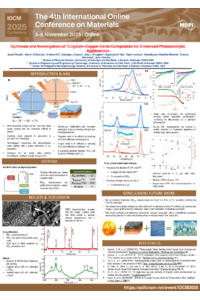
Synthesis and Investigation of Tungsten–Copper Oxide Composites for Enhanced Photocatalytic Applications
, in Proceedings of The 4th International Online Conference on Materials, 3 November–6 November 2025, MDPI: Basel, Switzerland
Share
Email
Facebook
Twitter
LinkedIn
- Synthesis and Investigation of Tungsten–Copper Oxide Composites for Enhanced Photocatalytic Applications
- Synthesis and Investigation of Tungsten–Copper Oxide Composites for Enhanced Photocatalytic Applications
'%3e%3cpath%20d='M12.6647%2010.9104C12.4176%2010.325%2012.0589%209.7933%2011.6088%209.34485C11.16%208.89511%2010.6283%208.53653%2010.0432%208.28891C10.038%208.28629%2010.0327%208.28498%2010.0275%208.28236C10.8437%207.69282%2011.3743%206.73252%2011.3743%205.64907C11.3743%203.85423%209.92005%202.40002%208.12522%202.40002C6.33038%202.40002%204.87618%203.85423%204.87618%205.64907C4.87618%206.73252%205.40677%207.69282%206.22296%208.28367C6.21772%208.28629%206.21248%208.2876%206.20724%208.29022C5.62031%208.53783%205.09365%208.89287%204.64167%209.34616C4.19192%209.79496%203.83334%2010.3266%203.58573%2010.9117C3.34247%2011.4846%203.21128%2012.0987%203.19925%2012.721C3.1989%2012.735%203.20135%2012.7489%203.20646%2012.7619C3.21157%2012.7749%203.21924%2012.7868%203.22901%2012.7968C3.23877%2012.8068%203.25045%2012.8148%203.26334%2012.8202C3.27623%2012.8256%203.29007%2012.8284%203.30406%2012.8284H4.09012C4.14776%2012.8284%204.19362%2012.7825%204.19493%2012.7262C4.22113%2011.7148%204.62726%2010.7676%205.34519%2010.0497C6.08802%209.30686%207.07452%208.89811%208.12522%208.89811C9.17592%208.89811%2010.1624%209.30686%2010.9052%2010.0497C11.6232%2010.7676%2012.0293%2011.7148%2012.0555%2012.7262C12.0568%2012.7839%2012.1027%2012.8284%2012.1603%2012.8284H12.9464C12.9604%2012.8284%2012.9742%2012.8256%2012.9871%2012.8202C13%2012.8148%2013.0117%2012.8068%2013.0214%2012.7968C13.0312%2012.7868%2013.0389%2012.7749%2013.044%2012.7619C13.0491%2012.7489%2013.0515%2012.735%2013.0512%2012.721C13.0381%2012.0947%2012.9084%2011.4856%2012.6647%2010.9104ZM8.12522%207.90243C7.52388%207.90243%206.95792%207.66793%206.53214%207.24215C6.10636%206.81636%205.87185%206.2504%205.87185%205.64907C5.87185%205.04773%206.10636%204.48177%206.53214%204.05599C6.95792%203.63021%207.52388%203.3957%208.12522%203.3957C8.72655%203.3957%209.29252%203.63021%209.7183%204.05599C10.1441%204.48177%2010.3786%205.04773%2010.3786%205.64907C10.3786%206.2504%2010.1441%206.81636%209.7183%207.24215C9.29252%207.66793%208.72655%207.90243%208.12522%207.90243Z'%20fill='%235D1EE1'/%3e%3c/g%3e%3c/svg%3e)
Janak Paudel 1
Marvin M Bonney 1
Krishna KC 1
Santiago J Dopico 1
Alex J. Kingston 1
Ogooluwa P. Ojo 2
Taylor Lackey 2
Ashokkumar Misarilal Sharma 2
Fumiya Watanabe 3
John Nichols 1
1. School of Physical Science, University of Arkansas at Little Rock, Littlerock, Arkansas 72204, USA
2. School of Engineering and Engineering Technology, University of Arkansas at Little Rock, Little Rock, Arkansas 72204, USA
3. Center for Integrative Nanotechnology Science, University of Arkansas at Little Rock, Littlerock, Arkansas 72204, USA
Abstract
A major challenge in energy technology is the limitation of large-scale energy storage technologies, which greatly impedes the widespread adoption of many renewable energy sources due to their non-constant and commonly unpredictable energy generation rates. Thus, for society to move away from its current dependence on fossil fuels, a cost-effective solution for large-scale energy storage is essential. One promising technology is hydrogen generation through photoelectrochemical (PEC) water splitting, which uses sunlight to split water into hydrogen and oxygen gas. This method allows hydrogen gas to be stored and utilized as an on-demand energy source utilizing existing technologies, thus providing a green energy source with the flexibility of fossil fuels. Previous studies on single-catalyst PECs are greatly limited by only being able to harvest a fraction of the solar spectrum or have band edges that do not facilitate the evolution of both hydrogen and oxygen gases. In order to overcome this barrier, we have identified WO2.9 and Cu2O as co-catalysts for direct Z-scheme device geometry. We have prepared the WO2.9/Cu2O heterostructures by synthesizing WO2.9 nanostructures using hot wire chemical vapor deposition on Cu2O thin films that were grown in situ on Cu substrates. The resulting WO2.9 nanostructures are rod-shaped with an average diameter of 50 nm. The photocatalyst shows excellent hydrogen production activity under visible light, achieving a solar-to-hydrogen (STH) efficiency of approximately 1% without any applied bias potential. Here we will discuss these results along with their potential for utilization in high-performance, low-cost photocatalysts for green hydrogen production applications.
Keywords
Photocatalysis
Hydrogen evolution
Z- scheme
Heterojunction
tungsten oxide
Poster
IOCM 2025 - Janak Paudel poster.pdf
Light Scattering from Graphite Powder - an Analog to Asteroid Surfaces
Beyond Animal Studies: AI-Driven Toxicogenomics for Next-Generation Titanium Dioxide Nanoparticle Safety