Event submissions
Published
This submission belongs to the session S5. Materials for Energy Harvesting, Conversion and Storage of the event The 4th International Online Conference on Materials
Published date
29 Oct, 2025
Academic Editor
'%3e%3cpath%20d='M12.6657%2010.9104C12.4185%2010.325%2012.0599%209.79327%2011.6097%209.34482C11.1609%208.89508%2010.6293%208.5365%2010.0442%208.28888C10.0389%208.28626%2010.0337%208.28495%2010.0285%208.28233C10.8446%207.69279%2011.3752%206.73249%2011.3752%205.64904C11.3752%203.8542%209.92103%202.39999%208.1262%202.39999C6.33136%202.39999%204.87715%203.8542%204.87715%205.64904C4.87715%206.73249%205.40774%207.69279%206.22393%208.28364C6.21869%208.28626%206.21345%208.28757%206.20821%208.29019C5.62129%208.5378%205.09463%208.89284%204.64265%209.34613C4.1929%209.79493%203.83432%2010.3266%203.58671%2010.9117C3.34345%2011.4845%203.21226%2012.0987%203.20023%2012.7209C3.19988%2012.7349%203.20233%2012.7488%203.20744%2012.7619C3.21255%2012.7749%203.22022%2012.7867%203.22998%2012.7968C3.23975%2012.8068%203.25142%2012.8147%203.26431%2012.8202C3.2772%2012.8256%203.29105%2012.8284%203.30504%2012.8284H4.09109C4.14874%2012.8284%204.19459%2012.7825%204.1959%2012.7262C4.2221%2011.7148%204.62823%2010.7676%205.34617%2010.0497C6.08899%209.30683%207.0755%208.89808%208.1262%208.89808C9.17689%208.89808%2010.1634%209.30683%2010.9062%2010.0497C11.6242%2010.7676%2012.0303%2011.7148%2012.0565%2012.7262C12.0578%2012.7838%2012.1037%2012.8284%2012.1613%2012.8284H12.9474C12.9613%2012.8284%2012.9752%2012.8256%2012.9881%2012.8202C13.001%2012.8147%2013.0126%2012.8068%2013.0224%2012.7968C13.0322%2012.7867%2013.0398%2012.7749%2013.0449%2012.7619C13.0501%2012.7488%2013.0525%2012.7349%2013.0522%2012.7209C13.0391%2012.0947%2012.9094%2011.4855%2012.6657%2010.9104ZM8.1262%207.9024C7.52486%207.9024%206.9589%207.6679%206.53312%207.24211C6.10733%206.81633%205.87283%206.25037%205.87283%205.64904C5.87283%205.0477%206.10733%204.48174%206.53312%204.05596C6.9589%203.63018%207.52486%203.39567%208.1262%203.39567C8.72753%203.39567%209.29349%203.63018%209.71927%204.05596C10.1451%204.48174%2010.3796%205.0477%2010.3796%205.64904C10.3796%206.25037%2010.1451%206.81633%209.71927%207.24211C9.29349%207.6679%208.72753%207.9024%208.1262%207.9024Z'%20fill='%235D1EE1'/%3e%3c/g%3e%3c/svg%3e) Federico Bella
Federico BellaCitation
Partha Protim Borthakur, Keshab Biswakarma, Sangeeta Saikia, Next-Generation Materials for Lithium-Ion Batteries: Progress, Challenges, and Prospects, in Proceedings of The 4th International Online Conference on Materials, 3 November–6 November 2025, MDPI: Basel, Switzerland
Share
Email
Facebook
Twitter
LinkedIn
Next-Generation Materials for Lithium-Ion Batteries: Progress, Challenges, and Prospects

Partha Protim Borthakur 1
'%3e%3cpath%20d='M12.6647%2010.9104C12.4176%2010.325%2012.0589%209.7933%2011.6088%209.34485C11.16%208.89511%2010.6283%208.53653%2010.0432%208.28891C10.038%208.28629%2010.0327%208.28498%2010.0275%208.28236C10.8437%207.69282%2011.3743%206.73252%2011.3743%205.64907C11.3743%203.85423%209.92005%202.40002%208.12522%202.40002C6.33038%202.40002%204.87618%203.85423%204.87618%205.64907C4.87618%206.73252%205.40677%207.69282%206.22296%208.28367C6.21772%208.28629%206.21248%208.2876%206.20724%208.29022C5.62031%208.53783%205.09365%208.89287%204.64167%209.34616C4.19192%209.79496%203.83334%2010.3266%203.58573%2010.9117C3.34247%2011.4846%203.21128%2012.0987%203.19925%2012.721C3.1989%2012.735%203.20135%2012.7489%203.20646%2012.7619C3.21157%2012.7749%203.21924%2012.7868%203.22901%2012.7968C3.23877%2012.8068%203.25045%2012.8148%203.26334%2012.8202C3.27623%2012.8256%203.29007%2012.8284%203.30406%2012.8284H4.09012C4.14776%2012.8284%204.19362%2012.7825%204.19493%2012.7262C4.22113%2011.7148%204.62726%2010.7676%205.34519%2010.0497C6.08802%209.30686%207.07452%208.89811%208.12522%208.89811C9.17592%208.89811%2010.1624%209.30686%2010.9052%2010.0497C11.6232%2010.7676%2012.0293%2011.7148%2012.0555%2012.7262C12.0568%2012.7839%2012.1027%2012.8284%2012.1603%2012.8284H12.9464C12.9604%2012.8284%2012.9742%2012.8256%2012.9871%2012.8202C13%2012.8148%2013.0117%2012.8068%2013.0214%2012.7968C13.0312%2012.7868%2013.0389%2012.7749%2013.044%2012.7619C13.0491%2012.7489%2013.0515%2012.735%2013.0512%2012.721C13.0381%2012.0947%2012.9084%2011.4856%2012.6647%2010.9104ZM8.12522%207.90243C7.52388%207.90243%206.95792%207.66793%206.53214%207.24215C6.10636%206.81636%205.87185%206.2504%205.87185%205.64907C5.87185%205.04773%206.10636%204.48177%206.53214%204.05599C6.95792%203.63021%207.52388%203.3957%208.12522%203.3957C8.72655%203.3957%209.29252%203.63021%209.7183%204.05599C10.1441%204.48177%2010.3786%205.04773%2010.3786%205.64907C10.3786%206.2504%2010.1441%206.81636%209.7183%207.24215C9.29252%207.66793%208.72655%207.90243%208.12522%207.90243Z'%20fill='%235D1EE1'/%3e%3c/g%3e%3c/svg%3e)
Keshab Biswakarma 1

Sangeeta Saikia 1
1. Department of Mechanical Engineering, Dibrugarh University, Dibrugarh, Assam, India
Abstract
Introduction:
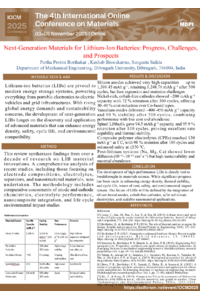
Lithium-ion batteries (LIBs) are pivotal to modern energy storage systems, powering everything from portable electronics to electric vehicles and grid infrastructures. With rising global energy demands and sustainability concerns, the development of next-generation LIBs hinges on the discovery and application of advanced materials that can enhance energy density, safety, cycle life, and environmental compatibility.
Methods:
This review synthesizes findings from over a decade of research on LIB material innovations. A comprehensive analysis of recent studies, including those focusing on electrode compositions, electrolytes, separators, and nanostructured materials, is undertaken. The methodology includes comparative assessments of anode and cathode chemistries, electrolyte performance, nanocomposite integration, and life cycle environmental impact studies.
Results:
Emerging anode materials such as silicon and lithium-metal-based composites demonstrate significantly higher theoretical capacities than commercial graphite but face limitations due to volumetric expansion and mechanical instability. Cathode advancements have focused on high-nickel and cobalt-free layered oxides to reduce costs and improve sustainability. Electrolyte innovations include solid-state and polymer-based alternatives that enhance safety and support high-voltage operations. Furthermore, nanocomposite materials incorporating carbon, oxides, and polymers have shown potential in improving structural integrity, conductivity, and lithium diffusion pathways. Advanced separators and interface engineering continue to address thermal stability and safety concerns. Environmental life cycle assessments have underscored the need for sustainable material sourcing, recycling technologies, and green processing, particularly for high-output markets.
Conclusions:
The development of high-performance LIBs is closely tied to breakthroughs in materials science. While significant progress has been made in enhancing energy density, thermal stability, and cycle life, issues of cost, safety, and environmental impact remain. The future of LIBs will be defined by the integration of silicon-based anodes, cobalt-free cathodes, safer solid-state electrolytes, and scalable nanomaterial applications. Additionally, closed-loop recycling and green chemistry approaches will be critical for establishing sustainable supply chains.
Keywords
Lithium-ion batteries
Anode and cathode materials
Solid-state electrolytes
Nanocomposites
Energy storage systems
Poster
sangeeta saikia.pdf
Evaluation of Durability of Clay stabilized by Quarry Dust-based Geopolymer
Tailoring Novel Cathode Materials with High Potential to Combine Performance with Reduced Content of Critical Raw Materials