Event submissions
Published
This submission belongs to the session S5. Materials for Energy Harvesting, Conversion and Storage of the event The 4th International Online Conference on Materials
Published date
29 Oct, 2025
Academic Editor
'%3e%3cpath%20d='M12.6657%2010.9104C12.4185%2010.325%2012.0599%209.79327%2011.6097%209.34482C11.1609%208.89508%2010.6293%208.5365%2010.0442%208.28888C10.0389%208.28626%2010.0337%208.28495%2010.0285%208.28233C10.8446%207.69279%2011.3752%206.73249%2011.3752%205.64904C11.3752%203.8542%209.92103%202.39999%208.1262%202.39999C6.33136%202.39999%204.87715%203.8542%204.87715%205.64904C4.87715%206.73249%205.40774%207.69279%206.22393%208.28364C6.21869%208.28626%206.21345%208.28757%206.20821%208.29019C5.62129%208.5378%205.09463%208.89284%204.64265%209.34613C4.1929%209.79493%203.83432%2010.3266%203.58671%2010.9117C3.34345%2011.4845%203.21226%2012.0987%203.20023%2012.7209C3.19988%2012.7349%203.20233%2012.7488%203.20744%2012.7619C3.21255%2012.7749%203.22022%2012.7867%203.22998%2012.7968C3.23975%2012.8068%203.25142%2012.8147%203.26431%2012.8202C3.2772%2012.8256%203.29105%2012.8284%203.30504%2012.8284H4.09109C4.14874%2012.8284%204.19459%2012.7825%204.1959%2012.7262C4.2221%2011.7148%204.62823%2010.7676%205.34617%2010.0497C6.08899%209.30683%207.0755%208.89808%208.1262%208.89808C9.17689%208.89808%2010.1634%209.30683%2010.9062%2010.0497C11.6242%2010.7676%2012.0303%2011.7148%2012.0565%2012.7262C12.0578%2012.7838%2012.1037%2012.8284%2012.1613%2012.8284H12.9474C12.9613%2012.8284%2012.9752%2012.8256%2012.9881%2012.8202C13.001%2012.8147%2013.0126%2012.8068%2013.0224%2012.7968C13.0322%2012.7867%2013.0398%2012.7749%2013.0449%2012.7619C13.0501%2012.7488%2013.0525%2012.7349%2013.0522%2012.7209C13.0391%2012.0947%2012.9094%2011.4855%2012.6657%2010.9104ZM8.1262%207.9024C7.52486%207.9024%206.9589%207.6679%206.53312%207.24211C6.10733%206.81633%205.87283%206.25037%205.87283%205.64904C5.87283%205.0477%206.10733%204.48174%206.53312%204.05596C6.9589%203.63018%207.52486%203.39567%208.1262%203.39567C8.72753%203.39567%209.29349%203.63018%209.71927%204.05596C10.1451%204.48174%2010.3796%205.0477%2010.3796%205.64904C10.3796%206.25037%2010.1451%206.81633%209.71927%207.24211C9.29349%207.6679%208.72753%207.9024%208.1262%207.9024Z'%20fill='%235D1EE1'/%3e%3c/g%3e%3c/svg%3e) Federico Bella
Federico BellaCitation
Ioana Anasiei, Beatrice Adriana Șerban, Ioana Cristina Badea, Sabina Andreea Fironda, Mihai Tudor Olaru, Marian Burada, Alexandru Cristian Matei, Elena Bacalum, Tailoring Novel Cathode Materials with High Potential to Combine Performance with Reduced Content of Critical Raw Materials, in Proceedings of The 4th International Online Conference on Materials, 3 November–6 November 2025, MDPI: Basel, Switzerland
Share
Email
Facebook
Twitter
LinkedIn
Tailoring Novel Cathode Materials with High Potential to Combine Performance with Reduced Content of Critical Raw Materials
'%3e%3cpath%20d='M12.6647%2010.9104C12.4176%2010.325%2012.0589%209.7933%2011.6088%209.34485C11.16%208.89511%2010.6283%208.53653%2010.0432%208.28891C10.038%208.28629%2010.0327%208.28498%2010.0275%208.28236C10.8437%207.69282%2011.3743%206.73252%2011.3743%205.64907C11.3743%203.85423%209.92005%202.40002%208.12522%202.40002C6.33038%202.40002%204.87618%203.85423%204.87618%205.64907C4.87618%206.73252%205.40677%207.69282%206.22296%208.28367C6.21772%208.28629%206.21248%208.2876%206.20724%208.29022C5.62031%208.53783%205.09365%208.89287%204.64167%209.34616C4.19192%209.79496%203.83334%2010.3266%203.58573%2010.9117C3.34247%2011.4846%203.21128%2012.0987%203.19925%2012.721C3.1989%2012.735%203.20135%2012.7489%203.20646%2012.7619C3.21157%2012.7749%203.21924%2012.7868%203.22901%2012.7968C3.23877%2012.8068%203.25045%2012.8148%203.26334%2012.8202C3.27623%2012.8256%203.29007%2012.8284%203.30406%2012.8284H4.09012C4.14776%2012.8284%204.19362%2012.7825%204.19493%2012.7262C4.22113%2011.7148%204.62726%2010.7676%205.34519%2010.0497C6.08802%209.30686%207.07452%208.89811%208.12522%208.89811C9.17592%208.89811%2010.1624%209.30686%2010.9052%2010.0497C11.6232%2010.7676%2012.0293%2011.7148%2012.0555%2012.7262C12.0568%2012.7839%2012.1027%2012.8284%2012.1603%2012.8284H12.9464C12.9604%2012.8284%2012.9742%2012.8256%2012.9871%2012.8202C13%2012.8148%2013.0117%2012.8068%2013.0214%2012.7968C13.0312%2012.7868%2013.0389%2012.7749%2013.044%2012.7619C13.0491%2012.7489%2013.0515%2012.735%2013.0512%2012.721C13.0381%2012.0947%2012.9084%2011.4856%2012.6647%2010.9104ZM8.12522%207.90243C7.52388%207.90243%206.95792%207.66793%206.53214%207.24215C6.10636%206.81636%205.87185%206.2504%205.87185%205.64907C5.87185%205.04773%206.10636%204.48177%206.53214%204.05599C6.95792%203.63021%207.52388%203.3957%208.12522%203.3957C8.72655%203.3957%209.29252%203.63021%209.7183%204.05599C10.1441%204.48177%2010.3786%205.04773%2010.3786%205.64907C10.3786%206.2504%2010.1441%206.81636%209.7183%207.24215C9.29252%207.66793%208.72655%207.90243%208.12522%207.90243Z'%20fill='%235D1EE1'/%3e%3c/g%3e%3c/svg%3e)
Ioana Anasiei 1,2
Beatrice Adriana Șerban 1
Ioana Cristina Badea 1
Sabina Andreea Fironda 1,2
Mihai Tudor Olaru 1
Marian Burada 1
Alexandru Cristian Matei 1,2
Elena Bacalum 1
1. National Research&Development Institute for Non-ferrous and Rare Metals – IMNR, 102 Biruinței, 077145 Pantelimon, Romania
2. National University of Science and Technology POLITEHNICA Bucharest, 313 Splaiul Independentei, Bucharest, 060042, Romania
Abstract
The economic impact of vehicles powered by internal combustion engines continues to grow. Dependence on fossil fuels significantly contributes to the rising global energy demand and has intensified the development of environmentally friendly systems for energy generation and storage. In this context, lithium-ion batteries have emerged as a viable solution to environmental, economic, and social challenges, currently dominating the electric vehicle industry.
Among the battery components, cathode material has the most significant influence on performance, safety, cost, or lifespan. The first commercialized cathode was LiCoO₂, which is now being gradually replaced due to its low safety level and high cost.
Partial or complete substitution of cobalt with other elements enables the development of new properties that would otherwise be difficult to achieve. The introduction of aluminium contributes to structural stability and reduced economic impact, but also leads to a decrease in storage capacity. Manganese has high potential for improving electronic conductivity, suppressing microcracks, enhancing structural integrity and mechanical strength. Nickel allows for high energy density, but pure LiNiO₂ is difficult to synthesize and process and lacks sufficient safety.
Therefore, although conventional cathodes, such as LiNi1-x-yCoxMny and LiNi1-x-yCoxAly exhibit valuable properties, they still suffer from several limitations. Therefore, the development of new cathode materials that deliver high performance without compromising safety or durability is essential.
This work focuses on the synthesis of new oxide-based materials with high potential for use as cathodes in lithium-ion batteries, aiming to achieve a balance between performance, cost-effectiveness, and criticality of the constituent elements.
Keywords
Li-ion batteries
cathode materials
critical raw materials
novel oxide materials
Poster
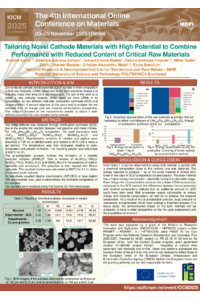
Poster_Anasiei Ioana_fin.pdf
Next-Generation Materials for Lithium-Ion Batteries: Progress, Challenges, and Prospects
Engineering Low-Dimensional Materials for Efficient Energy Conversion