Event submissions
Published
This submission belongs to the session S6. Green Materials, Synthesis, Characterization and Recycling of the event The 4th International Online Conference on Materials
Published date
29 Oct, 2025
Academic Editor
'%3e%3cpath%20d='M12.6657%2010.9104C12.4185%2010.325%2012.0599%209.79327%2011.6097%209.34482C11.1609%208.89508%2010.6293%208.5365%2010.0442%208.28888C10.0389%208.28626%2010.0337%208.28495%2010.0285%208.28233C10.8446%207.69279%2011.3752%206.73249%2011.3752%205.64904C11.3752%203.8542%209.92103%202.39999%208.1262%202.39999C6.33136%202.39999%204.87715%203.8542%204.87715%205.64904C4.87715%206.73249%205.40774%207.69279%206.22393%208.28364C6.21869%208.28626%206.21345%208.28757%206.20821%208.29019C5.62129%208.5378%205.09463%208.89284%204.64265%209.34613C4.1929%209.79493%203.83432%2010.3266%203.58671%2010.9117C3.34345%2011.4845%203.21226%2012.0987%203.20023%2012.7209C3.19988%2012.7349%203.20233%2012.7488%203.20744%2012.7619C3.21255%2012.7749%203.22022%2012.7867%203.22998%2012.7968C3.23975%2012.8068%203.25142%2012.8147%203.26431%2012.8202C3.2772%2012.8256%203.29105%2012.8284%203.30504%2012.8284H4.09109C4.14874%2012.8284%204.19459%2012.7825%204.1959%2012.7262C4.2221%2011.7148%204.62823%2010.7676%205.34617%2010.0497C6.08899%209.30683%207.0755%208.89808%208.1262%208.89808C9.17689%208.89808%2010.1634%209.30683%2010.9062%2010.0497C11.6242%2010.7676%2012.0303%2011.7148%2012.0565%2012.7262C12.0578%2012.7838%2012.1037%2012.8284%2012.1613%2012.8284H12.9474C12.9613%2012.8284%2012.9752%2012.8256%2012.9881%2012.8202C13.001%2012.8147%2013.0126%2012.8068%2013.0224%2012.7968C13.0322%2012.7867%2013.0398%2012.7749%2013.0449%2012.7619C13.0501%2012.7488%2013.0525%2012.7349%2013.0522%2012.7209C13.0391%2012.0947%2012.9094%2011.4855%2012.6657%2010.9104ZM8.1262%207.9024C7.52486%207.9024%206.9589%207.6679%206.53312%207.24211C6.10733%206.81633%205.87283%206.25037%205.87283%205.64904C5.87283%205.0477%206.10733%204.48174%206.53312%204.05596C6.9589%203.63018%207.52486%203.39567%208.1262%203.39567C8.72753%203.39567%209.29349%203.63018%209.71927%204.05596C10.1451%204.48174%2010.3796%205.0477%2010.3796%205.64904C10.3796%206.25037%2010.1451%206.81633%209.71927%207.24211C9.29349%207.6679%208.72753%207.9024%208.1262%207.9024Z'%20fill='%235D1EE1'/%3e%3c/g%3e%3c/svg%3e) SARA GARCIA BALLESTEROS
SARA GARCIA BALLESTEROSCitation
Pabina Rani Boro, Partha Protim Borthakur, Madhurjya Saikia, Rupam Deka, Recent Advances in Fiber-Reinforced Biopolymers Derived from Rice Husk Waste for Sustainable Construction Materials, in Proceedings of The 4th International Online Conference on Materials, 3 November–6 November 2025, MDPI: Basel, Switzerland
Share
Email
Facebook
Twitter
LinkedIn
Recent Advances in Fiber-Reinforced Biopolymers Derived from Rice Husk Waste for Sustainable Construction Materials

Pabina Rani Boro 1

Partha Protim Borthakur 1
'%3e%3cpath%20d='M12.6647%2010.9104C12.4176%2010.325%2012.0589%209.7933%2011.6088%209.34485C11.16%208.89511%2010.6283%208.53653%2010.0432%208.28891C10.038%208.28629%2010.0327%208.28498%2010.0275%208.28236C10.8437%207.69282%2011.3743%206.73252%2011.3743%205.64907C11.3743%203.85423%209.92005%202.40002%208.12522%202.40002C6.33038%202.40002%204.87618%203.85423%204.87618%205.64907C4.87618%206.73252%205.40677%207.69282%206.22296%208.28367C6.21772%208.28629%206.21248%208.2876%206.20724%208.29022C5.62031%208.53783%205.09365%208.89287%204.64167%209.34616C4.19192%209.79496%203.83334%2010.3266%203.58573%2010.9117C3.34247%2011.4846%203.21128%2012.0987%203.19925%2012.721C3.1989%2012.735%203.20135%2012.7489%203.20646%2012.7619C3.21157%2012.7749%203.21924%2012.7868%203.22901%2012.7968C3.23877%2012.8068%203.25045%2012.8148%203.26334%2012.8202C3.27623%2012.8256%203.29007%2012.8284%203.30406%2012.8284H4.09012C4.14776%2012.8284%204.19362%2012.7825%204.19493%2012.7262C4.22113%2011.7148%204.62726%2010.7676%205.34519%2010.0497C6.08802%209.30686%207.07452%208.89811%208.12522%208.89811C9.17592%208.89811%2010.1624%209.30686%2010.9052%2010.0497C11.6232%2010.7676%2012.0293%2011.7148%2012.0555%2012.7262C12.0568%2012.7839%2012.1027%2012.8284%2012.1603%2012.8284H12.9464C12.9604%2012.8284%2012.9742%2012.8256%2012.9871%2012.8202C13%2012.8148%2013.0117%2012.8068%2013.0214%2012.7968C13.0312%2012.7868%2013.0389%2012.7749%2013.044%2012.7619C13.0491%2012.7489%2013.0515%2012.735%2013.0512%2012.721C13.0381%2012.0947%2012.9084%2011.4856%2012.6647%2010.9104ZM8.12522%207.90243C7.52388%207.90243%206.95792%207.66793%206.53214%207.24215C6.10636%206.81636%205.87185%206.2504%205.87185%205.64907C5.87185%205.04773%206.10636%204.48177%206.53214%204.05599C6.95792%203.63021%207.52388%203.3957%208.12522%203.3957C8.72655%203.3957%209.29252%203.63021%209.7183%204.05599C10.1441%204.48177%2010.3786%205.04773%2010.3786%205.64907C10.3786%206.2504%2010.1441%206.81636%209.7183%207.24215C9.29252%207.66793%208.72655%207.90243%208.12522%207.90243Z'%20fill='%235D1EE1'/%3e%3c/g%3e%3c/svg%3e)
Madhurjya Saikia 1
Rupam Deka 1
1. Department of Mechanical Engineering, Dibrugarh University. Dibrugarh. Assam. India. 786004
Abstract
Introduction
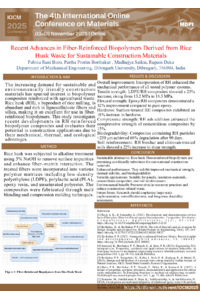
The increasing demand for sustainable and environmentally friendly construction materials has spurred interest in biopolymer composites reinforced with agricultural waste. Rice husk (RH), a byproduct of rice milling, is abundant and rich in lignocellulosic fibers and silica, making it an excellent for use in fiber-reinforced biopolymers. This study investigates recent developments in RH-reinforced biopolymer composites and evaluates their potential in construction applications due to their mechanical, thermal, and ecological advantages.
Methods
Rice husk was subjected to alkaline treatment using 5% NaOH to remove surface impurities and enhance fiber–matrix interaction. The treated fibers were incorporated into various polymer matrices including low-density polyethylene (LDPE), polylactic acid (PLA), epoxy resin, and unsaturated polyester. The composites were fabricated through melt blending and compression molding techniques. Physical and mechanical properties—such as tensile strength, flexural strength, impact resistance, water absorption, and thermal stability—were measured according to ASTM standards.
Results
Incorporation of RH improved mechanical performance in all tested polymers. LDPE/RH composites exhibited a 25% increase in tensile strength (from 13.2 MPa to 16.5 MPa), while epoxy/RH systems showed a 32% enhancement in flexural strength. Treated composites exhibited an 18% increase in hardness. RH ash increased compressive strength of cementitious composites by 15%. In biodegradability studies, composites with RH particles <250 μm showed 60% degradation after 90 days. RH biochar and chitosan-enhanced soil samples showed a 22% increase in shear strength.
Conclusions
Fiber-reinforced biopolymers made from rice husk waste show significant promise as sustainable alternatives to conventional construction materials. Their enhanced mechanical properties, biodegradability, and thermal performance make them suitable for use in panels, insulation, cementitious composites, and soil reinforcement. These materials contribute to circular economy practices and offer environmentally friendly solutions for green construction. Further research should focus on large-scale implementation, cost analysis, and long-term durability studies.
Keywords
Rice Husk Biocomposites
Fiber-Reinforced Polymers
Sustainable Construction Materials
Agricultural Waste Utilization
Mechanical Properties of Biopolymers
Poster
pabina rani boro.pdf
Beyond the Si/Al ratio: structure–acidity correlation in mesostructured Al-SBA-16 catalysts for the one-pot CO₂-to-DME conversion
Exploring the Ferroelectric Nematic Liquid Crystals for Electromechanical Performance Evaluation in PVDF-based Triboelectric Nanogenerators