Event submissions
Published
This submission belongs to the session S5. Materials for Energy Harvesting, Conversion and Storage of the event The 4th International Online Conference on Materials
Published date
29 Oct, 2025
Academic Editor
'%3e%3cpath%20d='M12.6657%2010.9104C12.4185%2010.325%2012.0599%209.79327%2011.6097%209.34482C11.1609%208.89508%2010.6293%208.5365%2010.0442%208.28888C10.0389%208.28626%2010.0337%208.28495%2010.0285%208.28233C10.8446%207.69279%2011.3752%206.73249%2011.3752%205.64904C11.3752%203.8542%209.92103%202.39999%208.1262%202.39999C6.33136%202.39999%204.87715%203.8542%204.87715%205.64904C4.87715%206.73249%205.40774%207.69279%206.22393%208.28364C6.21869%208.28626%206.21345%208.28757%206.20821%208.29019C5.62129%208.5378%205.09463%208.89284%204.64265%209.34613C4.1929%209.79493%203.83432%2010.3266%203.58671%2010.9117C3.34345%2011.4845%203.21226%2012.0987%203.20023%2012.7209C3.19988%2012.7349%203.20233%2012.7488%203.20744%2012.7619C3.21255%2012.7749%203.22022%2012.7867%203.22998%2012.7968C3.23975%2012.8068%203.25142%2012.8147%203.26431%2012.8202C3.2772%2012.8256%203.29105%2012.8284%203.30504%2012.8284H4.09109C4.14874%2012.8284%204.19459%2012.7825%204.1959%2012.7262C4.2221%2011.7148%204.62823%2010.7676%205.34617%2010.0497C6.08899%209.30683%207.0755%208.89808%208.1262%208.89808C9.17689%208.89808%2010.1634%209.30683%2010.9062%2010.0497C11.6242%2010.7676%2012.0303%2011.7148%2012.0565%2012.7262C12.0578%2012.7838%2012.1037%2012.8284%2012.1613%2012.8284H12.9474C12.9613%2012.8284%2012.9752%2012.8256%2012.9881%2012.8202C13.001%2012.8147%2013.0126%2012.8068%2013.0224%2012.7968C13.0322%2012.7867%2013.0398%2012.7749%2013.0449%2012.7619C13.0501%2012.7488%2013.0525%2012.7349%2013.0522%2012.7209C13.0391%2012.0947%2012.9094%2011.4855%2012.6657%2010.9104ZM8.1262%207.9024C7.52486%207.9024%206.9589%207.6679%206.53312%207.24211C6.10733%206.81633%205.87283%206.25037%205.87283%205.64904C5.87283%205.0477%206.10733%204.48174%206.53312%204.05596C6.9589%203.63018%207.52486%203.39567%208.1262%203.39567C8.72753%203.39567%209.29349%203.63018%209.71927%204.05596C10.1451%204.48174%2010.3796%205.0477%2010.3796%205.64904C10.3796%206.25037%2010.1451%206.81633%209.71927%207.24211C9.29349%207.6679%208.72753%207.9024%208.1262%207.9024Z'%20fill='%235D1EE1'/%3e%3c/g%3e%3c/svg%3e) Vlassis Likodimos
Vlassis LikodimosCitation
Huma Amber, Dmytro Shyshkin, Loreta Tamašauskaitė-Tamašiūnaitė, Aldona Balčiūnaitė, Eugenijus Norkus, Enhancing Hydrogen Generation via Overall Water Splitting Using Au-Modified CoP and CoFeP, in Proceedings of The 4th International Online Conference on Materials, 3 November–6 November 2025, MDPI: Basel, Switzerland
Share
Email
Facebook
Twitter
LinkedIn
Enhancing Hydrogen Generation via Overall Water Splitting Using Au-Modified CoP and CoFeP
'%3e%3cpath%20d='M12.6647%2010.9104C12.4176%2010.325%2012.0589%209.7933%2011.6088%209.34485C11.16%208.89511%2010.6283%208.53653%2010.0432%208.28891C10.038%208.28629%2010.0327%208.28498%2010.0275%208.28236C10.8437%207.69282%2011.3743%206.73252%2011.3743%205.64907C11.3743%203.85423%209.92005%202.40002%208.12522%202.40002C6.33038%202.40002%204.87618%203.85423%204.87618%205.64907C4.87618%206.73252%205.40677%207.69282%206.22296%208.28367C6.21772%208.28629%206.21248%208.2876%206.20724%208.29022C5.62031%208.53783%205.09365%208.89287%204.64167%209.34616C4.19192%209.79496%203.83334%2010.3266%203.58573%2010.9117C3.34247%2011.4846%203.21128%2012.0987%203.19925%2012.721C3.1989%2012.735%203.20135%2012.7489%203.20646%2012.7619C3.21157%2012.7749%203.21924%2012.7868%203.22901%2012.7968C3.23877%2012.8068%203.25045%2012.8148%203.26334%2012.8202C3.27623%2012.8256%203.29007%2012.8284%203.30406%2012.8284H4.09012C4.14776%2012.8284%204.19362%2012.7825%204.19493%2012.7262C4.22113%2011.7148%204.62726%2010.7676%205.34519%2010.0497C6.08802%209.30686%207.07452%208.89811%208.12522%208.89811C9.17592%208.89811%2010.1624%209.30686%2010.9052%2010.0497C11.6232%2010.7676%2012.0293%2011.7148%2012.0555%2012.7262C12.0568%2012.7839%2012.1027%2012.8284%2012.1603%2012.8284H12.9464C12.9604%2012.8284%2012.9742%2012.8256%2012.9871%2012.8202C13%2012.8148%2013.0117%2012.8068%2013.0214%2012.7968C13.0312%2012.7868%2013.0389%2012.7749%2013.044%2012.7619C13.0491%2012.7489%2013.0515%2012.735%2013.0512%2012.721C13.0381%2012.0947%2012.9084%2011.4856%2012.6647%2010.9104ZM8.12522%207.90243C7.52388%207.90243%206.95792%207.66793%206.53214%207.24215C6.10636%206.81636%205.87185%206.2504%205.87185%205.64907C5.87185%205.04773%206.10636%204.48177%206.53214%204.05599C6.95792%203.63021%207.52388%203.3957%208.12522%203.3957C8.72655%203.3957%209.29252%203.63021%209.7183%204.05599C10.1441%204.48177%2010.3786%205.04773%2010.3786%205.64907C10.3786%206.2504%2010.1441%206.81636%209.7183%207.24215C9.29252%207.66793%208.72655%207.90243%208.12522%207.90243Z'%20fill='%235D1EE1'/%3e%3c/g%3e%3c/svg%3e)
Huma Amber 1
Dmytro Shyshkin 2

Loreta Tamašauskaitė-Tamašiūnaitė 1

Aldona Balčiūnaitė 1
Eugenijus Norkus 1
1. Department of Catalysis, Center for Physical Sciences and Technology (FTMC), LT-10257 Vilnius, Lithuania
2. Faculty of Chemistry and Geosciences, Vilnius University, Naugarduko Str. 24, LT-03225 Vilnius, Lithuania
Abstract
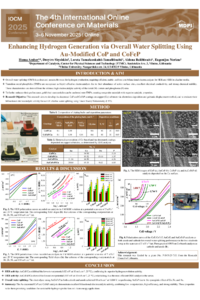
The innovative design and development of bifunctional electrocatalysts that exhibit both high catalytic activity and enhanced stability for the hydrogen evolution reaction (HER) and the oxygen evolution reaction (OER) are both highly desirable and challenging objectives. Transition metal phosphides (TMPs) are recognized as highly effective electrocatalysts due to their abundance of active surface sites, excellent electrical conductivity, and strong chemical stability. These characteristics are derived from the intrinsic high electrocatalytic activity of the metal (M) centers and phosphorus (P) sites. In this study, cobalt phosphide (CoP) and cobalt–iron phosphide (CoFeP) were directly deposited on copper (Cu) substrates via an electroless deposition method. The P source and reducing agent used in this process was sodium hypophosphite (NaH2PO2). Gold (Au) nanoparticles were subsequently anchored to the phosphides through a galvanic displacement strategy, thereby creating a composite material with enhanced properties. A comprehensive investigation was conducted to elucidate the morphology, composition, and crystal structure of the catalysts. This investigation utilized a range of analytical techniques, including scanning electron microscopy (SEM), energy-dispersive X-ray spectroscopy (EDS), X-ray diffraction (XRD), and X-ray photoelectron spectroscopy (XPS). The electrocatalytic bifunctionality of the materials for overall water splitting (OWS) was evaluated in a two-electrode setup in a 1 M KOH electrolyte.
The Au-CoFeP catalyst demonstrated notable bifunctional activity, achieving a low cell voltage of 1.68 V at 10 mA cm-2. This performance was superior to that of the Au-CoP catalyst, due to synergy among the Co, Fe, and Au elements. The combination of the Au modification and bimetallic CoFeP composition led to lower overpotentials and enhanced stability, underscoring a practical and effective strategy for designing gold-modified transition metal phosphides as durable and efficient candidates for application in the field of electrocatalysis.
Acknowledgement
This research was funded by a grant (No. P-SV3-25-715) from the Research Council of Lithuania.
Keywords
gold nanoparticles
cobalt phosphide
cobalt-iron phosphide
electroless deposition
galvanic displacement
overall water splitting
hydrogen evolution reaction
oxygen evolution reaction
bifunctional electrocatalyst
alkaline electrolysis
Poster
IOCM 2025 - poster huma.pdf
Exploring the Ferroelectric Nematic Liquid Crystals for Electromechanical Performance Evaluation in PVDF-based Triboelectric Nanogenerators
Simulation analysis of Cu2ZnSnS4 based heterostructure solar cell