Event submissions
Published
This submission belongs to the session S2. Nanomaterials, Nanotechnology and Quantum Materials of the event The 4th International Online Conference on Materials
Published date
29 Oct, 2025
Academic Editor
'%3e%3cpath%20d='M12.6657%2010.9104C12.4185%2010.325%2012.0599%209.79327%2011.6097%209.34482C11.1609%208.89508%2010.6293%208.5365%2010.0442%208.28888C10.0389%208.28626%2010.0337%208.28495%2010.0285%208.28233C10.8446%207.69279%2011.3752%206.73249%2011.3752%205.64904C11.3752%203.8542%209.92103%202.39999%208.1262%202.39999C6.33136%202.39999%204.87715%203.8542%204.87715%205.64904C4.87715%206.73249%205.40774%207.69279%206.22393%208.28364C6.21869%208.28626%206.21345%208.28757%206.20821%208.29019C5.62129%208.5378%205.09463%208.89284%204.64265%209.34613C4.1929%209.79493%203.83432%2010.3266%203.58671%2010.9117C3.34345%2011.4845%203.21226%2012.0987%203.20023%2012.7209C3.19988%2012.7349%203.20233%2012.7488%203.20744%2012.7619C3.21255%2012.7749%203.22022%2012.7867%203.22998%2012.7968C3.23975%2012.8068%203.25142%2012.8147%203.26431%2012.8202C3.2772%2012.8256%203.29105%2012.8284%203.30504%2012.8284H4.09109C4.14874%2012.8284%204.19459%2012.7825%204.1959%2012.7262C4.2221%2011.7148%204.62823%2010.7676%205.34617%2010.0497C6.08899%209.30683%207.0755%208.89808%208.1262%208.89808C9.17689%208.89808%2010.1634%209.30683%2010.9062%2010.0497C11.6242%2010.7676%2012.0303%2011.7148%2012.0565%2012.7262C12.0578%2012.7838%2012.1037%2012.8284%2012.1613%2012.8284H12.9474C12.9613%2012.8284%2012.9752%2012.8256%2012.9881%2012.8202C13.001%2012.8147%2013.0126%2012.8068%2013.0224%2012.7968C13.0322%2012.7867%2013.0398%2012.7749%2013.0449%2012.7619C13.0501%2012.7488%2013.0525%2012.7349%2013.0522%2012.7209C13.0391%2012.0947%2012.9094%2011.4855%2012.6657%2010.9104ZM8.1262%207.9024C7.52486%207.9024%206.9589%207.6679%206.53312%207.24211C6.10733%206.81633%205.87283%206.25037%205.87283%205.64904C5.87283%205.0477%206.10733%204.48174%206.53312%204.05596C6.9589%203.63018%207.52486%203.39567%208.1262%203.39567C8.72753%203.39567%209.29349%203.63018%209.71927%204.05596C10.1451%204.48174%2010.3796%205.0477%2010.3796%205.64904C10.3796%206.25037%2010.1451%206.81633%209.71927%207.24211C9.29349%207.6679%208.72753%207.9024%208.1262%207.9024Z'%20fill='%235D1EE1'/%3e%3c/g%3e%3c/svg%3e) Pietro Mazzuca
Pietro MazzucaCitation
Elena Pankratova, Dmitrii Gribanev, Hassan Alqahtani, Khalid Alruwaili, Vera Solovyeva, Carbon nanotubes and porous organic polymers for CO₂ capture, in Proceedings of The 4th International Online Conference on Materials, 3 November–6 November 2025, MDPI: Basel, Switzerland
Share
Email
Facebook
Twitter
LinkedIn
Carbon nanotubes and porous organic polymers for CO2 capture
'%3e%3cpath%20d='M12.6647%2010.9104C12.4176%2010.325%2012.0589%209.7933%2011.6088%209.34485C11.16%208.89511%2010.6283%208.53653%2010.0432%208.28891C10.038%208.28629%2010.0327%208.28498%2010.0275%208.28236C10.8437%207.69282%2011.3743%206.73252%2011.3743%205.64907C11.3743%203.85423%209.92005%202.40002%208.12522%202.40002C6.33038%202.40002%204.87618%203.85423%204.87618%205.64907C4.87618%206.73252%205.40677%207.69282%206.22296%208.28367C6.21772%208.28629%206.21248%208.2876%206.20724%208.29022C5.62031%208.53783%205.09365%208.89287%204.64167%209.34616C4.19192%209.79496%203.83334%2010.3266%203.58573%2010.9117C3.34247%2011.4846%203.21128%2012.0987%203.19925%2012.721C3.1989%2012.735%203.20135%2012.7489%203.20646%2012.7619C3.21157%2012.7749%203.21924%2012.7868%203.22901%2012.7968C3.23877%2012.8068%203.25045%2012.8148%203.26334%2012.8202C3.27623%2012.8256%203.29007%2012.8284%203.30406%2012.8284H4.09012C4.14776%2012.8284%204.19362%2012.7825%204.19493%2012.7262C4.22113%2011.7148%204.62726%2010.7676%205.34519%2010.0497C6.08802%209.30686%207.07452%208.89811%208.12522%208.89811C9.17592%208.89811%2010.1624%209.30686%2010.9052%2010.0497C11.6232%2010.7676%2012.0293%2011.7148%2012.0555%2012.7262C12.0568%2012.7839%2012.1027%2012.8284%2012.1603%2012.8284H12.9464C12.9604%2012.8284%2012.9742%2012.8256%2012.9871%2012.8202C13%2012.8148%2013.0117%2012.8068%2013.0214%2012.7968C13.0312%2012.7868%2013.0389%2012.7749%2013.044%2012.7619C13.0491%2012.7489%2013.0515%2012.735%2013.0512%2012.721C13.0381%2012.0947%2012.9084%2011.4856%2012.6647%2010.9104ZM8.12522%207.90243C7.52388%207.90243%206.95792%207.66793%206.53214%207.24215C6.10636%206.81636%205.87185%206.2504%205.87185%205.64907C5.87185%205.04773%206.10636%204.48177%206.53214%204.05599C6.95792%203.63021%207.52388%203.3957%208.12522%203.3957C8.72655%203.3957%209.29252%203.63021%209.7183%204.05599C10.1441%204.48177%2010.3786%205.04773%2010.3786%205.64907C10.3786%206.2504%2010.1441%206.81636%209.7183%207.24215C9.29252%207.66793%208.72655%207.90243%208.12522%207.90243Z'%20fill='%235D1EE1'/%3e%3c/g%3e%3c/svg%3e)
Elena Pankratova 1
Dmitrii Gribanev 1
Hassan Alqahtani 2
Khalid Alruwaili 2
Vera Solovyeva 1
1. Aramco Innovations LLC, Bld. 1, 9 Varshavskoye Highway, 117105 Moscow, Russia
2. EXPEC Advanced Research Center (EXPEC ARC); 31311 Dhahran, Saudi Arabia
Abstract
Emissions of carbon dioxide are considered to be the major factors leading to climate change. Reducing CO2 influence on global warming requires its capture and utilization. Current technologies of CO2 capture include chemical and physical absorption, membrane separation, and cryogenic distillation. Particularly, solid adsorbents demonstrate a high efficiency for CO2 capture and storage tasks. Porous liquids, containing a solid adsorbent dispersed on a compatible liquid, represent another promising approach for CO2 capture.
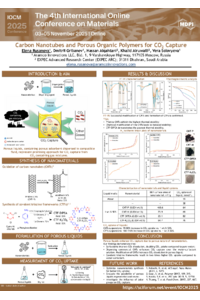
In this study, commercial and synthetic porous carbon nanomaterials and frameworks were obtained. Structure, amorphous domain, and thermal stability of samples were checked by Fourier-transform infrared spectroscopy, thermogravimetric analysis, and X-ray diffraction. Synthesized nanomaterials were dispersed in the water solutions of different surfactants and further compared on the efficiency of CO2 uptake. The characterization of samples confirmed successful synthesis and modification of nanomaterials in different conditions and provided the necessary data for further optimization of synthesis parameters for targeted applications.
Synthetic porous carbon nanomaterials and frameworks were compared for their efficiency as porous fillers in the fluids. The efficiency of porous fluids was estimated and compared with blank measurements for water and water with surfactants. Adding surfactants enhanced the dissolution of CO2, leading to a double increase in CO2 uptake for the water–surfactant solution, compared with pure water. Dispersion with commercial materials as porous fillers demonstrated a slight enhancement in CO2 uptake, compared with the water–surfactant solution. Synthesized carbon nanomaterials resulted in higher CO2 adsorption, exhibiting two times higher CO2 uptake in comparison with water–surfactant.
The modification of carbon nanomaterials led to an enhancement in CO2 adsorption capacity. Porous liquids containing adsorbents with a greater number of polar groups demonstrated higher CO₂ uptake. Particularly, nitrogen-doped carbon nanomaterials were more efficient, while surface-modified materials without nitrogen in their composition demonstrated less CO2 uptake.
Keywords
Carbon dioxide
porous frameworks
porous liquids
carbon nanomaterials
Poster
Elena Rusanova_Materials MDPI 2025_Poster.pdf
Synthesis and electrochemical performance of activated carbon from Lapsi (Choerospondias axillaris) seed biomass for supercapacitor applications
Parameters affecting ammonia production via lithium-mediated electrochemical dinitrogen reduction