Event submissions
Published
This submission belongs to the session S5. Materials for Energy Harvesting, Conversion and Storage of the event The 4th International Online Conference on Materials
Published date
29 Oct, 2025
Academic Editor
'%3e%3cpath%20d='M12.6657%2010.9104C12.4185%2010.325%2012.0599%209.79327%2011.6097%209.34482C11.1609%208.89508%2010.6293%208.5365%2010.0442%208.28888C10.0389%208.28626%2010.0337%208.28495%2010.0285%208.28233C10.8446%207.69279%2011.3752%206.73249%2011.3752%205.64904C11.3752%203.8542%209.92103%202.39999%208.1262%202.39999C6.33136%202.39999%204.87715%203.8542%204.87715%205.64904C4.87715%206.73249%205.40774%207.69279%206.22393%208.28364C6.21869%208.28626%206.21345%208.28757%206.20821%208.29019C5.62129%208.5378%205.09463%208.89284%204.64265%209.34613C4.1929%209.79493%203.83432%2010.3266%203.58671%2010.9117C3.34345%2011.4845%203.21226%2012.0987%203.20023%2012.7209C3.19988%2012.7349%203.20233%2012.7488%203.20744%2012.7619C3.21255%2012.7749%203.22022%2012.7867%203.22998%2012.7968C3.23975%2012.8068%203.25142%2012.8147%203.26431%2012.8202C3.2772%2012.8256%203.29105%2012.8284%203.30504%2012.8284H4.09109C4.14874%2012.8284%204.19459%2012.7825%204.1959%2012.7262C4.2221%2011.7148%204.62823%2010.7676%205.34617%2010.0497C6.08899%209.30683%207.0755%208.89808%208.1262%208.89808C9.17689%208.89808%2010.1634%209.30683%2010.9062%2010.0497C11.6242%2010.7676%2012.0303%2011.7148%2012.0565%2012.7262C12.0578%2012.7838%2012.1037%2012.8284%2012.1613%2012.8284H12.9474C12.9613%2012.8284%2012.9752%2012.8256%2012.9881%2012.8202C13.001%2012.8147%2013.0126%2012.8068%2013.0224%2012.7968C13.0322%2012.7867%2013.0398%2012.7749%2013.0449%2012.7619C13.0501%2012.7488%2013.0525%2012.7349%2013.0522%2012.7209C13.0391%2012.0947%2012.9094%2011.4855%2012.6657%2010.9104ZM8.1262%207.9024C7.52486%207.9024%206.9589%207.6679%206.53312%207.24211C6.10733%206.81633%205.87283%206.25037%205.87283%205.64904C5.87283%205.0477%206.10733%204.48174%206.53312%204.05596C6.9589%203.63018%207.52486%203.39567%208.1262%203.39567C8.72753%203.39567%209.29349%203.63018%209.71927%204.05596C10.1451%204.48174%2010.3796%205.0477%2010.3796%205.64904C10.3796%206.25037%2010.1451%206.81633%209.71927%207.24211C9.29349%207.6679%208.72753%207.9024%208.1262%207.9024Z'%20fill='%235D1EE1'/%3e%3c/g%3e%3c/svg%3e) Vlassis Likodimos
Vlassis LikodimosCitation
Yusuf Kepir, Holger Seidlitz, Lars Ulke-Winter, Felix Kuke, Lightweight Heat Exchanger Design Using Graphene-Reinforced Ceramics: A Comparative Study of Dimensional and Material Effects, in Proceedings of The 4th International Online Conference on Materials, 3 November–6 November 2025, MDPI: Basel, Switzerland
Share
Email
Facebook
Twitter
LinkedIn
Lightweight Heat Exchanger Design Using Graphene-Reinforced Ceramics: A Comparative Study of Dimensional and Material Effects

Yusuf Kepir 1
'%3e%3cpath%20d='M12.6647%2010.9104C12.4176%2010.325%2012.0589%209.7933%2011.6088%209.34485C11.16%208.89511%2010.6283%208.53653%2010.0432%208.28891C10.038%208.28629%2010.0327%208.28498%2010.0275%208.28236C10.8437%207.69282%2011.3743%206.73252%2011.3743%205.64907C11.3743%203.85423%209.92005%202.40002%208.12522%202.40002C6.33038%202.40002%204.87618%203.85423%204.87618%205.64907C4.87618%206.73252%205.40677%207.69282%206.22296%208.28367C6.21772%208.28629%206.21248%208.2876%206.20724%208.29022C5.62031%208.53783%205.09365%208.89287%204.64167%209.34616C4.19192%209.79496%203.83334%2010.3266%203.58573%2010.9117C3.34247%2011.4846%203.21128%2012.0987%203.19925%2012.721C3.1989%2012.735%203.20135%2012.7489%203.20646%2012.7619C3.21157%2012.7749%203.21924%2012.7868%203.22901%2012.7968C3.23877%2012.8068%203.25045%2012.8148%203.26334%2012.8202C3.27623%2012.8256%203.29007%2012.8284%203.30406%2012.8284H4.09012C4.14776%2012.8284%204.19362%2012.7825%204.19493%2012.7262C4.22113%2011.7148%204.62726%2010.7676%205.34519%2010.0497C6.08802%209.30686%207.07452%208.89811%208.12522%208.89811C9.17592%208.89811%2010.1624%209.30686%2010.9052%2010.0497C11.6232%2010.7676%2012.0293%2011.7148%2012.0555%2012.7262C12.0568%2012.7839%2012.1027%2012.8284%2012.1603%2012.8284H12.9464C12.9604%2012.8284%2012.9742%2012.8256%2012.9871%2012.8202C13%2012.8148%2013.0117%2012.8068%2013.0214%2012.7968C13.0312%2012.7868%2013.0389%2012.7749%2013.044%2012.7619C13.0491%2012.7489%2013.0515%2012.735%2013.0512%2012.721C13.0381%2012.0947%2012.9084%2011.4856%2012.6647%2010.9104ZM8.12522%207.90243C7.52388%207.90243%206.95792%207.66793%206.53214%207.24215C6.10636%206.81636%205.87185%206.2504%205.87185%205.64907C5.87185%205.04773%206.10636%204.48177%206.53214%204.05599C6.95792%203.63021%207.52388%203.3957%208.12522%203.3957C8.72655%203.3957%209.29252%203.63021%209.7183%204.05599C10.1441%204.48177%2010.3786%205.04773%2010.3786%205.64907C10.3786%206.2504%2010.1441%206.81636%209.7183%207.24215C9.29252%207.66793%208.72655%207.90243%208.12522%207.90243Z'%20fill='%235D1EE1'/%3e%3c/g%3e%3c/svg%3e)
Holger Seidlitz 1
Lars Ulke-Winter 1
Felix Kuke 1,2
1. Chair of Polymer‑based Lightweight Design, Brandenburg University of Technology Cottbus–Senftenberg (BTU), Cottbus, Germany
2. Research Division Polymeric Materials and Composites PYCO, Fraunhofer Institute for Applied Polymer Research IAP, Wildau, Germany
Abstract
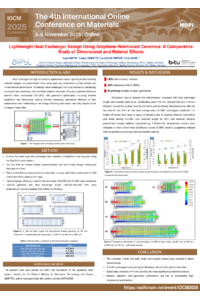
Introduction: In high-temperature environments, heat exchangers require lightweight designs, high thermal resistance, and high effectiveness. Graphene-reinforced ceramic matrix composites (G-CMC) offer promising thermal properties for such applications. This study investigates the effectiveness changes of a block-type heat exchanger made of G-CMC, depending on the length and design, leveraging the potential of 3D printing in the production of complex geometries.
Methods: SolidWorks was used to create the solid model and perform the numerical analyses. First, flow analyses were performed on 180 mm long heat exchangers made of steel and G-CMC. Then, to examine the effect of channel geometry, each 4×4 mm channel was divided into four 1×4 mm parallel channels, keeping the total flow volume constant. This increased the contact surface area by approximately 2.5 times. Additionally, heat exchanger models with lengths of 180, 250, 450, and 600 mm were analyzed to examine the effect of heat exchanger length on effectiveness.
Findings: Using ceramic composite instead of steel resulted in an approximately 11% increase in effectiveness for the 180 mm design length heat exchanger. Subdividing the channels resulted in an 82% increase in effectiveness for the steel model and a 38% increase for the G-CMC model. Extending the heat exchanger length to 600 mm increased effectiveness by 56% for the steel model and 34% for the composite model. Furthermore, using G-CMC reduced heat exchanger mass by approximately 50%, and the potential to produce complex geometries with 3D printing could provides material and energy savings during the production process.
Conclusion: These findings demonstrate that material selection and geometric optimization are critical to achieving high effectiveness and sustainability in high-temperature heat exchanger applications. The results highlight the potential of G-CMC and additive manufacturing to produce lightweight and efficient heat exchangers for challenging thermal environments.
Keywords
Ceramic matrix composite
heat exchanger
numerical analysis
heat transfer
thermal effectiveness
Poster
Kepir - IOCM 2025 POSTER - V2.pdf
Incorporating Plastic Wastes into Pavement Materials
Production of Lignin Nanoparticles from Eucalyptus Bark via Green Antisolvent Precipitation