Event submissions
Published
This submission belongs to the session S2. Nanomaterials, Nanotechnology and Quantum Materials of the event The 4th International Online Conference on Materials
Published date
29 Oct, 2025
Academic Editor
'%3e%3cpath%20d='M12.6657%2010.9104C12.4185%2010.325%2012.0599%209.79327%2011.6097%209.34482C11.1609%208.89508%2010.6293%208.5365%2010.0442%208.28888C10.0389%208.28626%2010.0337%208.28495%2010.0285%208.28233C10.8446%207.69279%2011.3752%206.73249%2011.3752%205.64904C11.3752%203.8542%209.92103%202.39999%208.1262%202.39999C6.33136%202.39999%204.87715%203.8542%204.87715%205.64904C4.87715%206.73249%205.40774%207.69279%206.22393%208.28364C6.21869%208.28626%206.21345%208.28757%206.20821%208.29019C5.62129%208.5378%205.09463%208.89284%204.64265%209.34613C4.1929%209.79493%203.83432%2010.3266%203.58671%2010.9117C3.34345%2011.4845%203.21226%2012.0987%203.20023%2012.7209C3.19988%2012.7349%203.20233%2012.7488%203.20744%2012.7619C3.21255%2012.7749%203.22022%2012.7867%203.22998%2012.7968C3.23975%2012.8068%203.25142%2012.8147%203.26431%2012.8202C3.2772%2012.8256%203.29105%2012.8284%203.30504%2012.8284H4.09109C4.14874%2012.8284%204.19459%2012.7825%204.1959%2012.7262C4.2221%2011.7148%204.62823%2010.7676%205.34617%2010.0497C6.08899%209.30683%207.0755%208.89808%208.1262%208.89808C9.17689%208.89808%2010.1634%209.30683%2010.9062%2010.0497C11.6242%2010.7676%2012.0303%2011.7148%2012.0565%2012.7262C12.0578%2012.7838%2012.1037%2012.8284%2012.1613%2012.8284H12.9474C12.9613%2012.8284%2012.9752%2012.8256%2012.9881%2012.8202C13.001%2012.8147%2013.0126%2012.8068%2013.0224%2012.7968C13.0322%2012.7867%2013.0398%2012.7749%2013.0449%2012.7619C13.0501%2012.7488%2013.0525%2012.7349%2013.0522%2012.7209C13.0391%2012.0947%2012.9094%2011.4855%2012.6657%2010.9104ZM8.1262%207.9024C7.52486%207.9024%206.9589%207.6679%206.53312%207.24211C6.10733%206.81633%205.87283%206.25037%205.87283%205.64904C5.87283%205.0477%206.10733%204.48174%206.53312%204.05596C6.9589%203.63018%207.52486%203.39567%208.1262%203.39567C8.72753%203.39567%209.29349%203.63018%209.71927%204.05596C10.1451%204.48174%2010.3796%205.0477%2010.3796%205.64904C10.3796%206.25037%2010.1451%206.81633%209.71927%207.24211C9.29349%207.6679%208.72753%207.9024%208.1262%207.9024Z'%20fill='%235D1EE1'/%3e%3c/g%3e%3c/svg%3e) Pietro Mazzuca
Pietro MazzucaCitation
Evangelia Tarani, Konstantinos Chrissafis, Exploring Material Behavior through DSC and TGA: Principles and Applications in Modern Thermal Analysis, in Proceedings of The 4th International Online Conference on Materials, 3 November–6 November 2025, MDPI: Basel, Switzerland
Share
Email
Facebook
Twitter
LinkedIn
Exploring Material Behavior through DSC and TGA: Principles and Applications in Modern Thermal Analysis

Evangelia Tarani 1
'%3e%3cpath%20d='M12.6647%2010.9104C12.4176%2010.325%2012.0589%209.7933%2011.6088%209.34485C11.16%208.89511%2010.6283%208.53653%2010.0432%208.28891C10.038%208.28629%2010.0327%208.28498%2010.0275%208.28236C10.8437%207.69282%2011.3743%206.73252%2011.3743%205.64907C11.3743%203.85423%209.92005%202.40002%208.12522%202.40002C6.33038%202.40002%204.87618%203.85423%204.87618%205.64907C4.87618%206.73252%205.40677%207.69282%206.22296%208.28367C6.21772%208.28629%206.21248%208.2876%206.20724%208.29022C5.62031%208.53783%205.09365%208.89287%204.64167%209.34616C4.19192%209.79496%203.83334%2010.3266%203.58573%2010.9117C3.34247%2011.4846%203.21128%2012.0987%203.19925%2012.721C3.1989%2012.735%203.20135%2012.7489%203.20646%2012.7619C3.21157%2012.7749%203.21924%2012.7868%203.22901%2012.7968C3.23877%2012.8068%203.25045%2012.8148%203.26334%2012.8202C3.27623%2012.8256%203.29007%2012.8284%203.30406%2012.8284H4.09012C4.14776%2012.8284%204.19362%2012.7825%204.19493%2012.7262C4.22113%2011.7148%204.62726%2010.7676%205.34519%2010.0497C6.08802%209.30686%207.07452%208.89811%208.12522%208.89811C9.17592%208.89811%2010.1624%209.30686%2010.9052%2010.0497C11.6232%2010.7676%2012.0293%2011.7148%2012.0555%2012.7262C12.0568%2012.7839%2012.1027%2012.8284%2012.1603%2012.8284H12.9464C12.9604%2012.8284%2012.9742%2012.8256%2012.9871%2012.8202C13%2012.8148%2013.0117%2012.8068%2013.0214%2012.7968C13.0312%2012.7868%2013.0389%2012.7749%2013.044%2012.7619C13.0491%2012.7489%2013.0515%2012.735%2013.0512%2012.721C13.0381%2012.0947%2012.9084%2011.4856%2012.6647%2010.9104ZM8.12522%207.90243C7.52388%207.90243%206.95792%207.66793%206.53214%207.24215C6.10636%206.81636%205.87185%206.2504%205.87185%205.64907C5.87185%205.04773%206.10636%204.48177%206.53214%204.05599C6.95792%203.63021%207.52388%203.3957%208.12522%203.3957C8.72655%203.3957%209.29252%203.63021%209.7183%204.05599C10.1441%204.48177%2010.3786%205.04773%2010.3786%205.64907C10.3786%206.2504%2010.1441%206.81636%209.7183%207.24215C9.29252%207.66793%208.72655%207.90243%208.12522%207.90243Z'%20fill='%235D1EE1'/%3e%3c/g%3e%3c/svg%3e)
Konstantinos Chrissafis 1
1. Laboratory of Advanced Materials & Devices, Physics Department, Aristotle University of Thessaloniki, GR 54124, Thessaloniki, Greece
Abstract
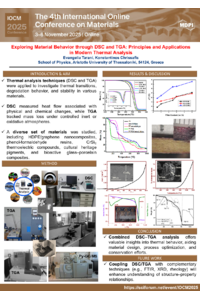
Thermal analysis is a fundamental approach in materials science for evaluating thermal transitions, degradation mechanisms, and stability. This study explores the application of two key techniques—Differential Scanning Calorimetry (DSC) and Thermogravimetric Analysis (TGA)—across a diverse range of materials relevant to industrial, scientific, and conservation applications.
DSC and TGA measurements were conducted under controlled inert or oxidative atmospheres using standard protocols. DSC assessed heat flow changes during physical and chemical transitions, while TGA monitored mass variations during thermal treatment. The following materials were examined: (1) neat high-density polyethylene (HDPE) and HDPE/graphene nanocomposites, (2) phenol-formaldehyde (PF) resins used in wood-based panels, (3) thermoelectric compound chromium disilicide (CrSi₂), (4) yellow ochre pigments and mineral phases from cultural heritage samples and (5) bioactive glass–porcelain composites for dental restorations.
DSC revealed characteristic transitions such as melting, crystallization, and glass transitions, with shifts dependent on composition and filler type. TGA of HDPE/graphene systems showed improved thermal stability with increasing graphene content. PF resins exhibited water and formaldehyde release below 260 °C, followed by resin decomposition. CrSi₂ showed high thermal stability with minimal mass loss. Cultural heritage pigments displayed complex thermal behavior linked to multiple mineral components. In dental ceramics, addition of bioactive glass shifted transition temperatures and introduced new crystallization peaks associated with leucite transformation.
DSC and TGA are versatile tools for characterizing thermal behavior across polymers, composites, ceramics, and mineral-based systems. Their combined application enables a comprehensive understanding of processing conditions, material stability, and functional performance. These techniques are essential for materials development, manufacturing optimization, and heritage conservation strategies.
Keywords
Thermal analysis
Differential Scanning Calorimetry (DSC)
Thermogravimetric Analysis (TGA)
HDPE nanocomposites
Graphene
Phenol-formaldehyde resins
CrSi₂
Cultural heritage materials
Bioactive glass
Poster
IOCM 2025 - Evangelia Tarani.pdf
Production of Lignin Nanoparticles from Eucalyptus Bark via Green Antisolvent Precipitation
Nanostructured Copper by GLAD for Non-Enzymatic L-Lactic Acid Sensors