Event submissions
Published
This submission belongs to the session S2. Nanomaterials, Nanotechnology and Quantum Materials of the event The 4th International Online Conference on Materials
Published date
29 Oct, 2025
Academic Editor
'%3e%3cpath%20d='M12.6657%2010.9104C12.4185%2010.325%2012.0599%209.79327%2011.6097%209.34482C11.1609%208.89508%2010.6293%208.5365%2010.0442%208.28888C10.0389%208.28626%2010.0337%208.28495%2010.0285%208.28233C10.8446%207.69279%2011.3752%206.73249%2011.3752%205.64904C11.3752%203.8542%209.92103%202.39999%208.1262%202.39999C6.33136%202.39999%204.87715%203.8542%204.87715%205.64904C4.87715%206.73249%205.40774%207.69279%206.22393%208.28364C6.21869%208.28626%206.21345%208.28757%206.20821%208.29019C5.62129%208.5378%205.09463%208.89284%204.64265%209.34613C4.1929%209.79493%203.83432%2010.3266%203.58671%2010.9117C3.34345%2011.4845%203.21226%2012.0987%203.20023%2012.7209C3.19988%2012.7349%203.20233%2012.7488%203.20744%2012.7619C3.21255%2012.7749%203.22022%2012.7867%203.22998%2012.7968C3.23975%2012.8068%203.25142%2012.8147%203.26431%2012.8202C3.2772%2012.8256%203.29105%2012.8284%203.30504%2012.8284H4.09109C4.14874%2012.8284%204.19459%2012.7825%204.1959%2012.7262C4.2221%2011.7148%204.62823%2010.7676%205.34617%2010.0497C6.08899%209.30683%207.0755%208.89808%208.1262%208.89808C9.17689%208.89808%2010.1634%209.30683%2010.9062%2010.0497C11.6242%2010.7676%2012.0303%2011.7148%2012.0565%2012.7262C12.0578%2012.7838%2012.1037%2012.8284%2012.1613%2012.8284H12.9474C12.9613%2012.8284%2012.9752%2012.8256%2012.9881%2012.8202C13.001%2012.8147%2013.0126%2012.8068%2013.0224%2012.7968C13.0322%2012.7867%2013.0398%2012.7749%2013.0449%2012.7619C13.0501%2012.7488%2013.0525%2012.7349%2013.0522%2012.7209C13.0391%2012.0947%2012.9094%2011.4855%2012.6657%2010.9104ZM8.1262%207.9024C7.52486%207.9024%206.9589%207.6679%206.53312%207.24211C6.10733%206.81633%205.87283%206.25037%205.87283%205.64904C5.87283%205.0477%206.10733%204.48174%206.53312%204.05596C6.9589%203.63018%207.52486%203.39567%208.1262%203.39567C8.72753%203.39567%209.29349%203.63018%209.71927%204.05596C10.1451%204.48174%2010.3796%205.0477%2010.3796%205.64904C10.3796%206.25037%2010.1451%206.81633%209.71927%207.24211C9.29349%207.6679%208.72753%207.9024%208.1262%207.9024Z'%20fill='%235D1EE1'/%3e%3c/g%3e%3c/svg%3e) Pietro Mazzuca
Pietro MazzucaCitation
Angela Viviana Alzate-García, Estiven Fernando Agudelo-Chacón, Sebastián Mendoza-Rincón, Natalia Prieto, Yury Paola García, Elisabeth Restrepo-Parra, Nanostructured Copper by GLAD for Non-Enzymatic L-Lactic Acid Sensors, in Proceedings of The 4th International Online Conference on Materials, 3 November–6 November 2025, MDPI: Basel, Switzerland
Share
Email
Facebook
Twitter
LinkedIn
Nanostructured Copper by GLAD for Non-Enzymatic L-Lactic Acid Sensors
'%3e%3cpath%20d='M12.6647%2010.9104C12.4176%2010.325%2012.0589%209.7933%2011.6088%209.34485C11.16%208.89511%2010.6283%208.53653%2010.0432%208.28891C10.038%208.28629%2010.0327%208.28498%2010.0275%208.28236C10.8437%207.69282%2011.3743%206.73252%2011.3743%205.64907C11.3743%203.85423%209.92005%202.40002%208.12522%202.40002C6.33038%202.40002%204.87618%203.85423%204.87618%205.64907C4.87618%206.73252%205.40677%207.69282%206.22296%208.28367C6.21772%208.28629%206.21248%208.2876%206.20724%208.29022C5.62031%208.53783%205.09365%208.89287%204.64167%209.34616C4.19192%209.79496%203.83334%2010.3266%203.58573%2010.9117C3.34247%2011.4846%203.21128%2012.0987%203.19925%2012.721C3.1989%2012.735%203.20135%2012.7489%203.20646%2012.7619C3.21157%2012.7749%203.21924%2012.7868%203.22901%2012.7968C3.23877%2012.8068%203.25045%2012.8148%203.26334%2012.8202C3.27623%2012.8256%203.29007%2012.8284%203.30406%2012.8284H4.09012C4.14776%2012.8284%204.19362%2012.7825%204.19493%2012.7262C4.22113%2011.7148%204.62726%2010.7676%205.34519%2010.0497C6.08802%209.30686%207.07452%208.89811%208.12522%208.89811C9.17592%208.89811%2010.1624%209.30686%2010.9052%2010.0497C11.6232%2010.7676%2012.0293%2011.7148%2012.0555%2012.7262C12.0568%2012.7839%2012.1027%2012.8284%2012.1603%2012.8284H12.9464C12.9604%2012.8284%2012.9742%2012.8256%2012.9871%2012.8202C13%2012.8148%2013.0117%2012.8068%2013.0214%2012.7968C13.0312%2012.7868%2013.0389%2012.7749%2013.044%2012.7619C13.0491%2012.7489%2013.0515%2012.735%2013.0512%2012.721C13.0381%2012.0947%2012.9084%2011.4856%2012.6647%2010.9104ZM8.12522%207.90243C7.52388%207.90243%206.95792%207.66793%206.53214%207.24215C6.10636%206.81636%205.87185%206.2504%205.87185%205.64907C5.87185%205.04773%206.10636%204.48177%206.53214%204.05599C6.95792%203.63021%207.52388%203.3957%208.12522%203.3957C8.72655%203.3957%209.29252%203.63021%209.7183%204.05599C10.1441%204.48177%2010.3786%205.04773%2010.3786%205.64907C10.3786%206.2504%2010.1441%206.81636%209.7183%207.24215C9.29252%207.66793%208.72655%207.90243%208.12522%207.90243Z'%20fill='%235D1EE1'/%3e%3c/g%3e%3c/svg%3e)
Angela Viviana Alzate-García 1,2,3
Estiven Fernando Agudelo-Chacón 1
Sebastián Mendoza-Rincón 1
Natalia Prieto 1,2
Yury Paola García 1

Elisabeth Restrepo-Parra 1
1. Grupo de investigación del Laboratorio de Física del Plasma (LAFIP). Universidad Nacional de Colombia-Sede Manizales, Colombia
2. Grupo de investigación en cromatografía y técnicas afines (GICTA). Facultad de Ciencias Exactas y Naturales. Universidad de Caldas, Colombia
3. Facultad de Ciencias e Ingeniería. Universidad de Manizales, Colombia
Abstract
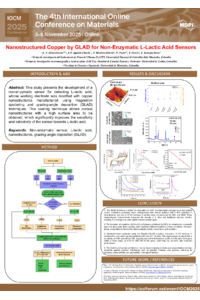
The advancement of biochemical sensing technologies relies heavily on the development of nanostructured sensors with superior electrochemical performance. In this work, a high-sensitivity, non-enzymatic L-lactic acid sensor was fabricated by coating a screen-printed carbon electrode with copper using the glancing angle deposition (GLAD) technique. During deposition, the substrate was positioned at an 80° tilt relative to the target while undergoing continuous rotation. Coatings were applied for 10 and 15 minutes at rotation speeds of 0 rpm and 45 rpm. Electrochemical characterization revealed a fast response and high sensitivity toward L-lactic acid. The GLAD-modified sensor (45 rpm, 15 minutes) achieved an active surface area of 14.14 mm²—an 11.1% increase compared to the apparent surface area of the unmodified carbon electrode (12.57 mm²), as determined using the Randles–Sevcík equation.
Atomic force microscopy confirmed a 16.3% increase in surface area, attributed to the growth of smaller nanostructures during rotation. Scanning electron microscopy images showed a porous, stacked morphology composed of copper (Cu) and copper oxide (CuO). The sensor detected L-lactic acid across the 0.75–10 mM range, with a sensitivity of 3.98 μA/mM and a detection limit of 0.56 μM. These results demonstrate that copper nanostructures engineered via GLAD can substantially enhance the selectivity and sensitivity of electrochemical sensors, offering a promising route for the development of next-generation sensing platforms.
Keywords
Non-enzymatic sensor
L-lactic acid
Copper nanostructures
Glancing angle deposition (GLAD)
Electrochemical sensing
Poster
IOCM 2025 - poster L-lactato.pdf
Exploring Material Behavior through DSC and TGA: Principles and Applications in Modern Thermal Analysis
Impact of Synthesis Methods on the Crystallinity, Morphology, and Electrocatalytic Performance of SrCo₀.₆Mn₀.₄O₃ Perovskite Oxides