Event submissions
Published
This submission belongs to the session S5. Materials for Energy Harvesting, Conversion and Storage of the event The 4th International Online Conference on Materials
Published date
29 Oct, 2025
Academic Editor
'%3e%3cpath%20d='M12.6657%2010.9104C12.4185%2010.325%2012.0599%209.79327%2011.6097%209.34482C11.1609%208.89508%2010.6293%208.5365%2010.0442%208.28888C10.0389%208.28626%2010.0337%208.28495%2010.0285%208.28233C10.8446%207.69279%2011.3752%206.73249%2011.3752%205.64904C11.3752%203.8542%209.92103%202.39999%208.1262%202.39999C6.33136%202.39999%204.87715%203.8542%204.87715%205.64904C4.87715%206.73249%205.40774%207.69279%206.22393%208.28364C6.21869%208.28626%206.21345%208.28757%206.20821%208.29019C5.62129%208.5378%205.09463%208.89284%204.64265%209.34613C4.1929%209.79493%203.83432%2010.3266%203.58671%2010.9117C3.34345%2011.4845%203.21226%2012.0987%203.20023%2012.7209C3.19988%2012.7349%203.20233%2012.7488%203.20744%2012.7619C3.21255%2012.7749%203.22022%2012.7867%203.22998%2012.7968C3.23975%2012.8068%203.25142%2012.8147%203.26431%2012.8202C3.2772%2012.8256%203.29105%2012.8284%203.30504%2012.8284H4.09109C4.14874%2012.8284%204.19459%2012.7825%204.1959%2012.7262C4.2221%2011.7148%204.62823%2010.7676%205.34617%2010.0497C6.08899%209.30683%207.0755%208.89808%208.1262%208.89808C9.17689%208.89808%2010.1634%209.30683%2010.9062%2010.0497C11.6242%2010.7676%2012.0303%2011.7148%2012.0565%2012.7262C12.0578%2012.7838%2012.1037%2012.8284%2012.1613%2012.8284H12.9474C12.9613%2012.8284%2012.9752%2012.8256%2012.9881%2012.8202C13.001%2012.8147%2013.0126%2012.8068%2013.0224%2012.7968C13.0322%2012.7867%2013.0398%2012.7749%2013.0449%2012.7619C13.0501%2012.7488%2013.0525%2012.7349%2013.0522%2012.7209C13.0391%2012.0947%2012.9094%2011.4855%2012.6657%2010.9104ZM8.1262%207.9024C7.52486%207.9024%206.9589%207.6679%206.53312%207.24211C6.10733%206.81633%205.87283%206.25037%205.87283%205.64904C5.87283%205.0477%206.10733%204.48174%206.53312%204.05596C6.9589%203.63018%207.52486%203.39567%208.1262%203.39567C8.72753%203.39567%209.29349%203.63018%209.71927%204.05596C10.1451%204.48174%2010.3796%205.0477%2010.3796%205.64904C10.3796%206.25037%2010.1451%206.81633%209.71927%207.24211C9.29349%207.6679%208.72753%207.9024%208.1262%207.9024Z'%20fill='%235D1EE1'/%3e%3c/g%3e%3c/svg%3e) Vlassis Likodimos
Vlassis LikodimosCitation
Rohit Kumar, Samriti Mehta, Rajni Thakur, Shwetharani R., Itika Kainthla, Impact of Synthesis Methods on the Crystallinity, Morphology, and Electrocatalytic Performance of SrCo₀.₆Mn₀.₄O₃ Perovskite Oxides, in Proceedings of The 4th International Online Conference on Materials, 3 November–6 November 2025, MDPI: Basel, Switzerland
Share
Email
Facebook
Twitter
LinkedIn
Impact of Synthesis Methods on the Crystallinity, Morphology, and Electrocatalytic Performance of SrCo₀.₆Mn₀.₄O₃ Perovskite Oxides
'%3e%3cpath%20d='M12.6647%2010.9104C12.4176%2010.325%2012.0589%209.7933%2011.6088%209.34485C11.16%208.89511%2010.6283%208.53653%2010.0432%208.28891C10.038%208.28629%2010.0327%208.28498%2010.0275%208.28236C10.8437%207.69282%2011.3743%206.73252%2011.3743%205.64907C11.3743%203.85423%209.92005%202.40002%208.12522%202.40002C6.33038%202.40002%204.87618%203.85423%204.87618%205.64907C4.87618%206.73252%205.40677%207.69282%206.22296%208.28367C6.21772%208.28629%206.21248%208.2876%206.20724%208.29022C5.62031%208.53783%205.09365%208.89287%204.64167%209.34616C4.19192%209.79496%203.83334%2010.3266%203.58573%2010.9117C3.34247%2011.4846%203.21128%2012.0987%203.19925%2012.721C3.1989%2012.735%203.20135%2012.7489%203.20646%2012.7619C3.21157%2012.7749%203.21924%2012.7868%203.22901%2012.7968C3.23877%2012.8068%203.25045%2012.8148%203.26334%2012.8202C3.27623%2012.8256%203.29007%2012.8284%203.30406%2012.8284H4.09012C4.14776%2012.8284%204.19362%2012.7825%204.19493%2012.7262C4.22113%2011.7148%204.62726%2010.7676%205.34519%2010.0497C6.08802%209.30686%207.07452%208.89811%208.12522%208.89811C9.17592%208.89811%2010.1624%209.30686%2010.9052%2010.0497C11.6232%2010.7676%2012.0293%2011.7148%2012.0555%2012.7262C12.0568%2012.7839%2012.1027%2012.8284%2012.1603%2012.8284H12.9464C12.9604%2012.8284%2012.9742%2012.8256%2012.9871%2012.8202C13%2012.8148%2013.0117%2012.8068%2013.0214%2012.7968C13.0312%2012.7868%2013.0389%2012.7749%2013.044%2012.7619C13.0491%2012.7489%2013.0515%2012.735%2013.0512%2012.721C13.0381%2012.0947%2012.9084%2011.4856%2012.6647%2010.9104ZM8.12522%207.90243C7.52388%207.90243%206.95792%207.66793%206.53214%207.24215C6.10636%206.81636%205.87185%206.2504%205.87185%205.64907C5.87185%205.04773%206.10636%204.48177%206.53214%204.05599C6.95792%203.63021%207.52388%203.3957%208.12522%203.3957C8.72655%203.3957%209.29252%203.63021%209.7183%204.05599C10.1441%204.48177%2010.3786%205.04773%2010.3786%205.64907C10.3786%206.2504%2010.1441%206.81636%209.7183%207.24215C9.29252%207.66793%208.72655%207.90243%208.12522%207.90243Z'%20fill='%235D1EE1'/%3e%3c/g%3e%3c/svg%3e)
Rohit Kumar 1
Samriti Mehta 1
Rajni Thakur 1
Shwetharani R. 2
Itika Kainthla 1
1. School of Physics and Materials Science, Shoolini University, Solan, 173229, Himachal Pradesh, India
2. Centre for Nano and Material Sciences, Jain University, Ramanagara, 562112, Karnataka, India
Abstract
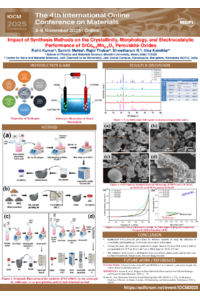
The oxygen evolution reaction (OER) is a critical half-reaction in electrochemical water splitting; however, its sluggish kinetics necessitate the development of efficient, stable, and low-cost electrocatalysts. Transition-metal-based perovskite oxides are promising candidates owing to their earth-abundant composition, structural tunability, and versatile surface chemistry. In this study, SrCo0.6Mn0.4O3 (SCM) perovskite oxides were synthesized via four different methods, such as solid state (SCM-SS), sol–gel (SCM-SG), co-precipitation (SCM-CP), and the hydrothermal method (SCM-HT). XRD and FESEM analyses confirmed the formation of crystalline perovskite oxides with distinct morphologies and crystallinities, directly influencing their electrocatalytic performance. Among all the samples, SCM-SS demonstrated the best activity, requiring an overpotential of 1.07 V at a current density of 10 mA cm-2 and exhibiting the smallest Tafel slope of 145.82 mV dec-1 in 1 M KOH. The overpotential values followed the following order: SCM-SS (1.07 V), SCM-SG (1.20 V), SCM-HT (1.22 V), and SCM-CP (1.35 V). Similarly, the Tafel slopes were SCM-SS (145.82 mV dec-1), SCM-CP (151.46 mV dec-1), SCM-SG (153.97 mV dec-1), and SCM-HT (226.55 mV dec-1). These findings highlight that the synthesis method plays a decisive role in tailoring crystallinity, morphology, and the electrocatalytic activity of SCM perovskites, offering valuable guidelines for designing next-generation water-splitting catalysts. This work contributes to advancing Sustainable Development Goal 7 by promoting clean energy technologies and supports Sustainable Development Goal 13 by addressing climate challenges through the development of efficient, sustainable electrocatalysts.
Keywords
Synthesis methods
perovskite oxides
Oxygen evolution reaction
water splitting
Crystallinity.
Poster
IOCM 2025 - poster template.pdf
Nanostructured Copper by GLAD for Non-Enzymatic L-Lactic Acid Sensors
Pump-Probe Microscopy Unravels Distance-Dependent Collective Plasmonic Behaviour in Gold Nanoparticle Supercrystals