Event submissions
Published
This submission belongs to the session S5. Materials for Energy Harvesting, Conversion and Storage of the event The 4th International Online Conference on Materials
Published date
29 Oct, 2025
Academic Editor
'%3e%3cpath%20d='M12.6657%2010.9104C12.4185%2010.325%2012.0599%209.79327%2011.6097%209.34482C11.1609%208.89508%2010.6293%208.5365%2010.0442%208.28888C10.0389%208.28626%2010.0337%208.28495%2010.0285%208.28233C10.8446%207.69279%2011.3752%206.73249%2011.3752%205.64904C11.3752%203.8542%209.92103%202.39999%208.1262%202.39999C6.33136%202.39999%204.87715%203.8542%204.87715%205.64904C4.87715%206.73249%205.40774%207.69279%206.22393%208.28364C6.21869%208.28626%206.21345%208.28757%206.20821%208.29019C5.62129%208.5378%205.09463%208.89284%204.64265%209.34613C4.1929%209.79493%203.83432%2010.3266%203.58671%2010.9117C3.34345%2011.4845%203.21226%2012.0987%203.20023%2012.7209C3.19988%2012.7349%203.20233%2012.7488%203.20744%2012.7619C3.21255%2012.7749%203.22022%2012.7867%203.22998%2012.7968C3.23975%2012.8068%203.25142%2012.8147%203.26431%2012.8202C3.2772%2012.8256%203.29105%2012.8284%203.30504%2012.8284H4.09109C4.14874%2012.8284%204.19459%2012.7825%204.1959%2012.7262C4.2221%2011.7148%204.62823%2010.7676%205.34617%2010.0497C6.08899%209.30683%207.0755%208.89808%208.1262%208.89808C9.17689%208.89808%2010.1634%209.30683%2010.9062%2010.0497C11.6242%2010.7676%2012.0303%2011.7148%2012.0565%2012.7262C12.0578%2012.7838%2012.1037%2012.8284%2012.1613%2012.8284H12.9474C12.9613%2012.8284%2012.9752%2012.8256%2012.9881%2012.8202C13.001%2012.8147%2013.0126%2012.8068%2013.0224%2012.7968C13.0322%2012.7867%2013.0398%2012.7749%2013.0449%2012.7619C13.0501%2012.7488%2013.0525%2012.7349%2013.0522%2012.7209C13.0391%2012.0947%2012.9094%2011.4855%2012.6657%2010.9104ZM8.1262%207.9024C7.52486%207.9024%206.9589%207.6679%206.53312%207.24211C6.10733%206.81633%205.87283%206.25037%205.87283%205.64904C5.87283%205.0477%206.10733%204.48174%206.53312%204.05596C6.9589%203.63018%207.52486%203.39567%208.1262%203.39567C8.72753%203.39567%209.29349%203.63018%209.71927%204.05596C10.1451%204.48174%2010.3796%205.0477%2010.3796%205.64904C10.3796%206.25037%2010.1451%206.81633%209.71927%207.24211C9.29349%207.6679%208.72753%207.9024%208.1262%207.9024Z'%20fill='%235D1EE1'/%3e%3c/g%3e%3c/svg%3e) Federico Bella
Federico BellaCitation
Prerit Chauhan, Neha Kumari, Mamta Shandilya, Phase Evolution, Dielectric Anomalies, and Electrical Relaxations in Lead-Free Ba₀.₉₅Ca₀.₀₅TiO₃ Ceramics, in Proceedings of The 4th International Online Conference on Materials, 3 November–6 November 2025, MDPI: Basel, Switzerland
Share
Email
Facebook
Twitter
LinkedIn
Phase Evolution, Dielectric Anomalies, and Electrical Relaxations in Lead-Free Ba₀.₉₅Ca₀.₀₅TiO₃ Ceramics
'%3e%3cpath%20d='M12.6647%2010.9104C12.4176%2010.325%2012.0589%209.7933%2011.6088%209.34485C11.16%208.89511%2010.6283%208.53653%2010.0432%208.28891C10.038%208.28629%2010.0327%208.28498%2010.0275%208.28236C10.8437%207.69282%2011.3743%206.73252%2011.3743%205.64907C11.3743%203.85423%209.92005%202.40002%208.12522%202.40002C6.33038%202.40002%204.87618%203.85423%204.87618%205.64907C4.87618%206.73252%205.40677%207.69282%206.22296%208.28367C6.21772%208.28629%206.21248%208.2876%206.20724%208.29022C5.62031%208.53783%205.09365%208.89287%204.64167%209.34616C4.19192%209.79496%203.83334%2010.3266%203.58573%2010.9117C3.34247%2011.4846%203.21128%2012.0987%203.19925%2012.721C3.1989%2012.735%203.20135%2012.7489%203.20646%2012.7619C3.21157%2012.7749%203.21924%2012.7868%203.22901%2012.7968C3.23877%2012.8068%203.25045%2012.8148%203.26334%2012.8202C3.27623%2012.8256%203.29007%2012.8284%203.30406%2012.8284H4.09012C4.14776%2012.8284%204.19362%2012.7825%204.19493%2012.7262C4.22113%2011.7148%204.62726%2010.7676%205.34519%2010.0497C6.08802%209.30686%207.07452%208.89811%208.12522%208.89811C9.17592%208.89811%2010.1624%209.30686%2010.9052%2010.0497C11.6232%2010.7676%2012.0293%2011.7148%2012.0555%2012.7262C12.0568%2012.7839%2012.1027%2012.8284%2012.1603%2012.8284H12.9464C12.9604%2012.8284%2012.9742%2012.8256%2012.9871%2012.8202C13%2012.8148%2013.0117%2012.8068%2013.0214%2012.7968C13.0312%2012.7868%2013.0389%2012.7749%2013.044%2012.7619C13.0491%2012.7489%2013.0515%2012.735%2013.0512%2012.721C13.0381%2012.0947%2012.9084%2011.4856%2012.6647%2010.9104ZM8.12522%207.90243C7.52388%207.90243%206.95792%207.66793%206.53214%207.24215C6.10636%206.81636%205.87185%206.2504%205.87185%205.64907C5.87185%205.04773%206.10636%204.48177%206.53214%204.05599C6.95792%203.63021%207.52388%203.3957%208.12522%203.3957C8.72655%203.3957%209.29252%203.63021%209.7183%204.05599C10.1441%204.48177%2010.3786%205.04773%2010.3786%205.64907C10.3786%206.2504%2010.1441%206.81636%209.7183%207.24215C9.29252%207.66793%208.72655%207.90243%208.12522%207.90243Z'%20fill='%235D1EE1'/%3e%3c/g%3e%3c/svg%3e)
Prerit Chauhan 1
Neha Kumari 1
Mamta Shandilya 1
1. Faculty of Sciences, School of Physics and Materials Science, Shoolini University, Bajhol, Solan, Himachal Pradesh, 173229, India
Abstract
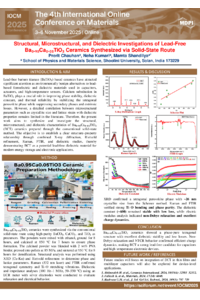
Lead-free ferroelectric ceramics have gained widespread interest as alternatives to toxic lead-based dielectrics. In this work, Ba₀.₉₅Ca₀.₀₅TiO₃ (BCT) ceramics were synthesized via the conventional solid-state reaction route and evaluated for their structural and dielectric characteristics. X-ray diffraction combined with Rietveld refinement confirmed the formation of dense ceramics with a tetragonal perovskite structure (P4mm) after calcination at 850 °C and sintering at 950 °C, with refined lattice parameters a = 3.9895 Å, c = 4.0114 Å and c/a = 1.0055. The nanocrystalline microstructure remained stable, with an average crystallite size of ~26 nm and minimal lattice strain, demonstrating uniformity of the phase. Raman spectroscopy further supported the tetragonal symmetry through distinct E(TO) and A₁ vibrational modes, underlining the structural robustness of the synthesized ceramics. Dielectric investigations revealed a high permittivity of ~600 at 100 Hz and 50 °C, while a stable dielectric response was maintained between 10 kHz and 1 MHz across 100–450 °C. Importantly, dielectric loss remained below 0.1 throughout this operational range, confirming excellent thermal–frequency stability and low energy dissipation. Impedance and electric modulus analyses highlighted the presence of non-Debye type relaxation, defect-mediated hopping conduction, and clear distinction between grain and grain boundary contributions. The combination of phase purity, nanocrystalline stability, and superior dielectric response demonstrates the potential of BCT ceramics as environmentally benign candidates for next-generation capacitors, high-temperature sensors, actuators, and energy-storage devices.
Keywords
Lead-free perovskites
Ba₀.₉₅Ca₀.₀₅TiO₃ (BCT)
Dielectric properties
Rietveld refinement
Microstructure–property correlation
Energy storage ceramics
Poster
IOCM 2025 - poster.pdf
Ag- and Li-Doped ZnO Nanostructures: Morphological Features and Piezoelectric Applications
Oxygen-Deficient WO3-x Photonic Crystal Photoanodes for Enhanced Photoelectrocatalytic Activity