Event submissions
Published
This submission belongs to the session S6. Green Materials, Synthesis, Characterization and Recycling of the event The 4th International Online Conference on Materials
Published date
29 Oct, 2025
Academic Editor
'%3e%3cpath%20d='M12.6657%2010.9104C12.4185%2010.325%2012.0599%209.79327%2011.6097%209.34482C11.1609%208.89508%2010.6293%208.5365%2010.0442%208.28888C10.0389%208.28626%2010.0337%208.28495%2010.0285%208.28233C10.8446%207.69279%2011.3752%206.73249%2011.3752%205.64904C11.3752%203.8542%209.92103%202.39999%208.1262%202.39999C6.33136%202.39999%204.87715%203.8542%204.87715%205.64904C4.87715%206.73249%205.40774%207.69279%206.22393%208.28364C6.21869%208.28626%206.21345%208.28757%206.20821%208.29019C5.62129%208.5378%205.09463%208.89284%204.64265%209.34613C4.1929%209.79493%203.83432%2010.3266%203.58671%2010.9117C3.34345%2011.4845%203.21226%2012.0987%203.20023%2012.7209C3.19988%2012.7349%203.20233%2012.7488%203.20744%2012.7619C3.21255%2012.7749%203.22022%2012.7867%203.22998%2012.7968C3.23975%2012.8068%203.25142%2012.8147%203.26431%2012.8202C3.2772%2012.8256%203.29105%2012.8284%203.30504%2012.8284H4.09109C4.14874%2012.8284%204.19459%2012.7825%204.1959%2012.7262C4.2221%2011.7148%204.62823%2010.7676%205.34617%2010.0497C6.08899%209.30683%207.0755%208.89808%208.1262%208.89808C9.17689%208.89808%2010.1634%209.30683%2010.9062%2010.0497C11.6242%2010.7676%2012.0303%2011.7148%2012.0565%2012.7262C12.0578%2012.7838%2012.1037%2012.8284%2012.1613%2012.8284H12.9474C12.9613%2012.8284%2012.9752%2012.8256%2012.9881%2012.8202C13.001%2012.8147%2013.0126%2012.8068%2013.0224%2012.7968C13.0322%2012.7867%2013.0398%2012.7749%2013.0449%2012.7619C13.0501%2012.7488%2013.0525%2012.7349%2013.0522%2012.7209C13.0391%2012.0947%2012.9094%2011.4855%2012.6657%2010.9104ZM8.1262%207.9024C7.52486%207.9024%206.9589%207.6679%206.53312%207.24211C6.10733%206.81633%205.87283%206.25037%205.87283%205.64904C5.87283%205.0477%206.10733%204.48174%206.53312%204.05596C6.9589%203.63018%207.52486%203.39567%208.1262%203.39567C8.72753%203.39567%209.29349%203.63018%209.71927%204.05596C10.1451%204.48174%2010.3796%205.0477%2010.3796%205.64904C10.3796%206.25037%2010.1451%206.81633%209.71927%207.24211C9.29349%207.6679%208.72753%207.9024%208.1262%207.9024Z'%20fill='%235D1EE1'/%3e%3c/g%3e%3c/svg%3e) Konstantinos Salonitis
Konstantinos SalonitisCitation
Gul Wali Khan, DESIGN, SYNTHESIS, AND PHYSICOCHEMICAL CHARACTERISTICS OF STABLE NITRONYL-NITROXIDE DIRADICALS AND THEIR COMPLEXES WITH Cu(II) BASED ON FUNCTIONAL DERIVATIVES OF ISOPHTHALALDEHYDE, in Proceedings of The 4th International Online Conference on Materials, 3 November–6 November 2025, MDPI: Basel, Switzerland
Share
Email
Facebook
Twitter
LinkedIn
DESIGN, SYNTHESIS, AND PHYSICOCHEMICAL CHARACTERISTICS OF STABLE NITRONYL-NITROXIDE DIRADICALS AND THEIR COMPLEXES WITH Cu(II) BASED ON FUNCTIONAL DERIVATIVES OF ISOPHTHALALDEHYDE
'%3e%3cpath%20d='M12.6647%2010.9104C12.4176%2010.325%2012.0589%209.7933%2011.6088%209.34485C11.16%208.89511%2010.6283%208.53653%2010.0432%208.28891C10.038%208.28629%2010.0327%208.28498%2010.0275%208.28236C10.8437%207.69282%2011.3743%206.73252%2011.3743%205.64907C11.3743%203.85423%209.92005%202.40002%208.12522%202.40002C6.33038%202.40002%204.87618%203.85423%204.87618%205.64907C4.87618%206.73252%205.40677%207.69282%206.22296%208.28367C6.21772%208.28629%206.21248%208.2876%206.20724%208.29022C5.62031%208.53783%205.09365%208.89287%204.64167%209.34616C4.19192%209.79496%203.83334%2010.3266%203.58573%2010.9117C3.34247%2011.4846%203.21128%2012.0987%203.19925%2012.721C3.1989%2012.735%203.20135%2012.7489%203.20646%2012.7619C3.21157%2012.7749%203.21924%2012.7868%203.22901%2012.7968C3.23877%2012.8068%203.25045%2012.8148%203.26334%2012.8202C3.27623%2012.8256%203.29007%2012.8284%203.30406%2012.8284H4.09012C4.14776%2012.8284%204.19362%2012.7825%204.19493%2012.7262C4.22113%2011.7148%204.62726%2010.7676%205.34519%2010.0497C6.08802%209.30686%207.07452%208.89811%208.12522%208.89811C9.17592%208.89811%2010.1624%209.30686%2010.9052%2010.0497C11.6232%2010.7676%2012.0293%2011.7148%2012.0555%2012.7262C12.0568%2012.7839%2012.1027%2012.8284%2012.1603%2012.8284H12.9464C12.9604%2012.8284%2012.9742%2012.8256%2012.9871%2012.8202C13%2012.8148%2013.0117%2012.8068%2013.0214%2012.7968C13.0312%2012.7868%2013.0389%2012.7749%2013.044%2012.7619C13.0491%2012.7489%2013.0515%2012.735%2013.0512%2012.721C13.0381%2012.0947%2012.9084%2011.4856%2012.6647%2010.9104ZM8.12522%207.90243C7.52388%207.90243%206.95792%207.66793%206.53214%207.24215C6.10636%206.81636%205.87185%206.2504%205.87185%205.64907C5.87185%205.04773%206.10636%204.48177%206.53214%204.05599C6.95792%203.63021%207.52388%203.3957%208.12522%203.3957C8.72655%203.3957%209.29252%203.63021%209.7183%204.05599C10.1441%204.48177%2010.3786%205.04773%2010.3786%205.64907C10.3786%206.2504%2010.1441%206.81636%209.7183%207.24215C9.29252%207.66793%208.72655%207.90243%208.12522%207.90243Z'%20fill='%235D1EE1'/%3e%3c/g%3e%3c/svg%3e)
Gul Wali Khan 1
1. Novosibirsk Institute of Organic Chemistry SB RAS Russian federation, Novosibirsk, Russia
Abstract
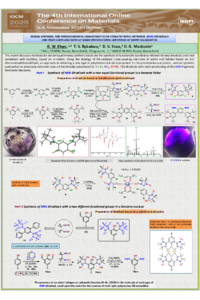
Stable high-spin organic radicals (S ≥ 1) are attractive objects for organic materials with potential applications in fields such as organic magnets, spintronics, spin filters, and memory devices [1]. However, the synthesis of thermally stable di- and polyradicals is a challenging task, especially when ferromagnetic exchange interactions between multiple paramagnetic centers are desired. The report discusses methods for obtaining promising synthetic blocks for the synthesis of functionally substituted di-nitronyl nitroxyl radicals and their complexes with Cu(hfac)2 based on m-xylene. Using the strategy of Pd-catalyzed cross-coupling reactions of active aryl halides based on 4,6-dibromoiso-phthalaldehyde, an approach to obtaining a new type of polyhetero-radicals is proposed. The structural features of the obtained paramagnets and their EPR spectra are considered. Recently, the bifunctional substituted nitronyl nitroxide (NNR) diradical which was synthesized by cross coupling reaction such as 1 which was successfully used as a working body in a molecular heat engine in the study of spin phase transitions between superconducting electrodes [2].
In this presentation and graphical abstract , various synthetic approaches to previously unknown types
of functionally substituted (X, Y = Br, NO2, COOR) diradicals 2, 3 with meta-positioning of the NHR fragments will be discussed. Special attention will be paid to methods of introducing reactive groups into the diradical molecule by using cross coupling reaction and the possibility of obtaining various complexes with copper salts.
References:
[1] E. V. Tretyakov, I. A. Zayakin, A. A. Dmitriev, M. V. Fedin et al. Chem. Eur. J. 2024, 30, e202303456.
[2] S. Volosheniuk, D. Bouwmeester, D. Vogel, H.S.J. van der Zant et al. Nat. Commun., 2025, 16, 3279.
Keywords
monoradicals
diradicals
imidazolidine
cross coupling reactions
substituted groups
Poster
Gul Wali Khan_Poster-2025.pdf
Computational Biocompatibility and Safety Evaluation of Metal-Doped PET-Carbon Quantum Dots via Multi-Target Molecular Docking and ADMET Analysis on Human Proteins
Applying Material Science to Caffeine Delivery in Functional Drinks: Targeted Release and Improved Bioaccessibility with Nano/Microcarriers