Event submissions
Published
This submission belongs to the session S5. Materials for Energy Harvesting, Conversion and Storage of the event The 4th International Online Conference on Materials
Published date
29 Oct, 2025
Academic Editor
'%3e%3cpath%20d='M12.6657%2010.9104C12.4185%2010.325%2012.0599%209.79327%2011.6097%209.34482C11.1609%208.89508%2010.6293%208.5365%2010.0442%208.28888C10.0389%208.28626%2010.0337%208.28495%2010.0285%208.28233C10.8446%207.69279%2011.3752%206.73249%2011.3752%205.64904C11.3752%203.8542%209.92103%202.39999%208.1262%202.39999C6.33136%202.39999%204.87715%203.8542%204.87715%205.64904C4.87715%206.73249%205.40774%207.69279%206.22393%208.28364C6.21869%208.28626%206.21345%208.28757%206.20821%208.29019C5.62129%208.5378%205.09463%208.89284%204.64265%209.34613C4.1929%209.79493%203.83432%2010.3266%203.58671%2010.9117C3.34345%2011.4845%203.21226%2012.0987%203.20023%2012.7209C3.19988%2012.7349%203.20233%2012.7488%203.20744%2012.7619C3.21255%2012.7749%203.22022%2012.7867%203.22998%2012.7968C3.23975%2012.8068%203.25142%2012.8147%203.26431%2012.8202C3.2772%2012.8256%203.29105%2012.8284%203.30504%2012.8284H4.09109C4.14874%2012.8284%204.19459%2012.7825%204.1959%2012.7262C4.2221%2011.7148%204.62823%2010.7676%205.34617%2010.0497C6.08899%209.30683%207.0755%208.89808%208.1262%208.89808C9.17689%208.89808%2010.1634%209.30683%2010.9062%2010.0497C11.6242%2010.7676%2012.0303%2011.7148%2012.0565%2012.7262C12.0578%2012.7838%2012.1037%2012.8284%2012.1613%2012.8284H12.9474C12.9613%2012.8284%2012.9752%2012.8256%2012.9881%2012.8202C13.001%2012.8147%2013.0126%2012.8068%2013.0224%2012.7968C13.0322%2012.7867%2013.0398%2012.7749%2013.0449%2012.7619C13.0501%2012.7488%2013.0525%2012.7349%2013.0522%2012.7209C13.0391%2012.0947%2012.9094%2011.4855%2012.6657%2010.9104ZM8.1262%207.9024C7.52486%207.9024%206.9589%207.6679%206.53312%207.24211C6.10733%206.81633%205.87283%206.25037%205.87283%205.64904C5.87283%205.0477%206.10733%204.48174%206.53312%204.05596C6.9589%203.63018%207.52486%203.39567%208.1262%203.39567C8.72753%203.39567%209.29349%203.63018%209.71927%204.05596C10.1451%204.48174%2010.3796%205.0477%2010.3796%205.64904C10.3796%206.25037%2010.1451%206.81633%209.71927%207.24211C9.29349%207.6679%208.72753%207.9024%208.1262%207.9024Z'%20fill='%235D1EE1'/%3e%3c/g%3e%3c/svg%3e) Vlassis Likodimos
Vlassis LikodimosCitation
Hind Zegtouf, Nadia Saoula, Mourad Azibi, Influence of RF sputtering power during RFMS on the electrochemical behavior of zirconia thin films in a Hanks solution, in Proceedings of The 4th International Online Conference on Materials, 3 November–6 November 2025, MDPI: Basel, Switzerland
Share
Email
Facebook
Twitter
LinkedIn
Influence of RF sputtering power during RFMS on the electrochemical behavior of zirconia thin films in a Hanks solution
'%3e%3cpath%20d='M12.6647%2010.9104C12.4176%2010.325%2012.0589%209.7933%2011.6088%209.34485C11.16%208.89511%2010.6283%208.53653%2010.0432%208.28891C10.038%208.28629%2010.0327%208.28498%2010.0275%208.28236C10.8437%207.69282%2011.3743%206.73252%2011.3743%205.64907C11.3743%203.85423%209.92005%202.40002%208.12522%202.40002C6.33038%202.40002%204.87618%203.85423%204.87618%205.64907C4.87618%206.73252%205.40677%207.69282%206.22296%208.28367C6.21772%208.28629%206.21248%208.2876%206.20724%208.29022C5.62031%208.53783%205.09365%208.89287%204.64167%209.34616C4.19192%209.79496%203.83334%2010.3266%203.58573%2010.9117C3.34247%2011.4846%203.21128%2012.0987%203.19925%2012.721C3.1989%2012.735%203.20135%2012.7489%203.20646%2012.7619C3.21157%2012.7749%203.21924%2012.7868%203.22901%2012.7968C3.23877%2012.8068%203.25045%2012.8148%203.26334%2012.8202C3.27623%2012.8256%203.29007%2012.8284%203.30406%2012.8284H4.09012C4.14776%2012.8284%204.19362%2012.7825%204.19493%2012.7262C4.22113%2011.7148%204.62726%2010.7676%205.34519%2010.0497C6.08802%209.30686%207.07452%208.89811%208.12522%208.89811C9.17592%208.89811%2010.1624%209.30686%2010.9052%2010.0497C11.6232%2010.7676%2012.0293%2011.7148%2012.0555%2012.7262C12.0568%2012.7839%2012.1027%2012.8284%2012.1603%2012.8284H12.9464C12.9604%2012.8284%2012.9742%2012.8256%2012.9871%2012.8202C13%2012.8148%2013.0117%2012.8068%2013.0214%2012.7968C13.0312%2012.7868%2013.0389%2012.7749%2013.044%2012.7619C13.0491%2012.7489%2013.0515%2012.735%2013.0512%2012.721C13.0381%2012.0947%2012.9084%2011.4856%2012.6647%2010.9104ZM8.12522%207.90243C7.52388%207.90243%206.95792%207.66793%206.53214%207.24215C6.10636%206.81636%205.87185%206.2504%205.87185%205.64907C5.87185%205.04773%206.10636%204.48177%206.53214%204.05599C6.95792%203.63021%207.52388%203.3957%208.12522%203.3957C8.72655%203.3957%209.29252%203.63021%209.7183%204.05599C10.1441%204.48177%2010.3786%205.04773%2010.3786%205.64907C10.3786%206.2504%2010.1441%206.81636%209.7183%207.24215C9.29252%207.66793%208.72655%207.90243%208.12522%207.90243Z'%20fill='%235D1EE1'/%3e%3c/g%3e%3c/svg%3e)
Hind Zegtouf 1
Nadia Saoula 2
Mourad Azibi 2
1. Department of Sciences , Teacher Education College of Sétif - Messaoud Zeghar, El Eulma, Sétif, 19600, Algeria
2. Division Milieux Ionisés et Lasers, Centre de Développement des Technologies Avancées, (CDTA), Baba Hassen, Algiers, 16081, Algeria
Abstract
Zirconia (ZrO2) is a ceramic oxide known for its properties such as inertness and biocompatibility, making it attractive for biomedical and protective coating applications.
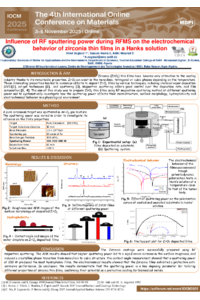
In this study, Zirconia (ZrO2) thin films were deposited using a radio-frequency magnetron sputtering (RFMS) system. A pure zirconium target was sputtered in an Ar–O2 gas mixture. The sputtering power was systematically varied from 100 W to 400 W in order to investigate its influence on the film’s properties.
The structural, morphological and surface characteristics of the deposited films were analyzed using X-ray Diffraction, contact angle measurements and Atomic Force Microscopy. XRD results show that the monoclinic phase is predominant in lower sputtering power, and the increase in the power induces a notable change in the films' crystallinity and the preferred orientation. Higher sputtering power also led to a significance increase in the surface roughness (from 0.46 nm at 100 W to 14.77 nm at 400 W). In line with our previous work [1], in this study, the contact angle measurement showed that a sputtering power of 250 W produced the most hydrophobic films. In addition. The electrochemical behavior of the films was assessed trough potentiodynamic polarization tests in Hank’s solution. Compare to the uncoated sample, the films presented a better corrosion resistance. The results also showed that the Zirconia films exhibited a protective anti-corrosion performance.
In conclusion, the results demonstrate that the sputtering power is a key deposing parameter for tailoring different properties of zirconia thin films, confirming their potential as a protective coating for biomedical metals.
[1] H.Zegtouf et al , Influence of oxygen percentage on in vitro bioactivity of zirconia thin films obtained by RF magnetron sputtering, Applied Surface Science, V532, 2020, 147403, ISSN 0169-4332
Keywords
ZrO2
magnetron sputtering
thin films
roughness
contact angle
corrosion
Poster
Hind Zegtouf-IOCM 2025.pdf
Applying Material Science to Caffeine Delivery in Functional Drinks: Targeted Release and Improved Bioaccessibility with Nano/Microcarriers
A One-Parameter Transport Law for Nanofluids Capturing Nonlinear Thermal-Conductivity Enhancements